Research & Development World

  • R&D World Home
  • Topics
    • Aerospace
    • Automotive
    • Biotech
    • Careers
    • Chemistry
    • Environment
    • Energy
    • Life Science
    • Material Science
    • R&D Management
    • Physics
  • Technology
    • 3D Printing
    • A.I./Robotics
    • Software
    • Battery Technology
    • Controlled Environments
      • Cleanrooms
      • Graphene
      • Lasers
      • Regulations/Standards
      • Sensors
    • Imaging
    • Nanotechnology
    • Scientific Computing
      • Big Data
      • HPC/Supercomputing
      • Informatics
      • Security
    • Semiconductors
  • R&D Market Pulse
  • R&D 100
    • 2025 R&D 100 Award Winners
    • 2025 Professional Award Winners
    • 2025 Special Recognition Winners
    • R&D 100 Awards Event
    • R&D 100 Submissions
    • Winner Archive
  • Resources
    • Research Reports
    • Digital Issues
    • Educational Assets
    • Subscribe
    • Video
    • Webinars
    • Content submission guidelines for R&D World
  • Global Funding Forecast
  • Top Labs
  • Advertise
  • SUBSCRIBE

‘Persistent Photoconductivity’ Offers New Tool for Bioelectronics

By North Carolina State University | May 8, 2017

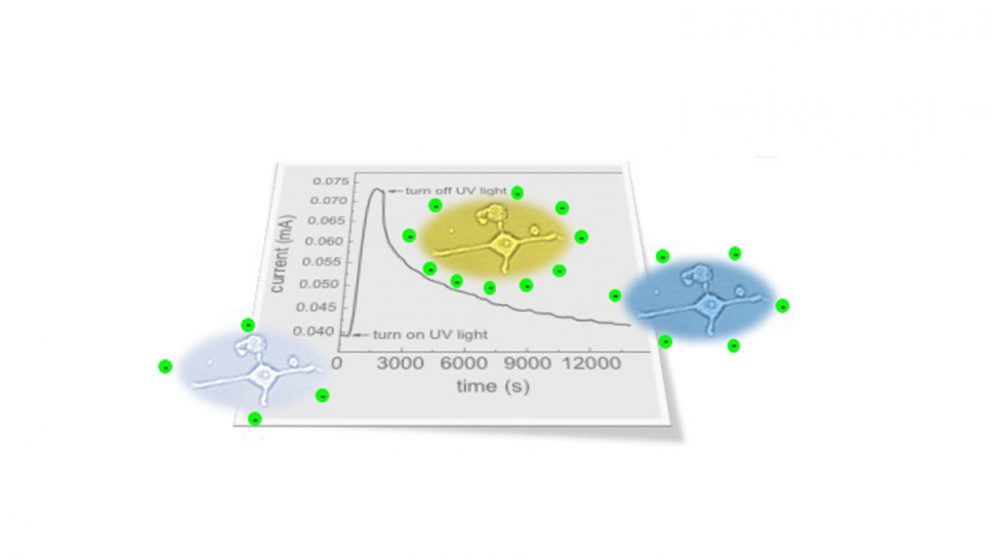
Changes in photocurrent before and after exposure to UV light. Persistent photoconductivity is demonstrated even hours after the UV light has been turned off. This is illustrated by the pictograms showing charge carriers that come into contact with cells at the interface during in vitro experiments.

Researchers at North Carolina State University have developed a new approach for manipulating the behavior of cells on semiconductor materials, using light to alter the conductivity of the material itself.

“There’s a great deal of interest in being able to control cell behavior in relation to semiconductors – that’s the underlying idea behind bioelectronics,” says Albena Ivanisevic, a professor of materials science and engineering at NC State and corresponding author of a paper on the work. “Our work here effectively adds another tool to the toolbox for the development of new bioelectronic devices.”

The new approach makes use of a phenomenon called persistent photoconductivity. Materials that exhibit persistent photoconductivity become much more conductive when you shine a light on them. When the light is removed, it takes the material a long time to return to its original conductivity.

When conductivity is elevated, the charge at the surface of the material increases. And that increased surface charge can be used to direct cells to adhere to the surface.

“This is only one way to control the adhesion of cells to the surface of a material,” Ivanisevic says. “But it can be used in conjunction with others, such as engineering the roughness of the material’s surface or chemically modifying the material.”

For this study, the researchers demonstrated that all three characteristics can be used together, working with a gallium nitride substrate and PC12 cells – a line of model cells used widely in bioelectronics testing.

The researchers tested two groups of gallium nitride substrates that were identical, except that one group was exposed to UV light – triggering its persistent photoconductivity properties – while the second group was not.

“There was a clear, quantitative difference between the two groups – more cells adhered to the materials that had been exposed to light,” Ivanisevic says.

“This is a proof-of-concept paper,” Ivanisevic says. “We now need to explore how to engineer the topography and thickness of the semiconductor material in order to influence the persistent photoconductivity and roughness of the material. Ultimately, we want to provide better control of cell adhesion and behavior.”

Related Articles Read More >

AI agent mines 3,000+ papers to create comprehensive lithium metal battery database
New metal-organic material can capture water from atmosphere
Sandia scientists develop rapid PFAS test using desorption electrospray ionization 
Colored scanning electron microscopy image showing multiple high-index-facet high-entropy alloy nanoparticles. Image courtesy of Northwestern.
Northwestern unravels a key surface-control problem in high-entropy alloy catalysts
rd newsletter
EXPAND YOUR KNOWLEDGE AND STAY CONNECTED
Get the latest info on technologies, trends, and strategies in Research & Development.

R&D World Digital Issues

Fall 2025 issue

Browse the most current issue of R&D World and back issues in an easy to use high quality format. Clip, share and download with the leading R&D magazine today.

R&D 100 Awards
Research & Development World
  • Subscribe to R&D World Magazine
  • Sign up for R&D World’s newsletter
  • Contact Us
  • About Us
  • Drug Discovery & Development
  • Pharmaceutical Processing
  • Global Funding Forecast

Copyright © 2026 WTWH Media LLC. All Rights Reserved. The material on this site may not be reproduced, distributed, transmitted, cached or otherwise used, except with the prior written permission of WTWH Media
Privacy Policy | Advertising | About Us

Search R&D World

  • R&D World Home
  • Topics
    • Aerospace
    • Automotive
    • Biotech
    • Careers
    • Chemistry
    • Environment
    • Energy
    • Life Science
    • Material Science
    • R&D Management
    • Physics
  • Technology
    • 3D Printing
    • A.I./Robotics
    • Software
    • Battery Technology
    • Controlled Environments
      • Cleanrooms
      • Graphene
      • Lasers
      • Regulations/Standards
      • Sensors
    • Imaging
    • Nanotechnology
    • Scientific Computing
      • Big Data
      • HPC/Supercomputing
      • Informatics
      • Security
    • Semiconductors
  • R&D Market Pulse
  • R&D 100
    • 2025 R&D 100 Award Winners
    • 2025 Professional Award Winners
    • 2025 Special Recognition Winners
    • R&D 100 Awards Event
    • R&D 100 Submissions
    • Winner Archive
  • Resources
    • Research Reports
    • Digital Issues
    • Educational Assets
    • Subscribe
    • Video
    • Webinars
    • Content submission guidelines for R&D World
  • Global Funding Forecast
  • Top Labs
  • Advertise
  • SUBSCRIBE