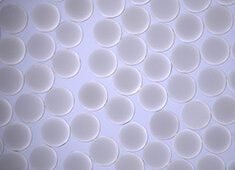
An example of polarizing organic photovoltaic film. |

We’ve
all worried about the charge on our smartphone or laptop running down
when we have no access to an electrical outlet. But new technology
developed by researchers at the UCLA Henry Samueli School of Engineering
and Applied Science could finally help solve the problem.
The
UCLA engineers have created a novel concept for harvesting and
recycling energy for electronic devices—one that involves equipping
these devices’ LCD screens with built-in photovoltaic polarizers,
allowing them to convert ambient light, sunlight and their own backlight
into electricity.
LCDs,
or liquid crystal displays, are used in many of today’s electronic
devices, including smartphones, TV screens, computer monitors, laptops
and tablet computers. They work by using two polarized sheets that let
only a certain amount of a device’s backlight pass through. Tiny liquid
crystal molecules are sandwiched between the two polarizers, and these
crystals can be switched by tiny transistors to act as light valves.
Manipulating each light valve, or pixel, lets a certain amount of the
backlight escape; millions of pixels are combined to create images on
LCDs.
The
UCLA Engineering team created a new type of energy-harvesting polarizer
for LCDs called a polarizing organic photovoltaic, which can
potentially boost the function of an LCD by working simultaneously as a
polarizer, a photovoltaic device and an ambient light or sunlight
photovoltaic panel.
Their research findings are currently available in the online edition of the journal Advanced Materials and will be published in a forthcoming print issue of the journal.
“I
believe this is a game-changer invention to improve the efficiency of
LCD displays,” said Yang Yang, a professor of materials science at UCLA
Engineering and principal investigator on the research. “In addition,
these polarizers can also be used as regular solar cells to harvest
indoor or outdoor light. So next time you are on the beach, you could
charge your iPhone via sunlight.”
From
the point of view of energy use, current LCD polarizers are
inefficient, the researchers said. A device’s backlight can consume 80
to 90 percent of the device’s power. But as much as 75 percent of the
light generated is lost through the polarizers. A polarizing organic
photovoltaic LCD could recover much of that unused energy.
“In
the near future, we would like to increase the efficiency of the
polarizing organic photovoltaics, and eventually we hope to work with
electronic manufacturers to integrate our technology into real
products”, Yang said. “We hope this energy-saving LCD will become a
mainstream technology in displays.”
“Our
coating method is simple, and it can be applied in the future in
large-area manufacturing processes,” said Rui Zhu, a postdoctoral
researcher at UCLA Engineering and the paper’s lead author.
“The
polarizing organic photovoltaic cell demonstrated by Professor Yang’s
research group can potentially harvest 75 percent of the wasted photons
from LCD backlight and turn them back into electricity,” said Youssry
Boutros, program director for the Intel Labs Academic Research Office,
which supported the research. “The strong collaboration between this
group at UCLA Engineering and other top groups has led to higher cell
efficiencies, increasing the potential for harvesting energy. This
approach is interesting in its own right and at the same time synergetic
with several other projects we are funding through the Intel Labs
Academic Research Office.”
Ankit Kumar, a materials science and engineering graduate student at UCLA Engineering was the paper’s second author.
Yang,
who holds UCLA’s Carol and Lawrence E. Tannas Jr. Endowed Chair in
Engineering, is also faculty director of the Nano Renewable Energy
Center at the California NanoSystems Institute at UCLA.
The research was supported by Intel through a gift to UCLA, and by the Office of Naval Research.