Research & Development World

  • R&D World Home
  • Topics
    • Aerospace
    • Automotive
    • Biotech
    • Careers
    • Chemistry
    • Environment
    • Energy
    • Life Science
    • Material Science
    • R&D Management
    • Physics
  • Technology
    • 3D Printing
    • A.I./Robotics
    • Software
    • Battery Technology
    • Controlled Environments
      • Cleanrooms
      • Graphene
      • Lasers
      • Regulations/Standards
      • Sensors
    • Imaging
    • Nanotechnology
    • Scientific Computing
      • Big Data
      • HPC/Supercomputing
      • Informatics
      • Security
    • Semiconductors
  • R&D Market Pulse
  • R&D 100
    • 2025 R&D 100 Award Winners
    • 2025 Professional Award Winners
    • 2025 Special Recognition Winners
    • R&D 100 Awards Event
    • R&D 100 Submissions
    • Winner Archive
  • Resources
    • Research Reports
    • Digital Issues
    • Educational Assets
    • R&D Index
    • Subscribe
    • Video
    • Webinars
    • Content submission guidelines for R&D World
  • Global Funding Forecast
  • Top Labs
  • Advertise
  • SUBSCRIBE

Physicists Uncover New Competing State of Matter in Superconducting Material

By DOE/Ames Laboratory | January 3, 2019

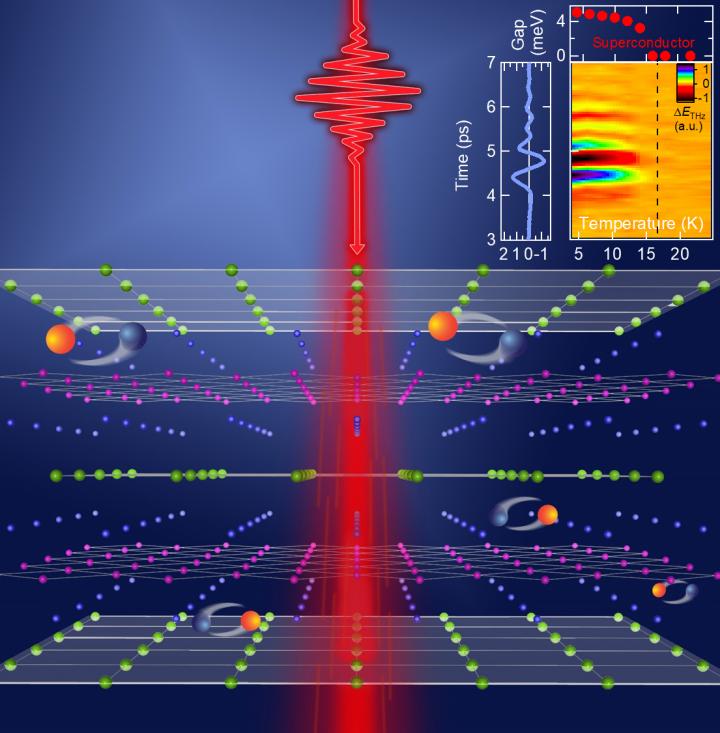
Ames Laboratory researchers used laser pulses of less than a trillionth of a second in much the same way as flash photography, in order to take a series of snapshots. Called terahertz spectroscopy, this technique can be thought of as “laser strobe photography” where many quick images reveal the subtle movement of electron pairings inside the materials using long wavelength far-infrared light. Credit: US Department of Energy, Ames Laboratory

A team of experimentalists at the U.S. Department of Energy’s Ames Laboratory and theoreticians at University of Alabama Birmingham discovered a remarkably long-lived new state of matter in an iron pnictide superconductor, which reveals a laser-induced formation of collective behaviors that compete with superconductivity.

“Superconductivity is a strange state of matter, in which the pairing of electrons makes them move faster,” said Jigang Wang, Ames Laboratory physicist and Iowa State University professor. “One of the big problems we are trying to solve is how different states in a material compete for those electrons, and how to balance competition and cooperation to increase temperature at which a superconducting state emerges.”

To get a closer look, Wang and his team used laser pulses of less than a trillionth of a second in much the same way as flash photography, in order to take a series of snapshots. Called terahertz spectroscopy, this technique can be thought of as “laser strobe photography” where many quick images reveal the subtle movement of electron pairings inside the materials using long wavelength far-infrared light.

“The ability to see these real time dynamics and fluctuations is a way to understanding them better, so that we can create better superconducting electronics and energy-efficient devices,” said Wang.

Related Articles Read More >

Research team shows nanoparticles adhere to quantum mechanics
Researchers could be one step closer to understanding the origin of matter thanks to a new study
The Milky Way is glowing: these scientists think dark matter may be the cause
Three scientists awarded Nobel Prize in physics for showing quantum properties could exist in large-scale systems
rd newsletter
EXPAND YOUR KNOWLEDGE AND STAY CONNECTED
Get the latest info on technologies, trends, and strategies in Research & Development.
RD 25 Power Index

R&D World Digital Issues

Fall 2025 issue

Browse the most current issue of R&D World and back issues in an easy to use high quality format. Clip, share and download with the leading R&D magazine today.

R&D 100 Awards
Research & Development World
  • Subscribe to R&D World Magazine
  • Sign up for R&D World’s newsletter
  • Contact Us
  • About Us
  • Drug Discovery & Development
  • Pharmaceutical Processing
  • Global Funding Forecast

Copyright © 2026 WTWH Media LLC. All Rights Reserved. The material on this site may not be reproduced, distributed, transmitted, cached or otherwise used, except with the prior written permission of WTWH Media
Privacy Policy | Advertising | About Us

Search R&D World

  • R&D World Home
  • Topics
    • Aerospace
    • Automotive
    • Biotech
    • Careers
    • Chemistry
    • Environment
    • Energy
    • Life Science
    • Material Science
    • R&D Management
    • Physics
  • Technology
    • 3D Printing
    • A.I./Robotics
    • Software
    • Battery Technology
    • Controlled Environments
      • Cleanrooms
      • Graphene
      • Lasers
      • Regulations/Standards
      • Sensors
    • Imaging
    • Nanotechnology
    • Scientific Computing
      • Big Data
      • HPC/Supercomputing
      • Informatics
      • Security
    • Semiconductors
  • R&D Market Pulse
  • R&D 100
    • 2025 R&D 100 Award Winners
    • 2025 Professional Award Winners
    • 2025 Special Recognition Winners
    • R&D 100 Awards Event
    • R&D 100 Submissions
    • Winner Archive
  • Resources
    • Research Reports
    • Digital Issues
    • Educational Assets
    • R&D Index
    • Subscribe
    • Video
    • Webinars
    • Content submission guidelines for R&D World
  • Global Funding Forecast
  • Top Labs
  • Advertise
  • SUBSCRIBE