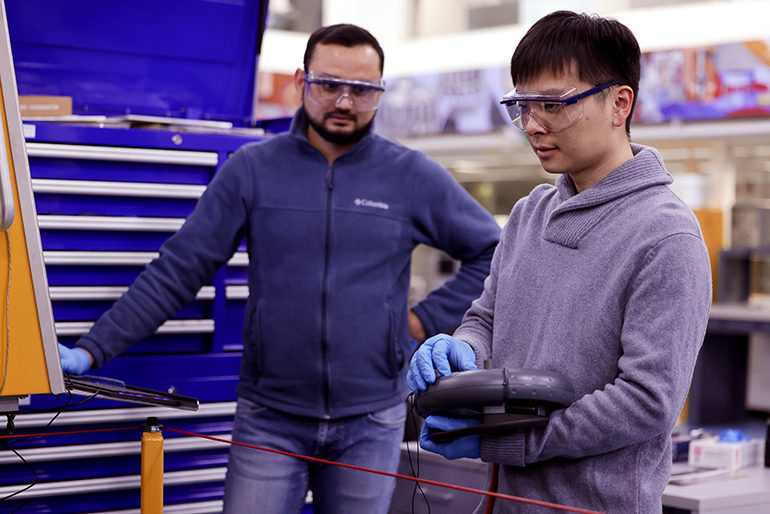
Yuning Zhang, right, and Abdul Khan, both PhD students in naval architecture and marine engineering, prepare to weld a sample of plastic and metal in the Herbert H. Dow Building on the North Campus of the University of Michigan, Ann Arbor.
Photo: Brenda Ahearn/University of Michigan, College of Engineering, Communications and Marketing
Making vehicle structures out of a combination of metals and plastics could make them dramatically lighter, stronger, safer, and more environmentally friendly than the all-steel or all-aluminum approaches that dominate today.
But how to join all those materials together quickly and cheaply has been a sticky problem. A University of Michigan lab is developing solutions.
The first viable method for welding plastic and metal directly together was recently developed under the leadership of Pingsha Dong, the Robert F. Beck Collegiate Professor of Engineering, and is now reported in the Journal of Manufacturing Processes.
Dong details how his team achieved a feat that was thought impossible for decades. He also discusses an aluminum-steel process that could enable 3D printing of aluminum onto steel.
How could the ability to weld very different materials together improve cars?
Dong: Computer models show us we can make the structures of cars and light trucks as much as 40% lighter by building them with a combination of metals and plastics. Lighter weight brings a variety of advantages, chiefly better efficiency. Gas-powered vehicles could see better fuel economy, while electric vehicles can get more range. Vehicles with multi-material structures can also handle better and offer improved safety.
The problem is traditionally, the only way to join metal and plastic has been with adhesives or mechanical fasteners, which is too slow and expensive for anything but low-volume specialty vehicles. The processes we’re developing could change that and bring multimaterial vehicle structures and components from the realm of exotics into the mainstream.
The new welding techniques could also improve EV battery packs and enclosures. Today, they’re multilayer structures that are usually held together with adhesives and mechanical fasteners. They’re very difficult to take apart for repair or recycling. Welded battery packs could be taken apart and reassembled much more easily, and they could also be lighter and cheaper to manufacture and easier to keep cool.
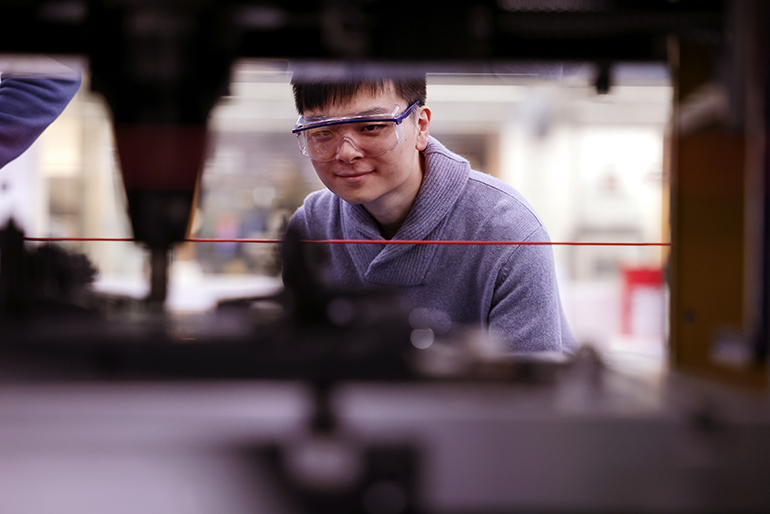
Yuning Zhang prepares to weld a sample of plastic and metal in the Herbert H. Dow Building on the North Campus of the University of Michigan, Ann Arbor
Photo: Brenda Ahearn/University of Michigan, College of Engineering, Communications and Marketing
Let’s talk about metal and plastic. Why is it so difficult to weld them together? How does the process work?
Dong: Welding is about creating bonds between two materials at the molecular level. The conventional wisdom for decades has been that plastic and metal are fundamentally incompatible, and there’s no reason to try welding them together. However, we discovered that the right combination of heat and pressure in the right areas can cause the carbon and oxygen in plastic to bond with metal.
We used an off-the-shelf machine that looks similar to a drill press with a cylindrical spinning head. The metal is placed on top of the plastic and the head is lowered onto the two materials. This creates heat and pressure, bonding the two materials together in either a spot weld or a linear weld.
What materials can be bonded with this process? And when might manufacturers be using it?
Dong: Any metal can be bonded directly with any plastic that contains an adequate amount of oxygen-carbon compounds. The key is to calculate the “sweet spot” of heat and pressure that will weld a given combination of materials, and we can work with manufacturers to determine that. For plastics that don’t have enough oxygen-carbon compounds, like polypropylene, we can put an inexpensive plastic film between the two materials to “seed” the bond with oxygen and carbon.
We’ve patented the process and we’re already working with equipment makers to develop commercial equipment that can be licensed to automakers and other manufacturers. I’d say we’ll see this technology in industry within the next two years.
What about your research into steel and aluminum?
Dong: The ability to combine steel and aluminum could enable not just welding, but also inexpensive new ways to 3D-print aluminum alloys onto steel. Previous attempts have led to the formation of brittle compounds at the interface between the two metals, reducing the strength of the alloy.
Our process uses a precise combination of heat and pressure to prevent those compounds from forming, and it could offer new ways to combine the light weight of aluminum with the high strength of steel.
Dong is also a professor of Integrative Systems and Design, Naval Architecture, and Marine Engineering and Mechanical Engineering. The research was supported by the National Science Foundation and by the University of Michigan College of Engineering.
Studies:


there has to be some layered approach that isn’t…..something like skin with interpenetrating forms that connect with each other as a thing
built from a design principle that says that there is already a natural matrix somewhere that embodies the necessary steps in form, if not in actuallity…..layers of skin w/pores, circulatory structures….evolved from a epithelial cells….history