Research & Development World

  • R&D World Home
  • Topics
    • Aerospace
    • Automotive
    • Biotech
    • Careers
    • Chemistry
    • Environment
    • Energy
    • Life Science
    • Material Science
    • R&D Management
    • Physics
  • Technology
    • 3D Printing
    • A.I./Robotics
    • Software
    • Battery Technology
    • Controlled Environments
      • Cleanrooms
      • Graphene
      • Lasers
      • Regulations/Standards
      • Sensors
    • Imaging
    • Nanotechnology
    • Scientific Computing
      • Big Data
      • HPC/Supercomputing
      • Informatics
      • Security
    • Semiconductors
  • R&D Market Pulse
  • R&D 100
    • 2026 R&D 100 Award Winners
    • 2026 Professional Award Winners
    • 2026 Special Recognition Winners
    • R&D 100 Awards Event
    • R&D 100 Submissions
    • Winner Archive
  • Resources
    • Research Reports
    • Digital Issues
    • Educational Assets
    • Subscribe
    • Video
    • Webinars
    • PharmSci360
    • Content submission guidelines for R&D World
  • Global Funding Forecast
  • Top Labs
  • Advertise
  • SUBSCRIBE

Polariton Filter Transforms Ordinary Laser Light into Quantum Light

By Macquarie University | February 20, 2019

An international team of researchers led out of Macquarie University has demonstrated a new approach for converting ordinary laser light into genuine quantum light.

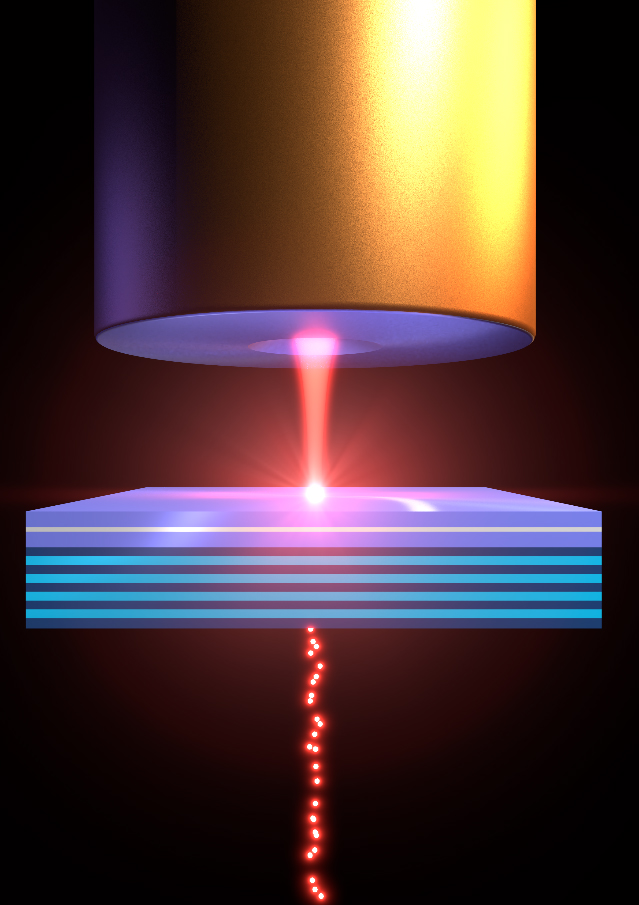
Their approach uses nanometer-thick films made of gallium arsenide, which is a semiconductor material widely used in solar cells. They sandwich the thin films between two mirrors to manipulate the incoming photons.

The photons interact with electron-hole pairs in the semiconductor, forming new chimeric particles called polaritons that carry properties from both the photons and the electron-hole pairs. The polaritons decay after a few picoseconds, and the photons they release exhibit distinct quantum signatures.

The teams’ research was published in the journal Nature Materials.

While these quantum signatures are weak at the moment, the work opens up a new avenue for producing single photons on demand.

“The ability to produce single photons on demand is hugely important for future applications in quantum communication and optical quantum information processing,” says Associate Professor Thomas Volz from the Department of Physics and Astronomy and the senior author on the paper. “Think unbreakable encryption, super-fast computers, more efficient computer chips or even optical transistors with minimal power consumption.”

Currently single-photon emitters are typically created by materials engineering—where the material itself is assembled in such a way that the ‘quantum’ behavior is built in.

But this standard approach faces serious limitations at smaller and smaller scales because producing identical single-photon emitters by pure materials engineering is extremely challenging.

“This means our approach could be much more amenable for massively scaling up, once we’re able to increase the strength of the quantum signatures we’re producing. We might be able to make identical quantum emitters from semiconductors by photon nanostructure engineering, rather than by direct materials engineering,” says Dr. Guillermo Munoz Matutano, also from Macquarie and lead author of the paper.

“While real-world applications are still a fair bit away, our paper describes a major milestone that the polariton community in particular has been waiting on for the last ten to fifteen years. The regime in which polaritons interact so strongly that they can imprint quantum signatures on photons has not been accessed to date and opens up a whole new playground for researchers in the field,” says Thomas.

The Macquarie University team is part of the ARC Centre of Excellence for Engineered Quantum Systems (EQUS), and the experiments were carried out at the CSIRO labs in Lindfield where part of the Macquarie quantum labs are based at present. The paper appears alongside a similar study carried out in parallel at ETH Zurich.
Related Articles Read More >

The photon frontier: how O2O Lasercom is redefining deep-space data on Artemis II
laser reflect on optic table un quantum laboratory
2026 ultrafast laser buyer’s guide: 86 models compared
NASA R&D 100 Winner enables high-speed data transfer from space
Illustration of ultracold atoms (gold) flowing frictionlessly along a laser boundary (green), representing the quantum phenomenon of edge states.
MIT physicists directly observe frictionless ‘edge state’ flow in ultracold atoms, offering a glimpse of super-efficient electronics
rd newsletter
EXPAND YOUR KNOWLEDGE AND STAY CONNECTED
Get the latest info on technologies, trends, and strategies in Research & Development.

R&D World Digital Issues

Fall 2025 issue

Browse the most current issue of R&D World and back issues in an easy to use high quality format. Clip, share and download with the leading R&D magazine today.

R&D 100 Awards
Research & Development World
  • Subscribe to R&D World Magazine
  • Sign up for R&D World’s newsletter
  • Contact Us
  • About Us
  • Drug Discovery & Development
  • Pharmaceutical Processing
  • Global Funding Forecast

Copyright © 2026 Arrowfly LLC. All Rights Reserved. The material on this site may not be reproduced, distributed, transmitted, cached or otherwise used, except with the prior written permission of Arrowfly
Privacy Policy | Advertising | About Us

Search R&D World

  • R&D World Home
  • Topics
    • Aerospace
    • Automotive
    • Biotech
    • Careers
    • Chemistry
    • Environment
    • Energy
    • Life Science
    • Material Science
    • R&D Management
    • Physics
  • Technology
    • 3D Printing
    • A.I./Robotics
    • Software
    • Battery Technology
    • Controlled Environments
      • Cleanrooms
      • Graphene
      • Lasers
      • Regulations/Standards
      • Sensors
    • Imaging
    • Nanotechnology
    • Scientific Computing
      • Big Data
      • HPC/Supercomputing
      • Informatics
      • Security
    • Semiconductors
  • R&D Market Pulse
  • R&D 100
    • 2026 R&D 100 Award Winners
    • 2026 Professional Award Winners
    • 2026 Special Recognition Winners
    • R&D 100 Awards Event
    • R&D 100 Submissions
    • Winner Archive
  • Resources
    • Research Reports
    • Digital Issues
    • Educational Assets
    • Subscribe
    • Video
    • Webinars
    • PharmSci360
    • Content submission guidelines for R&D World
  • Global Funding Forecast
  • Top Labs
  • Advertise
  • SUBSCRIBE