Research & Development World

  • R&D World Home
  • Topics
    • Aerospace
    • Automotive
    • Biotech
    • Careers
    • Chemistry
    • Environment
    • Energy
    • Life Science
    • Material Science
    • R&D Management
    • Physics
  • Technology
    • 3D Printing
    • A.I./Robotics
    • Software
    • Battery Technology
    • Controlled Environments
      • Cleanrooms
      • Graphene
      • Lasers
      • Regulations/Standards
      • Sensors
    • Imaging
    • Nanotechnology
    • Scientific Computing
      • Big Data
      • HPC/Supercomputing
      • Informatics
      • Security
    • Semiconductors
  • R&D Market Pulse
  • R&D 100
    • 2025 R&D 100 Award Winners
    • 2025 Professional Award Winners
    • 2025 Special Recognition Winners
    • R&D 100 Awards Event
    • R&D 100 Submissions
    • Winner Archive
  • Resources
    • Research Reports
    • Digital Issues
    • Educational Assets
    • Subscribe
    • Video
    • Webinars
    • Content submission guidelines for R&D World
  • Global Funding Forecast
  • Top Labs
  • Advertise
  • SUBSCRIBE

Pressure Helps to Make Better Li-Ion Batteries

By Science China Press | November 13, 2018

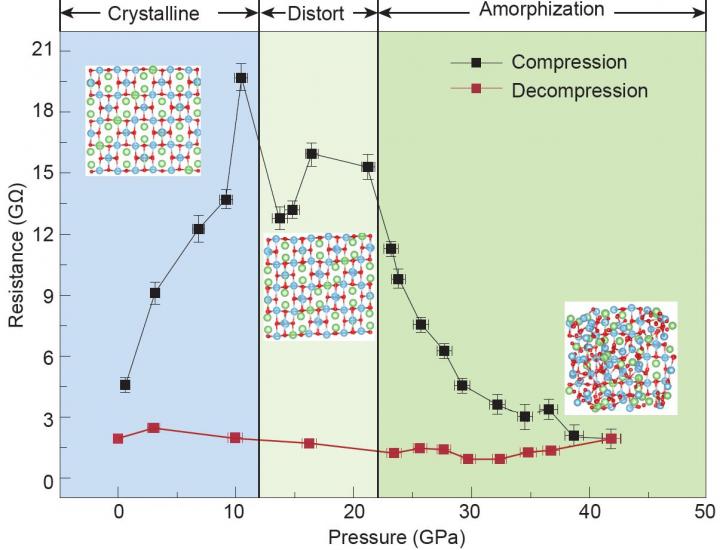
The resistance of LTO changes with increasing and decreasing pressure, the insets show the corresponding structures at different pressure regions. It indicates that LTO undergoes crystalline-distortion-amorphous transitions under high pressure. The resistance increases at lower pressures during the lattice distortion, then it starts to decrease sharply as amorphization takes place at higher pressure. The amorphous LTO can be decompressed down to ambient pressure and has much better conductivity compares with the crystalline LTO. Credit: Science China Press

Rechargeable Li-ion batteries are crucial parts for home electronics and portable devices such as cell phones and laptops. One can imagine how the life we have today would be like without cell phones and internet. Li-ion batteries (LIBs) are also growing in popularity for electric vehicle which can help to highly reduce the emission of CO2 and solve the serious greenhouse effect on the earth. All these demands call for superior Li-ion battery materials with better performance such as higher capacity, longer life time, lower cost, etc.

Lithium titanium oxide (Li4Ti5O12, LTO) spinel experiences negligible volume change during lithium insertion and extraction and is regarded as a “zero-strain” anode material for LIBs. Due to its great structural stability, LTO exhibits excellent cycling performance, making it a promising anode for LIBs in electrical vehicle and large-scale energy storage areas. However, LTO shows poor electronic and ionic conductivities, limiting its applications. Therefore, improving its conductivity becomes crucial.

In a recent research article published in the Beijing-based National Science Review, scientists at the Center for High Pressure Science and Technology Advanced Research, Institute of Geochemistry, and Institute of Physics of Chinese Academy of Sciences, and George Mason University, Carnegie Institution of Washington, and Argonne National Laboratory of USA present their results on the studies of phase stability and conductivity of LTO under high pressure. It was found that the LTO spinel structure starts to distort due to the significant difference in compressibility of the building blocks, LiO6 and TiO6 octahedra in LTO at low pressures. The strong highly distorted structure transforms into amorphous eventually as pressure over around 270 thousands times normal atmospheric pressure. Remarkably, the amorphous LTO can be decompressed down to ambient pressure and displays much better conductivity than crystalline LTO. “These findings may offer a new strategy for improving the conductivity of LTO anode in Li-ion batteries using a high-pressure technique.” said Dr. Lin Wang, the corresponding author of the article.

To understand the significant enhancement of conductivity in the amorphous phase, the ionic transport properties of crystalline and amorphous LTO were investigated by first-principles molecular dynamics simulations. Theoretical calculations revealed that the amorphous phase induced by high pressure can highly promote Li+ diffusion and increase its ionic conductivity by providing ion migration defects. “All of these findings increase the understanding of the relationship between structure and conducting properties of LTO” Dr. Wang added.
Related Articles Read More >

Researchers use hydrothermal carbonization to turn distillery waste into supercapacitor electrodes
175 Wh/kg: How CATL’s Naxtra Architecture Moves Sodium-Ion Beyond the Lab
Flexible electrolyte for solid batteries achieves 0.73 Li+ transference
GM XFC Cell: EV battery charges from 10% to 70% in approximately 5.6 minutes | Inside the R&D 100 win
rd newsletter
EXPAND YOUR KNOWLEDGE AND STAY CONNECTED
Get the latest info on technologies, trends, and strategies in Research & Development.

R&D World Digital Issues

Fall 2025 issue

Browse the most current issue of R&D World and back issues in an easy to use high quality format. Clip, share and download with the leading R&D magazine today.

R&D 100 Awards
Research & Development World
  • Subscribe to R&D World Magazine
  • Sign up for R&D World’s newsletter
  • Contact Us
  • About Us
  • Drug Discovery & Development
  • Pharmaceutical Processing
  • Global Funding Forecast

Copyright © 2026 WTWH Media LLC. All Rights Reserved. The material on this site may not be reproduced, distributed, transmitted, cached or otherwise used, except with the prior written permission of WTWH Media
Privacy Policy | Advertising | About Us

Search R&D World

  • R&D World Home
  • Topics
    • Aerospace
    • Automotive
    • Biotech
    • Careers
    • Chemistry
    • Environment
    • Energy
    • Life Science
    • Material Science
    • R&D Management
    • Physics
  • Technology
    • 3D Printing
    • A.I./Robotics
    • Software
    • Battery Technology
    • Controlled Environments
      • Cleanrooms
      • Graphene
      • Lasers
      • Regulations/Standards
      • Sensors
    • Imaging
    • Nanotechnology
    • Scientific Computing
      • Big Data
      • HPC/Supercomputing
      • Informatics
      • Security
    • Semiconductors
  • R&D Market Pulse
  • R&D 100
    • 2025 R&D 100 Award Winners
    • 2025 Professional Award Winners
    • 2025 Special Recognition Winners
    • R&D 100 Awards Event
    • R&D 100 Submissions
    • Winner Archive
  • Resources
    • Research Reports
    • Digital Issues
    • Educational Assets
    • Subscribe
    • Video
    • Webinars
    • Content submission guidelines for R&D World
  • Global Funding Forecast
  • Top Labs
  • Advertise
  • SUBSCRIBE