Research & Development World

  • R&D World Home
  • Topics
    • Aerospace
    • Automotive
    • Biotech
    • Careers
    • Chemistry
    • Environment
    • Energy
    • Life Science
    • Material Science
    • R&D Management
    • Physics
  • Technology
    • 3D Printing
    • A.I./Robotics
    • Software
    • Battery Technology
    • Controlled Environments
      • Cleanrooms
      • Graphene
      • Lasers
      • Regulations/Standards
      • Sensors
    • Imaging
    • Nanotechnology
    • Scientific Computing
      • Big Data
      • HPC/Supercomputing
      • Informatics
      • Security
    • Semiconductors
  • R&D Market Pulse
  • R&D 100
    • 2025 R&D 100 Award Winners
    • 2025 Professional Award Winners
    • 2025 Special Recognition Winners
    • R&D 100 Awards Event
    • R&D 100 Submissions
    • Winner Archive
  • Resources
    • Research Reports
    • Digital Issues
    • Educational Assets
    • R&D Index
    • Subscribe
    • Video
    • Webinars
    • Content submission guidelines for R&D World
  • Global Funding Forecast
  • Top Labs
  • Advertise
  • SUBSCRIBE

Purple Bacteria Shine Path to Super-Efficient Light Harvesting

By University of Queensland | November 1, 2016

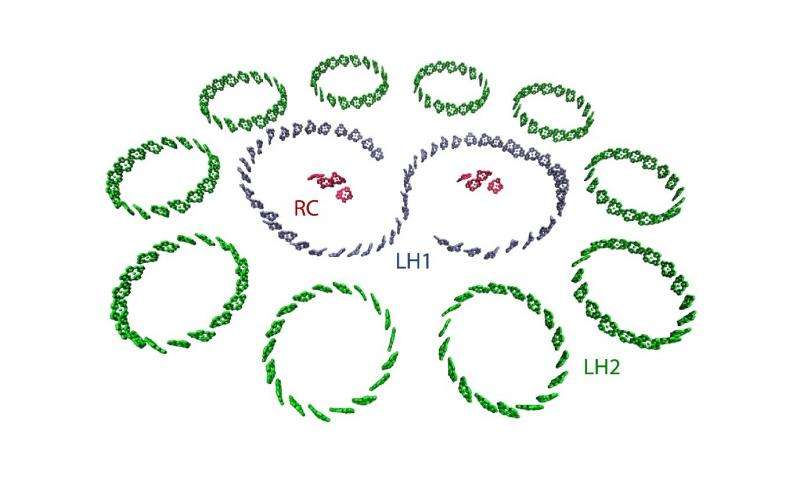
Credit: University of Queensland

In its billions of years on earth, plant life has become super-efficient at using light – and now it’s showing how it does it.

A quantum – minuscule – examination of chlorophyll within certain purple bacteria shows an exceptionally efficient geometric arrangement for light harvesting, say scientists from The University of Queensland and Iran’s Institute for Research in Fundamental Sciences.

UQ’s Ivan Kassal, Ph.D. also a researcher at the ARC Centre of Excellence for Engineered Quantum Systems, said the bacteria used “quantum coherence” – particles’ wave-like properties – to harvest light during photosynthesis.

“Inside, the bacteria’s chlorophyll molecules – which collect energy from light – are arranged in symmetrical rings,” Kassal said. “This geometric organisation is exceptionally good for light harvesting. By Understanding how the purple bacteria harvest light, we may be able to use these lessons to improve how we do artificial light harvesting.”

Kassal said previous research had proposed the theory that quantum coherence played a role in how the purple bacteria harvested light.

“We found that the geometry adopted by the purple bacteria allows for quantum coherence,” he said.”There has been debate in the field about whether coherent effects are possible in photosynthetic systems at all.”

“The research was significant also because it provided evidence of quantum effects in a biological setting,” he added.”We know now that quantum effects cannot be neglected in studies on biological light harvesting. This is a fertile ground for developing new technologies for simulating quantum systems in noisy environments.”

“The study also opens avenues for research into whether quantum coherence already occurs in organic solar cells, and whether humans can deliberately engineer that coherence to make them more efficient,” Kassal concluded.

 

Related Articles Read More >

Researchers could be one step closer to understanding the origin of matter thanks to a new study
The Milky Way is glowing: these scientists think dark matter may be the cause
Three scientists awarded Nobel Prize in physics for showing quantum properties could exist in large-scale systems
ORNL named on 20 R&D 100 Awards, including carbon-capture and AM tools
rd newsletter
EXPAND YOUR KNOWLEDGE AND STAY CONNECTED
Get the latest info on technologies, trends, and strategies in Research & Development.
RD 25 Power Index

R&D World Digital Issues

Fall 2024 issue

Browse the most current issue of R&D World and back issues in an easy to use high quality format. Clip, share and download with the leading R&D magazine today.

Research & Development World
  • Subscribe to R&D World Magazine
  • Sign up for R&D World’s newsletter
  • Contact Us
  • About Us
  • Drug Discovery & Development
  • Pharmaceutical Processing
  • Global Funding Forecast

Copyright © 2025 WTWH Media LLC. All Rights Reserved. The material on this site may not be reproduced, distributed, transmitted, cached or otherwise used, except with the prior written permission of WTWH Media
Privacy Policy | Advertising | About Us

Search R&D World

  • R&D World Home
  • Topics
    • Aerospace
    • Automotive
    • Biotech
    • Careers
    • Chemistry
    • Environment
    • Energy
    • Life Science
    • Material Science
    • R&D Management
    • Physics
  • Technology
    • 3D Printing
    • A.I./Robotics
    • Software
    • Battery Technology
    • Controlled Environments
      • Cleanrooms
      • Graphene
      • Lasers
      • Regulations/Standards
      • Sensors
    • Imaging
    • Nanotechnology
    • Scientific Computing
      • Big Data
      • HPC/Supercomputing
      • Informatics
      • Security
    • Semiconductors
  • R&D Market Pulse
  • R&D 100
    • 2025 R&D 100 Award Winners
    • 2025 Professional Award Winners
    • 2025 Special Recognition Winners
    • R&D 100 Awards Event
    • R&D 100 Submissions
    • Winner Archive
  • Resources
    • Research Reports
    • Digital Issues
    • Educational Assets
    • R&D Index
    • Subscribe
    • Video
    • Webinars
    • Content submission guidelines for R&D World
  • Global Funding Forecast
  • Top Labs
  • Advertise
  • SUBSCRIBE