Research & Development World

  • R&D World Home
  • Topics
    • Aerospace
    • Automotive
    • Biotech
    • Careers
    • Chemistry
    • Environment
    • Energy
    • Life Science
    • Material Science
    • R&D Management
    • Physics
  • Technology
    • 3D Printing
    • A.I./Robotics
    • Software
    • Battery Technology
    • Controlled Environments
      • Cleanrooms
      • Graphene
      • Lasers
      • Regulations/Standards
      • Sensors
    • Imaging
    • Nanotechnology
    • Scientific Computing
      • Big Data
      • HPC/Supercomputing
      • Informatics
      • Security
    • Semiconductors
  • R&D Market Pulse
  • R&D 100
    • 2025 R&D 100 Award Winners
    • 2025 Professional Award Winners
    • 2025 Special Recognition Winners
    • R&D 100 Awards Event
    • R&D 100 Submissions
    • Winner Archive
  • Resources
    • Research Reports
    • Digital Issues
    • Educational Assets
    • R&D Index
    • Subscribe
    • Video
    • Webinars
    • Content submission guidelines for R&D World
  • Global Funding Forecast
  • Top Labs
  • Advertise
  • SUBSCRIBE

Quantum Computing Building Blocks

By DOE Science News Source | July 25, 2017

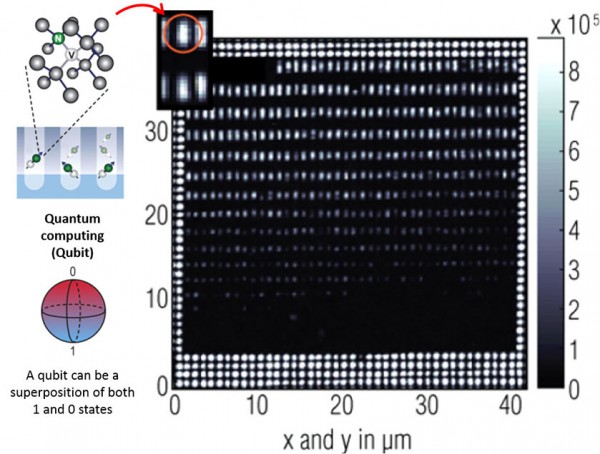
(Bottom left) Classical computers store data in bits that can have a state of either 0 or 1. Quantum computers store data in quantum bits (qubits) that can have a superposition of both 0 and 1 states. (Top left) A graphical representation of nitrogen vacancy (NV) qubits fabricated within diamond. (Right) These NVs were made in precise, dense arrays (μm = micrometers) for future quantum computers.

The Science

For decades scientists have known that a quantum computer—a device that stores and manipulates information in quantum objects such as atoms or photons—could theoretically perform certain calculations far faster than today’s computing schemes. But building the “parts” for a quantum computer is a monumental research task.  One promising approach involves using the quantum “spin” property of nitrogen-vacancy (NV) centers in diamonds to store and process data.  But properly placing these centers is a major challenge. Recently researchers constructed chains of NV centers in diamond with more precision than any previous effort.

The Impact

Diamond nanophotonics technology is a major contender for future optical computers. This work provides a wholly suitable pathway for the large-scale production of quantum logic gates for quantum computers that that approach the power of the human mind.

Summary

Scientists at the Massachusetts Institute of Technology created a wholly suitable pathway for the large-scale production of quantum logic gates. These gates are a critical component for quantum computing architectures. At the Center for Functional Nanomaterials, the researchers fabricated the silicon-based stencils. They used the stencils to pattern the NV centers. The stencils possessed features as small as 2 nanometers—nearly 10 times smaller than any previous demonstration. These devices are compatible with densities required for quantum computers.

Within diamonds, nitrogen vacancies have electron spin states that could be useful for future quantum computers. The NV electron spin triplet levels can be readily manipulated to create long-lasting states (exceeding milliseconds) at room temperature and even longer states (approaching one second) at the temperature of liquid nitrogen. To extend this approach to create more qubits, researchers devised a fabrication technique that produced well-spaced ensembles of several NVs. The spacing is required to allow the states to couple so they last longer. Their technique is based on masks produced from 270-nanometer-thick, silicon-based stencils, enabling 1-nanometer defects to be packed onto the surface. The team’s approach combined the low full-width half-maximum of the atomic force microscopy tip implantation with the quick patterning available using electron beam lithography. The team used the stencils to reach a regime where the nitrogen distribution is no longer limited by the size of the opening on the stencil but by the basic process of implanted nitrogen scattering in the diamond lattice. The team’s work opens the door to scalable creation of isolated spin ensembles for next-generation quantum computing.


Related Articles Read More >

These R&D 100 Finalists are improving pharmaceutical research with their award-winning CyroProbe
Lab automation is “vaporizing”: Why the hottest innovation is invisible
Maryland set for first subsea internet cable: AWS’s 320+ Tbps “Fastnet” to Ireland
Google on how AI will extend researchers
rd newsletter
EXPAND YOUR KNOWLEDGE AND STAY CONNECTED
Get the latest info on technologies, trends, and strategies in Research & Development.
RD 25 Power Index

R&D World Digital Issues

Fall 2025 issue

Browse the most current issue of R&D World and back issues in an easy to use high quality format. Clip, share and download with the leading R&D magazine today.

Research & Development World
  • Subscribe to R&D World Magazine
  • Sign up for R&D World’s newsletter
  • Contact Us
  • About Us
  • Drug Discovery & Development
  • Pharmaceutical Processing
  • Global Funding Forecast

Copyright © 2025 WTWH Media LLC. All Rights Reserved. The material on this site may not be reproduced, distributed, transmitted, cached or otherwise used, except with the prior written permission of WTWH Media
Privacy Policy | Advertising | About Us

Search R&D World

  • R&D World Home
  • Topics
    • Aerospace
    • Automotive
    • Biotech
    • Careers
    • Chemistry
    • Environment
    • Energy
    • Life Science
    • Material Science
    • R&D Management
    • Physics
  • Technology
    • 3D Printing
    • A.I./Robotics
    • Software
    • Battery Technology
    • Controlled Environments
      • Cleanrooms
      • Graphene
      • Lasers
      • Regulations/Standards
      • Sensors
    • Imaging
    • Nanotechnology
    • Scientific Computing
      • Big Data
      • HPC/Supercomputing
      • Informatics
      • Security
    • Semiconductors
  • R&D Market Pulse
  • R&D 100
    • 2025 R&D 100 Award Winners
    • 2025 Professional Award Winners
    • 2025 Special Recognition Winners
    • R&D 100 Awards Event
    • R&D 100 Submissions
    • Winner Archive
  • Resources
    • Research Reports
    • Digital Issues
    • Educational Assets
    • R&D Index
    • Subscribe
    • Video
    • Webinars
    • Content submission guidelines for R&D World
  • Global Funding Forecast
  • Top Labs
  • Advertise
  • SUBSCRIBE