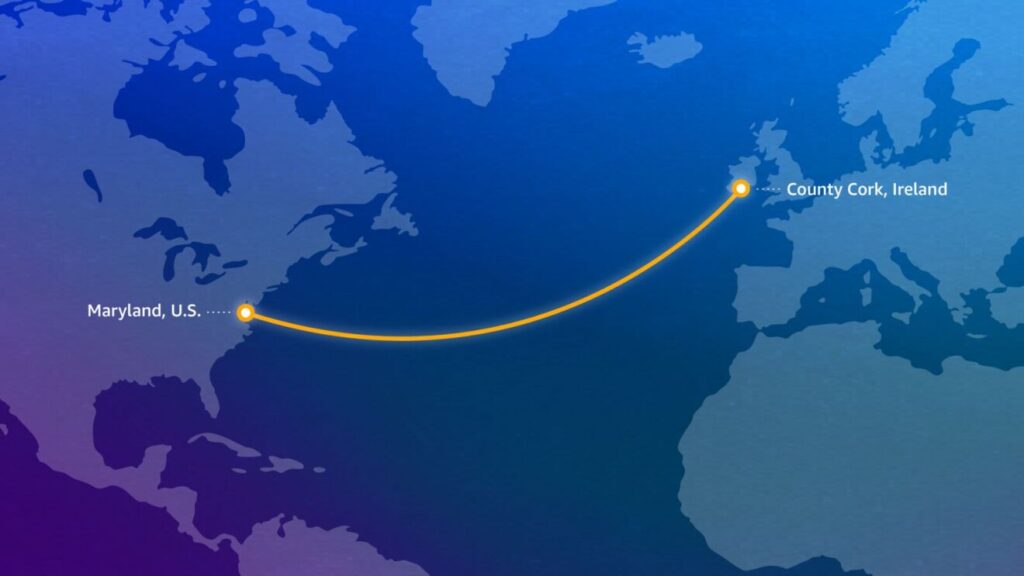
Fastnet’s transatlantic route avoids traditional cable corridors concentrated in the US Northeast, providing path diversity for AWS’s network. Credit: Amazon
Maryland is getting its first undersea internet cable, and it’s a monster. Amazon Web Services announced plans for “Fastnet,” a dedicated fiber optic system linking the state’s Eastern Shore to Ireland with enough raw power to stream 12.5 million HD films simultaneously.
The project, set to be operational in 2028, represents AWS’s bet that customer demand, particularly for AI workloads, will continue accelerating well into the next decade. With a design capacity exceeding 320 terabits per second, Fastnet could transmit the entire digitized Library of Congress three times every second. The cable adds to AWS’s global fiber optic network, which already spans more than 9 million kilometers—enough to circle from Earth to the Moon and back 11 times.
“The traffic is only growing, and our capacity is only going to have to meet that growth,” said David Selby, AWS’s Director of Global Network Infrastructure in an interview with R&D World. “We are actively looking globally at projects of this size.”

Subsea cable anatomy: At just 1.5 inches in diameter, the armored cable contains optical fibers at its core, surrounded by protective layers including steel armor wires, copper conductors for power, and polyethylene sheathing. Credit: Amazon
Fastnet joins a wave of big-tech subsea investment. According to industry analysts, some $11 billion in new cable builds is planned for 2024-26, double the amount of the previous three years. Google has deployed multiple transatlantic cables, including Grace Hopper (352 Tbps, operational in September 2022) connecting the US, UK and Spain, and Dunant (250 Tbps, operational in February 2021) linking Virginia to France. Meta’s Anjana, a 480 Tbps cable connecting South Carolina to Spain, landed in October 2024.
Why AWS is building (not leasing) here
Selby framed the project as a customer-driven build to link large AWS regions in the eastern U.S. with Ireland and continental Europe. “There have been a lot of cables built, but they don’t always mirror exactly what we need for our customers… We’re landing this cable in locations that are not normal locations, so there’s less chance of things getting hit at the same time.” The route decision was shaped by marine constraints (fishing grounds, wind, pipelines) and the need to keep latency low while increasing path diversity.
AWS says Fastnet will use advanced optical switching at the branching unit to let the company redirect entire fiber pairs to future landing points if demand shifts, while keeping each pair isolated to avoid unnecessary equipment in the path. The near-shore segments will be heavily armored and both shore ends will be horizontally drilled beneath the beach to minimize disturbance and reduce strike risk from anchors or surf.
“These assets last 20-plus years,” Selby said, “so we have to think about our forecast from the lens of what might happen in the next one to 10 years.”
Resilience and operations
AWS positions Fastnet as extra “path diversity” in its global backbone—insurance against single points of failure. “At the end of the day, something’s gonna happen,” Selby said. “You just try to ensure that if something happens, it doesn’t impact more than what you expected. You expect failure, and you have predictable failure scenarios.”
The company says its network runs millions of daily traffic optimizations. Every time AWS adds new capacity, it re-models all global traffic flows to ensure every data packet has primary, secondary, and tertiary paths mapped. “It’s an ongoing, live network planning and failure planning technology,” Selby explained.

AWS’s Fastnet cable diagram showing the transatlantic route from Maryland to County Cork, Ireland, with armored nearshore segments and deep-sea repeaters. Credit: Amazon
Community angle
AWS says it will establish Community Benefit Funds for both Maryland’s Eastern Shore and County Cork, working with local stakeholders to support initiatives addressing each community’s priorities—potentially including STEM education, workforce development, and environmental programs.
“Building Maryland’s first-ever subsea fiber cable is an achievement bigger than broadband connectivity—it’s about securing Maryland’s status as a global hub for innovation, job creation, and high-tech investment,” said Maryland Governor Wes Moore in a press release.Ireland’s Taoiseach Micheál Martin called the cable “a vote of confidence in Ireland’s digital future,” adding that “by linking County Cork to Maryland, Ireland will become a true gateway to Europe for submarine telecommunications cables.”
Selby noted AWS worked closely with local communities from the start. “We’ve had a lot of interactions with the local community and government there, the local fishermen,” he said. “They’ve been really supportive of it.”