Image from Adobe Stock
As GPS jamming and spoofing affect over 1,500 commercial flights daily, about five times early-2024 levels, the aviation industry is racing to deploy quantum-powered backup systems that don’t rely on vulnerable satellite signals.
New research from the University of Chicago and the Chicago Quantum Exchange reveals that quantum navigation prototypes are already being tested by major aerospace companies, with Boeing completing a four-hour GPS-free flight using multiple quantum systems in 2024.
GPS interference is more than an inconvenience
GNSS interference has become a routine operational hazard. According to IATA data, there’s been a 175% year-over-year surge in GNSS interference in 2024 and a staggering 220% increase in GPS signal-loss events compared with 2021. By late summer 2024, approximately 1,500 commercial flights per day were affected by spoofing.
Pilots describe increasingly sophisticated attacks where false signals make cockpits show aircraft at wrong altitudes, off-course by miles, or even looping in impossible patterns. These incidents can trigger false terrain warnings and other system anomalies, creating serious safety risks.
Several corporate partners of the Chicago Quantum Exchange, including Boeing, Infleqtion, and SandboxAQ, are developing quantum sensor-based techniques that operate independently of satellite signals.
Magnetic fields and Inertial Sensing
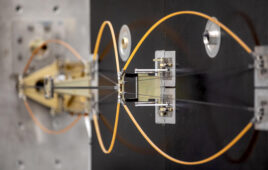
Boeing’s 2024 test flight incorporated quantum inertial navigation using an AOSense quantum IMU. In parallel, Boeing and partners have also tested magnetic navigation (MagNav) approaches such as SandboxAQ’s AQNav system, which reads the Earth’s crustal magnetic field variations, similar to how birds navigate, comparing real-time measurements to detailed magnetic maps.
In 2024, Boeing’s historic four-hour GPS-free flight proved these systems work in real conditions. By 2025, Airbus’s Acubed and SandboxAQ reported over 150 flight hours across the U.S., meeting FAA en-route accuracy thresholds and achieving 550 meters or better accuracy in 64% of cases.
SandboxAQ completed its first flight tests for the United States Air Force in May 2023, participating in major Air Force exercises including Golden Phoenix and Mobility Guardian. Meanwhile, Infleqtion wrapped up commercial trials in the United Kingdom and plans U.S. tests soon.
Infleqtion’s SAPIENT wins U.S. Army award
Infleqtion’s Chicago office developed SAPIENT, an AI-powered tool that won first place in the U.S. Army’s xTechScalable competition. As Pranav Gokhale, general manager of computing at Infleqtion, explains: “SAPIENT is focusing on the software side, taking the outputs of multiple kinds of sensors and stitching them all together with AI to provide a more robust navigation signal.”
Progress accelerated in 2025. Q-CTRL’s Ironstone Opal quantum system, using magnetic anomaly detection and AI noise filtration, achieved ~22 meter best-case accuracy in flight tests, reportedly up to 46 times better than traditional inertial navigation systems. France’s Sodern advanced stellar navigation with Astradia, a daytime star tracker that locks onto fixed celestial positions for positioning without radio signals.
The U.S. Air Force’s X-37B spaceplane launched its eighth mission on August 21, 2025, carrying quantum sensing payloads from the Defense Innovation Unit for orbital navigation tests. Boeing recapped its 2024 work in March 2025, emphasizing quantum IMUs from AOSense that cut errors from kilometers to meters over long flights. “The ability to safely operate in GPS-denied environments is critical,” said Boeing CTO Todd Citron.
Safran offers IDM anti-jamming/spoofing solutions and its SkyNaute INS provides certified inertial fallback when interference is detected.
Safety risks escalate
Interference isn’t abstract. In December 2024, an Azerbaijan Airlines Embraer 190 crashed near Aktau, Kazakhstan, killing 38. Preliminary findings cite external object damage; the cause remains under investigation. The event intensified focus on GNSS resilience amid regional conflicts.
Regulators responded. EASA and IATA’s June 18, 2025 plan calls for better data, prevention/mitigation, infrastructure use, and cross-agency coordination. The FAA’s January 2024 safety alert urged monitoring, reporting anomalies, and readiness to operate without GPS.
Quantum tech isn’t plug-and-play. MagNav demands high-res magnetic maps, sparse in remote areas. Inertial systems still drift without resets, though quantum versions extend accuracy to hours. Certification under FAA and EASA rules could take years, and integration costs millions per aircraft.
Still, demand drives it. “The power of quantum navigation is not just that it vastly improves existing inertial navigation systems,” said Infleqtion’s Caitlin Carnahan. With spoofing at industrial scale, these systems form the backbone of layered navigation, whether INS, visuals, celestials and now quantum, for flights that can’t afford to lose their way.