Biomacromolecule Engineering by Soft Chain Coupling Technology
Category: Process/Prototyping
Developers: Oak Ridge National laboratory
United States
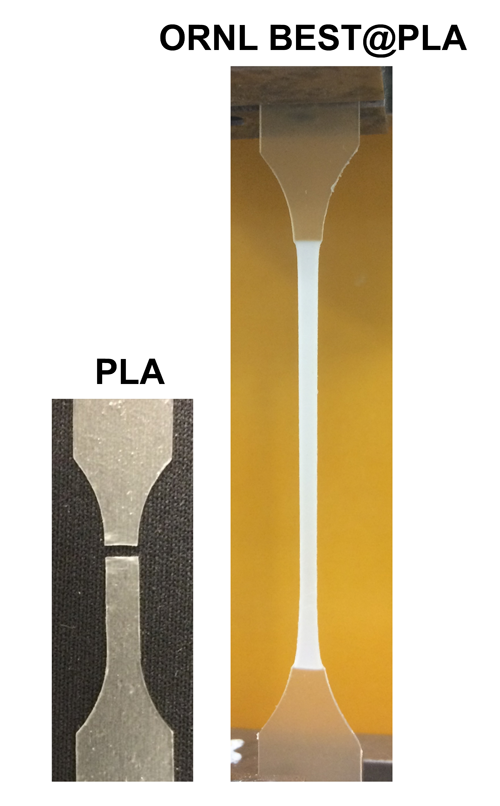
Product Description:PLA (Polylactic acid) is one of the few biopolymers available in large quantities and at a commodity price; however, its brittleness significantly limits its use in many applications. Strategies to improve its ductility are available, however, they compromise the strength and modulus of PLA and are costly. In contrast, Oak Ridge National Laboratory’s low cost, unique Soft Chain Coupling Technology improves the ductility and toughness of PLA dramatically, while maintaining other mechanical properties. The process is an environmentally friendly melt phase, and it is scalable with currently available industrial equipment. Moreover, modified PLA offers some unique properties, such as damage tolerance and improved shock-induced toughness, which were never realized before in PLA or in any other biopolymer. Furthermore, ORNL BEST-modified PLA outperforms other biopolymers, such as polycaprolactone, poly (butylene adipate-co-terephthalate), and poly (butylene succinate) in terms of strength and toughness. ORNL’s technology is critical for expanding use of PLA into many new areas and for providing a sustainable product that replaces petroleum-based plastics.
Developers: Oak Ridge National laboratory
United States
Product Description:PLA (Polylactic acid) is one of the few biopolymers available in large quantities and at a commodity price; however, its brittleness significantly limits its use in many applications. Strategies to improve its ductility are available, however, they compromise the strength and modulus of PLA and are costly. In contrast, Oak Ridge National Laboratory’s low cost, unique Soft Chain Coupling Technology improves the ductility and toughness of PLA dramatically, while maintaining other mechanical properties. The process is an environmentally friendly melt phase, and it is scalable with currently available industrial equipment. Moreover, modified PLA offers some unique properties, such as damage tolerance and improved shock-induced toughness, which were never realized before in PLA or in any other biopolymer. Furthermore, ORNL BEST-modified PLA outperforms other biopolymers, such as polycaprolactone, poly (butylene adipate-co-terephthalate), and poly (butylene succinate) in terms of strength and toughness. ORNL’s technology is critical for expanding use of PLA into many new areas and for providing a sustainable product that replaces petroleum-based plastics.
Supporting information A-1