Carbon Capture & Utilization through Reduction Electrolysis (Carbon CURE)
Category: Mechanical/Materials
Developers: Idaho National Laboratory
United States
Product Description:Decarbonizing energy production through carbon capture and sequestration (CCS) is a popular idea that has been plagued by operational and economic challenges but integrating carbon capture with reuse to make high-value products could offer an operational advantage. The Carbon CURE process, from Idaho National Laboratory, provides a solution by using recyclable solvents as a carbon capture medium that can be fed directly to an electrochemical cell. The cell converts carbon dioxide to syngas, the building block for a raft of high value products. The process will help to achieve economical carbon capture at an industrial scale. Traditional methods of producing syngas require upstream or downstream separations along with processes that aren’t feasible for scale-up. Yet the Carbon CURE process requires no extra steps and is scalable. A low temperature completely electrified process means that with electricity supplied from noncarbon-producing sources, industry may finally be on the verge of a “green” chemical production process that produces fewer carbon emissions while also reducing greenhouse gas emissions.
Developers: Idaho National Laboratory
United States
Product Description:Decarbonizing energy production through carbon capture and sequestration (CCS) is a popular idea that has been plagued by operational and economic challenges but integrating carbon capture with reuse to make high-value products could offer an operational advantage. The Carbon CURE process, from Idaho National Laboratory, provides a solution by using recyclable solvents as a carbon capture medium that can be fed directly to an electrochemical cell. The cell converts carbon dioxide to syngas, the building block for a raft of high value products. The process will help to achieve economical carbon capture at an industrial scale. Traditional methods of producing syngas require upstream or downstream separations along with processes that aren’t feasible for scale-up. Yet the Carbon CURE process requires no extra steps and is scalable. A low temperature completely electrified process means that with electricity supplied from noncarbon-producing sources, industry may finally be on the verge of a “green” chemical production process that produces fewer carbon emissions while also reducing greenhouse gas emissions.
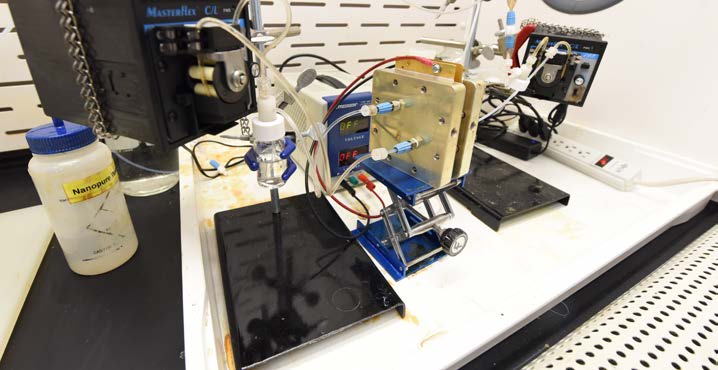
Carbon CURE