Research & Development World

  • R&D World Home
  • Topics
    • Aerospace
    • Automotive
    • Biotech
    • Careers
    • Chemistry
    • Environment
    • Energy
    • Life Science
    • Material Science
    • R&D Management
    • Physics
  • Technology
    • 3D Printing
    • A.I./Robotics
    • Software
    • Battery Technology
    • Controlled Environments
      • Cleanrooms
      • Graphene
      • Lasers
      • Regulations/Standards
      • Sensors
    • Imaging
    • Nanotechnology
    • Scientific Computing
      • Big Data
      • HPC/Supercomputing
      • Informatics
      • Security
    • Semiconductors
  • R&D Market Pulse
  • R&D 100
    • 2025 R&D 100 Award Winners
    • 2025 Professional Award Winners
    • 2025 Special Recognition Winners
    • R&D 100 Awards Event
    • R&D 100 Submissions
    • Winner Archive
  • Resources
    • Research Reports
    • Digital Issues
    • Educational Assets
    • R&D Index
    • Subscribe
    • Video
    • Webinars
    • Content submission guidelines for R&D World
  • Global Funding Forecast
  • Top Labs
  • Advertise
  • SUBSCRIBE

Sandia Labs engineers MOFs for selective rare-earth element extraction

By R&D Editors | August 30, 2024

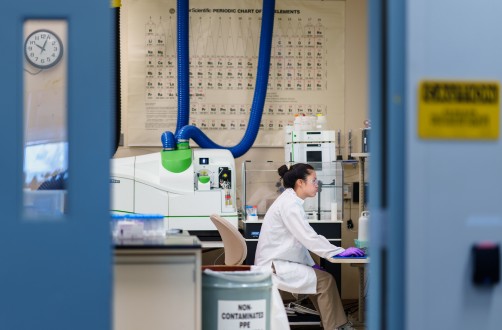
Sandia National Laboratories intern Kadie Marie Mei Sanchez conducts research on rare-earth element separation using advanced analytical equipment.

Sandia National Laboratories intern Kadie Marie Mei Sanchez conducts research on rare-earth element separation using advanced analytical equipment. [Craig Fritz/Sandia National Laboratories]

Scientists at Sandia National Laboratories in Albuquerque, New Mexico, have announced that they are pioneering an environmentally friendly method to purify rare-earth elements for an array modern technologies. This research follows other recent announcements from Sandia, including a new computer simulation tool designed to accelerate scientific discovery.

Exploiting metal-organic frameworks

The crux of the new research focuses on exploiting metal-organic frameworks (MOFs), a class of customizable, porous materials, to selectively extract rare-earth elements from aqueous solutions. Currently, the purification of these elements, found in everything from smartphones and LED lights to electric vehicles and wind turbines, relies on harsh acids and hazardous solvents.

“We synthesized MOFs with variable surface chemistry and were able to show through adsorption experiments that these MOFs can pick out rare-earth elements from a mixture of other metals,” said Anastasia Ilgen, a Sandia geochemist and project lead.
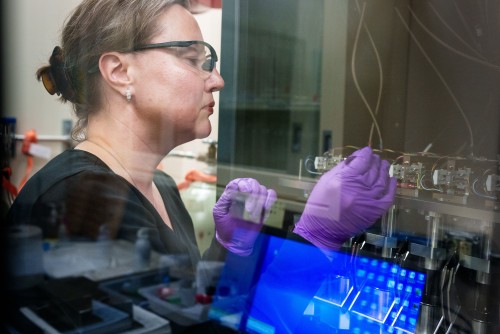
A Sandia researcher carefully handles samples during experiments on metal-organic frameworks (MOFs).

Sandia’s team, under the leadership of geochemist Anastasia Ilgen and materials chemist Dorina Sava Gallis, is designing MOFs with specific surface chemistries and pore sizes to act as selective “sponges” for individual rare-earth elements. To aid this design process, computational materials scientist Kevin Leung employs advanced modeling techniques, including molecular dynamics simulations and density functional theory calculations. These simulations help understand the atomic-level interactions between rare-earth elements and various MOF structures, guiding the team towards creating MOFs with enhanced selectivity and efficiency.

Next focus areas

Further analysis of these interactions is conducted using X-ray absorption fine structure spectroscopy at Argonne National Laboratory. This technique allows Ilgen to directly observe the chemical bonding between rare-earth elements and specific sites within the MOFs, such as the metal hubs or the attached chemical groups. These observations provide information for optimizing the MOF design for targeted rare-earth element capture. For example, Ilgen’s work revealed that rare-earth elements can bind to both the metal hubs and specific surface groups like phosphonates.

Ultimately, this research aims to develop a viable alternative for rare-earth element purification. By precisely tailoring the MOF structure and surface chemistry, the team seeks to create materials capable of selectively adsorbing individual rare-earth elements from complex mixtures. Successful development of this technology could lead to a more environmentally benign and potentially cost-effective purification process. It could also help decrease reliance on current methods that employ harsh chemicals and contribute to geopolitical supply chain concerns. Future research will focus on exploring different MOF designs, including incorporating mixed-metal hubs and fine-tuning pore dimensions.
Related Articles Read More >

Gadolyn names Jack Lifton advisory board chair, adds Gareth Hatch
Lead-free piezoelectric material converts motion to power without lead
R&D 100 Winners protecting nuclear materials
R&D Winners turn fruit waste into ‘leather’
rd newsletter
EXPAND YOUR KNOWLEDGE AND STAY CONNECTED
Get the latest info on technologies, trends, and strategies in Research & Development.
RD 25 Power Index

R&D World Digital Issues

Fall 2025 issue

Browse the most current issue of R&D World and back issues in an easy to use high quality format. Clip, share and download with the leading R&D magazine today.

R&D 100 Awards
Research & Development World
  • Subscribe to R&D World Magazine
  • Sign up for R&D World’s newsletter
  • Contact Us
  • About Us
  • Drug Discovery & Development
  • Pharmaceutical Processing
  • Global Funding Forecast

Copyright © 2025 WTWH Media LLC. All Rights Reserved. The material on this site may not be reproduced, distributed, transmitted, cached or otherwise used, except with the prior written permission of WTWH Media
Privacy Policy | Advertising | About Us

Search R&D World

  • R&D World Home
  • Topics
    • Aerospace
    • Automotive
    • Biotech
    • Careers
    • Chemistry
    • Environment
    • Energy
    • Life Science
    • Material Science
    • R&D Management
    • Physics
  • Technology
    • 3D Printing
    • A.I./Robotics
    • Software
    • Battery Technology
    • Controlled Environments
      • Cleanrooms
      • Graphene
      • Lasers
      • Regulations/Standards
      • Sensors
    • Imaging
    • Nanotechnology
    • Scientific Computing
      • Big Data
      • HPC/Supercomputing
      • Informatics
      • Security
    • Semiconductors
  • R&D Market Pulse
  • R&D 100
    • 2025 R&D 100 Award Winners
    • 2025 Professional Award Winners
    • 2025 Special Recognition Winners
    • R&D 100 Awards Event
    • R&D 100 Submissions
    • Winner Archive
  • Resources
    • Research Reports
    • Digital Issues
    • Educational Assets
    • R&D Index
    • Subscribe
    • Video
    • Webinars
    • Content submission guidelines for R&D World
  • Global Funding Forecast
  • Top Labs
  • Advertise
  • SUBSCRIBE