Scientists at Sandia National Laboratory won an R&D 100 award for their project “Bleeding Materials and Enclosures,” a tamper-indicating container made of colorful water beads sealed with epoxy, creating an enclosure. Upon contact with oxygen, the beads turn black in an irreversible chemical reaction, indicating that someone tampered with the enclosure. The project was designed for international nuclear safeguards, but could have multiple use cases across industries.
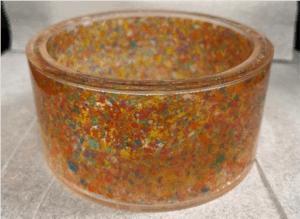
The Bleeding Materials & Enclosures tamper indicator container. Credit: Sandia National Laboratory
“This is essentially a new way to do a tamper-indicating enclosure in a visually obvious way, which should save inspectors time and effort, but it’s also a much better system than what’s currently used,” said Heidi Smartt, one of the lead researchers.
The current system used to detect tampering of nuclear materials is highly subjective and time-consuming, Smartt said. With the traditional method, an inspector has to look over anodized aluminum containers for signs of tampering. The inspector has to look carefully at each enclosure and could have a hard time differentiating between normal signs of wear and tear, such as a scratch, from a sign of tampering.
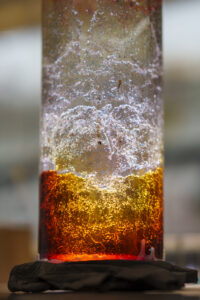
Exposed oxygen sensitive material at the bottom is contrasted with unexposed portions inside two concentric cylinders at Sandia National Labs on Nov. 30, 2023. The cylinder will protect contents by indicating if there has been tampering. Photo by Craig Fritz
The other way tampering is detected in nuclear materials is by embedding fiber in the walls and electronically monitoring for signs of tampering. This method is more expensive than the alternatives. These difficulties with the current systems inspired the team at Sandia to create a method that was both visually obvious and cost-effective.
The enclosure is made of common, inexpensive materials such as epoxy, acrylic and silicone. “The components of this are things you could get at a Home Depot or on Amazon,” said Cody Corbin, another lead researcher, “If you think about something long enough, there’s a way to do it simply and inexpensively for most things.”
While the team designed the product for nuclear materials tamper indication, it could be used across industries such as pharmaceutical packaging, cargo containers or high-value assets like diamonds and art, said Smartt.
The product is a passive system, which indicates tampering without immediate notification. With the dramatic color change, it might be possible to monitor the enclosure to notify the user if it is tampered with, Corbin said, creating a more active detection system.
The team aims to license the technology to a local business next fall to bring it to the market, and hopes to continue their work if they receive more funding.