Research & Development World

  • R&D World Home
  • Topics
    • Aerospace
    • Automotive
    • Biotech
    • Careers
    • Chemistry
    • Environment
    • Energy
    • Life Science
    • Material Science
    • R&D Management
    • Physics
  • Technology
    • 3D Printing
    • A.I./Robotics
    • Software
    • Battery Technology
    • Controlled Environments
      • Cleanrooms
      • Graphene
      • Lasers
      • Regulations/Standards
      • Sensors
    • Imaging
    • Nanotechnology
    • Scientific Computing
      • Big Data
      • HPC/Supercomputing
      • Informatics
      • Security
    • Semiconductors
  • R&D Market Pulse
  • R&D 100
    • 2025 R&D 100 Award Winners
    • 2025 Professional Award Winners
    • 2025 Special Recognition Winners
    • R&D 100 Awards Event
    • R&D 100 Submissions
    • Winner Archive
  • Resources
    • Research Reports
    • Digital Issues
    • Educational Assets
    • R&D Index
    • Subscribe
    • Video
    • Webinars
    • Content submission guidelines for R&D World
  • Global Funding Forecast
  • Top Labs
  • Advertise
  • SUBSCRIBE

Scientists Develop Novel Chip for Fast, Accurate Disease Detection at Low Cost

By National University of Singapore | April 2, 2018

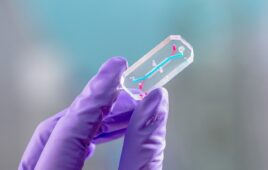
NUS Engineering researchers have developed a low-cost microfluidic chip that can quickly and accurately detect and quantify nano-bioparticles using only a standard laboratory microscope without any fluorescent labels.

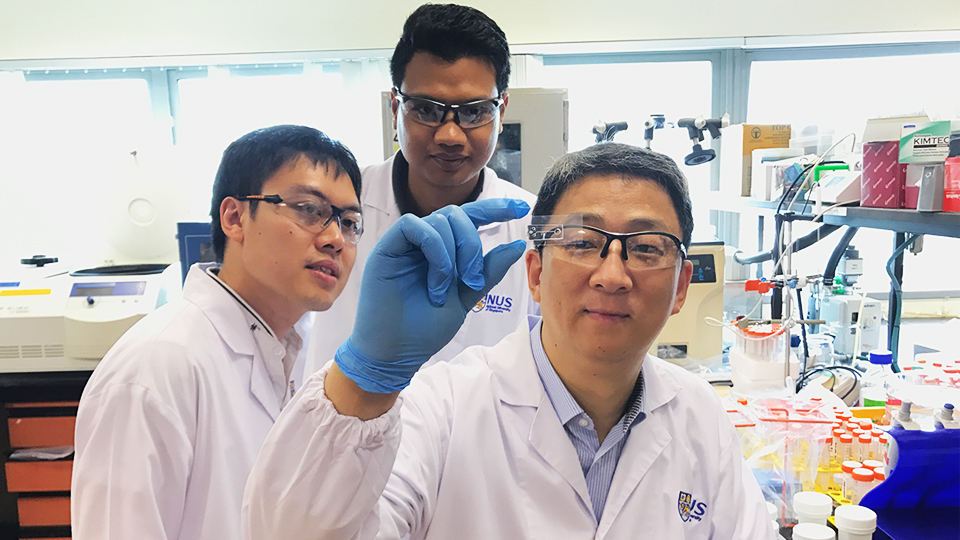
A novel invention by a team of researchers from the National University of Singapore (NUS) holds promise for a faster and cheaper way to diagnose diseases with high accuracy. Professor Zhang Yong from the Department of Biomedical Engineering at the NUS Faculty of Engineering and his team have developed a tiny microfluidic chip that could effectively detect minute amounts of biomolecules without the need for complex lab equipment.

Diseases diagnostics involves detection and quantification of nano-sized bio-particles such as DNA, proteins, viruses, and exosomes (extracellular vesicles). Typically, detection of biomolecules such as proteins are performed using colorimetric assays or fluorescent labelling with a secondary antibody for detection, and requires complex optical detection equipment such as fluorescent microscopy or spectrophotometry.

One alternative to reduce cost and complexity of disease detection is the adoption of label-free techniques, which are gaining traction in recent times. However, this approach requires precision engineering of nano-features (in a detection chip), complex optical setups, novel nano-probes (such as graphene oxide, carbon nanotubes, and gold nanorods) or additional amplification steps such as aggregation of nanoparticles to achieve sensitive detection of biomarkers.

“Our invention is an example of disruptive diagnostics. This tiny biochip can sensitively detect proteins and nano-sized polymer vesicles with a concentration as low as 10ng/mL (150 pM) and 3.75μg/mL respectively. It also has a very small footprint, weighing only 500 mg and is 6mm³ in size. Detection can be performed using standard laboratory microscopes, making this approach highly attractive for use in point-of-care diagnostics,” explained Prof Zhang. 

His team, comprising Dr Kerwin Kwek Zeming and two NUS PhD students Mr Thoriq Salafi and Ms Swati Shikha, published their findings in scientific journal Nature Communications on 28 March 2018.

Novel approach for disease diagnosis

This novel fluorescent label-free approach uses the lateral shifts in the position of the microbead substrate in pillar arrays, for quantifying the biomolecules, based on the change in surface forces and size, without the need of any external equipment. Due to the usage of lateral displacement, the nano-biomolecules can be detected in real-time and the detection is significantly faster in comparison to fluorescent label based detection.  

“These techniques can also be extended to many other types of nano-biomolecules, including nucleic acid and virus detection. To complement this chip technology, we are also developing a portable smartphone-based accessory and microfluidic pump to make the whole detection platform portable for outside laboratory disease diagnostics. We hope to further develop this technology for commercialisation,” said Prof Zhang.


Related Articles Read More >

Who’s building in pharma, and who would be spared from 100% tariffs, if enacted
2025 R&D layoffs tracker: hardware and chips lead the year’s biggest cuts while biopharma pares pipelines
Skin’s built-in “stretch sensor” helps tissue grow in mouse study
Meissner launches rotary impeller mixing solutions (RMS) portfolio for biocontainer mixing
rd newsletter
EXPAND YOUR KNOWLEDGE AND STAY CONNECTED
Get the latest info on technologies, trends, and strategies in Research & Development.
RD 25 Power Index

R&D World Digital Issues

Fall 2025 issue

Browse the most current issue of R&D World and back issues in an easy to use high quality format. Clip, share and download with the leading R&D magazine today.

Research & Development World
  • Subscribe to R&D World Magazine
  • Sign up for R&D World’s newsletter
  • Contact Us
  • About Us
  • Drug Discovery & Development
  • Pharmaceutical Processing
  • Global Funding Forecast

Copyright © 2025 WTWH Media LLC. All Rights Reserved. The material on this site may not be reproduced, distributed, transmitted, cached or otherwise used, except with the prior written permission of WTWH Media
Privacy Policy | Advertising | About Us

Search R&D World

  • R&D World Home
  • Topics
    • Aerospace
    • Automotive
    • Biotech
    • Careers
    • Chemistry
    • Environment
    • Energy
    • Life Science
    • Material Science
    • R&D Management
    • Physics
  • Technology
    • 3D Printing
    • A.I./Robotics
    • Software
    • Battery Technology
    • Controlled Environments
      • Cleanrooms
      • Graphene
      • Lasers
      • Regulations/Standards
      • Sensors
    • Imaging
    • Nanotechnology
    • Scientific Computing
      • Big Data
      • HPC/Supercomputing
      • Informatics
      • Security
    • Semiconductors
  • R&D Market Pulse
  • R&D 100
    • 2025 R&D 100 Award Winners
    • 2025 Professional Award Winners
    • 2025 Special Recognition Winners
    • R&D 100 Awards Event
    • R&D 100 Submissions
    • Winner Archive
  • Resources
    • Research Reports
    • Digital Issues
    • Educational Assets
    • R&D Index
    • Subscribe
    • Video
    • Webinars
    • Content submission guidelines for R&D World
  • Global Funding Forecast
  • Top Labs
  • Advertise
  • SUBSCRIBE