
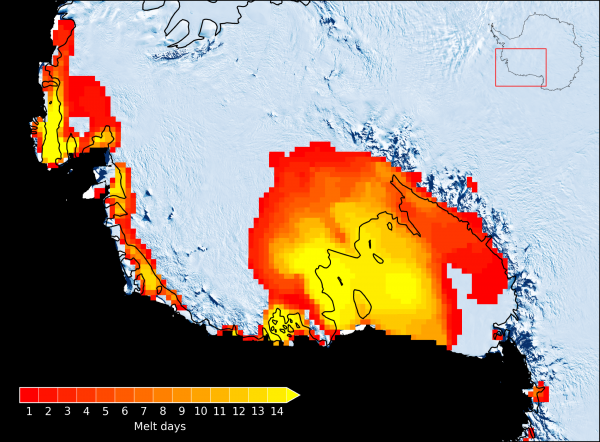
Number of days in January 2016 when surface melt was detected from passive microwave satellite observations.
The West Antarctic Ice Sheet, a landbound mass of ice larger than Mexico, experienced substantial surface melt through the austral summer of 2015-2016 during one of the largest El Niño events of the past 50 years, according to scientists who had been conducting the first comprehensive atmospheric measurements in the region since the 1960s.
The science team conducting the ARM West Antarctic Radiation Experiment (AWARE) led by researchers at Scripps Institution of Oceanography at the University of California San Diego reports that the melting caused by warm air bearing moisture and extensive cloud cover was likely delivered by El Niño over the ice sheet. Melted snow was spotted over most of the Ross Ice Shelf, a thick platform of floating ice that channels about a third of the ice flowing from the West Antarctic Ice Sheet into the ocean.
The study, “January 2016 extensive summer melt in West Antarctica favoured by strong El Niño,” was led by AWARE scientist Julien Nicolas of Ohio State University and appears in the June 15 issue of the journal Nature Communications.
Though clouds can often cool the surface of the planet by reflecting solar radiation back to space, they also trap heat between the cloud deck and the ground. Meteorological data gathered during AWARE found that in this instance, the latter effect was the more influential.
The finding of this joint U.S. Department of Energy (DOE) and National Science Foundation-funded project is of interest, said the scientists, because El Niño events are expected to become more common if planetary warming trends continue since surface melt enhances ice sheet instability already caused by warm ocean waters melting it from below.
“We were extraordinarily fortunate to be able to deploy state-of-the art equipment to West Antarctica just before this large melt event occurred,” said AWARE principal investigator Dan Lubin, a research physicist at Scripps Oceanography. “These atmospheric measurements will help geophysical scientists develop better physical models for projecting how the Antarctic ice sheet might respond to a changing climate and influence sea level rise.”
Scientists had been able to see melt episodes in Antarctica via satellite during El Niño years of the past. The 2015-2016 event was the first, however, in which sophisticated instruments from the DOE’s Atmospheric Radiation Measurement (ARM) Climate Research Facility installed on the ice sheet and at McMurdo Station adjacent to the nearby Ross Ice Shelf were present and able to make detailed measurements of atmospheric conditions at the time of a large-scale melt.
El Niño is characterized by the movement of warm waters to the eastern equatorial Pacific Ocean, which often influences water temperatures off California. The same climate phenomenon also directs warm marine air toward West Antarctica. The AWARE team noted that the melting took place even in the presence of a wind pattern that usually counteracts the flow of warm air. During the positive phase of the Southern Annular Mode (SAM), strong westerly winds blast around Antarctica, creating a fence of sorts that keeps the continent cold. The SAM during the 2015-2016 austral summer was strongly positive but nevertheless warm air penetrated the continent. AWARE researchers suggest that the melt might have been even more pronounced if the SAM were weak.
“In West Antarctica, we have a tug-of-war going on between the influence of El Niños and the westerly winds, and it looks like the El Niños are winning,” said study co-author David Bromwich, professor of geography at Ohio State. “It’s a pattern that is emerging. And because we expect stronger, more frequent El Niños in the future with a warming climate, we can expect more major surface melt events in West Antarctica.”
The West Antarctic Ice Sheet rests on bedrock that is below sea level and is protected by a fringe of floating ice shelves. The melting and disintegration of these ice shelves would accelerate the flow of ice into the ocean. Were the ice sheet to melt completely, as probably occurred during the Earth’s last inter-glacial period about 125,000 years ago, it contains enough mass to raise global mean sea level by three meters (11 feet).
In addition to Nicolas, Lubin, and Bromwich, co-authors included Ryan Scott and Lynn Russell of Scripps Oceanography and scientists from Brookhaven National Laboratory in New York, Argonne National Laboratory in Illinois, Penn State University, the Australian Bureau of Meteorology, and Los Alamos National Laboratory in New Mexico.