Research & Development World

  • R&D World Home
  • Topics
    • Aerospace
    • Automotive
    • Biotech
    • Careers
    • Chemistry
    • Environment
    • Energy
    • Life Science
    • Material Science
    • R&D Management
    • Physics
  • Technology
    • 3D Printing
    • A.I./Robotics
    • Software
    • Battery Technology
    • Controlled Environments
      • Cleanrooms
      • Graphene
      • Lasers
      • Regulations/Standards
      • Sensors
    • Imaging
    • Nanotechnology
    • Scientific Computing
      • Big Data
      • HPC/Supercomputing
      • Informatics
      • Security
    • Semiconductors
  • R&D Market Pulse
  • R&D 100
    • 2025 R&D 100 Award Winners
    • 2025 Professional Award Winners
    • 2025 Special Recognition Winners
    • R&D 100 Awards Event
    • R&D 100 Submissions
    • Winner Archive
  • Resources
    • Research Reports
    • Digital Issues
    • Educational Assets
    • Subscribe
    • Video
    • Webinars
    • Content submission guidelines for R&D World
  • Global Funding Forecast
  • Top Labs
  • Advertise
  • SUBSCRIBE

Self-Reconfiguring Modular Robots Can Merge, Split and Self-Heal

By Université Libre De Bruxelles | September 12, 2017

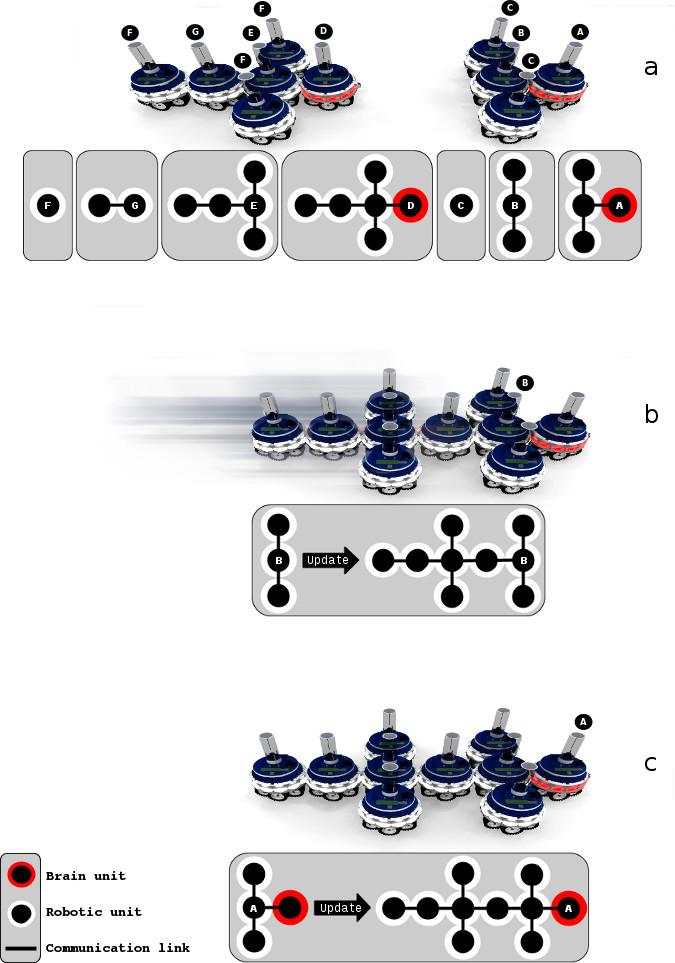
This image shows a self-reconfiguring modular robots scheme. Credit: Iridia Lab ULB

Researchers at the Université libre de Bruxelles have developed self-reconfiguring modular robots that can merge, split and even self-heal while retaining full sensorimotor control. The work may take us closer to producing robots that can autonomously change their size, shape and function. The study is published in the scientific review Nature Communications.

Many robots are controlled by robotic nervous systems in which sensors and actuators are connected to a central processing unit. However, in most cases the robotic nervous systems are mapped strictly to the shape of the robot, which limits flexibility in their capabilities. Adaptability could be improved using modular robots, made up of multiple units that can form collective bodies, but coordination and control of modular robots have been constrained by a limited set of predefined shapes that the units can form into.

Marco Dorigo, IRIDIA Laboratory, Brussels School of Engineering, and colleagues design modular robots that can adapt their bodies by splitting and merging to become new independent robotic entities, autonomously choosing appropriate shapes and sizes in response to the task or environment. Their robotic nervous systems can also split and merge to maintain sensorimotor control. These robots can even self-heal by removing or replacing malfunctioning parts, including a malfunctioning brain unit. The system is demonstrated using 10 units, but the authors suggest that the system may be easy to scale-up. They propose that in the future, robots will no longer be designed and built for a particular task, and suggest that their system could eventually inspire the production of robots that can adapt to changing task requirements.


Related Articles Read More >

How Cypris evolved from selling patent reports to agentic R&D intelligence
Medable’s Digital Data Flow Agent focuses on protocol translation as the agentic race accelerates
AI image firm Midjourney spins up health division, unveils ‘Ultrasonic CT’
SpaceX is now worth nearly as much as 41 aerospace peers combined. Its revenue is another story
rd newsletter
EXPAND YOUR KNOWLEDGE AND STAY CONNECTED
Get the latest info on technologies, trends, and strategies in Research & Development.

R&D World Digital Issues

Fall 2025 issue

Browse the most current issue of R&D World and back issues in an easy to use high quality format. Clip, share and download with the leading R&D magazine today.

R&D 100 Awards
Research & Development World
  • Subscribe to R&D World Magazine
  • Sign up for R&D World’s newsletter
  • Contact Us
  • About Us
  • Drug Discovery & Development
  • Pharmaceutical Processing
  • Global Funding Forecast

Copyright © 2026 WTWH Media LLC. All Rights Reserved. The material on this site may not be reproduced, distributed, transmitted, cached or otherwise used, except with the prior written permission of WTWH Media
Privacy Policy | Advertising | About Us

Search R&D World

  • R&D World Home
  • Topics
    • Aerospace
    • Automotive
    • Biotech
    • Careers
    • Chemistry
    • Environment
    • Energy
    • Life Science
    • Material Science
    • R&D Management
    • Physics
  • Technology
    • 3D Printing
    • A.I./Robotics
    • Software
    • Battery Technology
    • Controlled Environments
      • Cleanrooms
      • Graphene
      • Lasers
      • Regulations/Standards
      • Sensors
    • Imaging
    • Nanotechnology
    • Scientific Computing
      • Big Data
      • HPC/Supercomputing
      • Informatics
      • Security
    • Semiconductors
  • R&D Market Pulse
  • R&D 100
    • 2025 R&D 100 Award Winners
    • 2025 Professional Award Winners
    • 2025 Special Recognition Winners
    • R&D 100 Awards Event
    • R&D 100 Submissions
    • Winner Archive
  • Resources
    • Research Reports
    • Digital Issues
    • Educational Assets
    • Subscribe
    • Video
    • Webinars
    • Content submission guidelines for R&D World
  • Global Funding Forecast
  • Top Labs
  • Advertise
  • SUBSCRIBE