Research & Development World

  • R&D World Home
  • Topics
    • Aerospace
    • Automotive
    • Biotech
    • Careers
    • Chemistry
    • Environment
    • Energy
    • Life Science
    • Material Science
    • R&D Management
    • Physics
  • Technology
    • 3D Printing
    • A.I./Robotics
    • Software
    • Battery Technology
    • Controlled Environments
      • Cleanrooms
      • Graphene
      • Lasers
      • Regulations/Standards
      • Sensors
    • Imaging
    • Nanotechnology
    • Scientific Computing
      • Big Data
      • HPC/Supercomputing
      • Informatics
      • Security
    • Semiconductors
  • R&D Market Pulse
  • R&D 100
    • 2026 R&D 100 Award Winners
    • 2026 Professional Award Winners
    • 2026 Special Recognition Winners
    • R&D 100 Awards Event
    • R&D 100 Submissions
    • Winner Archive
  • Resources
    • Research Reports
    • Digital Issues
    • Educational Assets
    • Subscribe
    • Video
    • Webinars
    • PharmSci360
    • Content submission guidelines for R&D World
  • Global Funding Forecast
  • Top Labs
  • Advertise
  • SUBSCRIBE

SpaceX in talks to buy Boost Mobile as it builds a hybrid satellite-cell service

By Brian Buntz | November 2, 2026

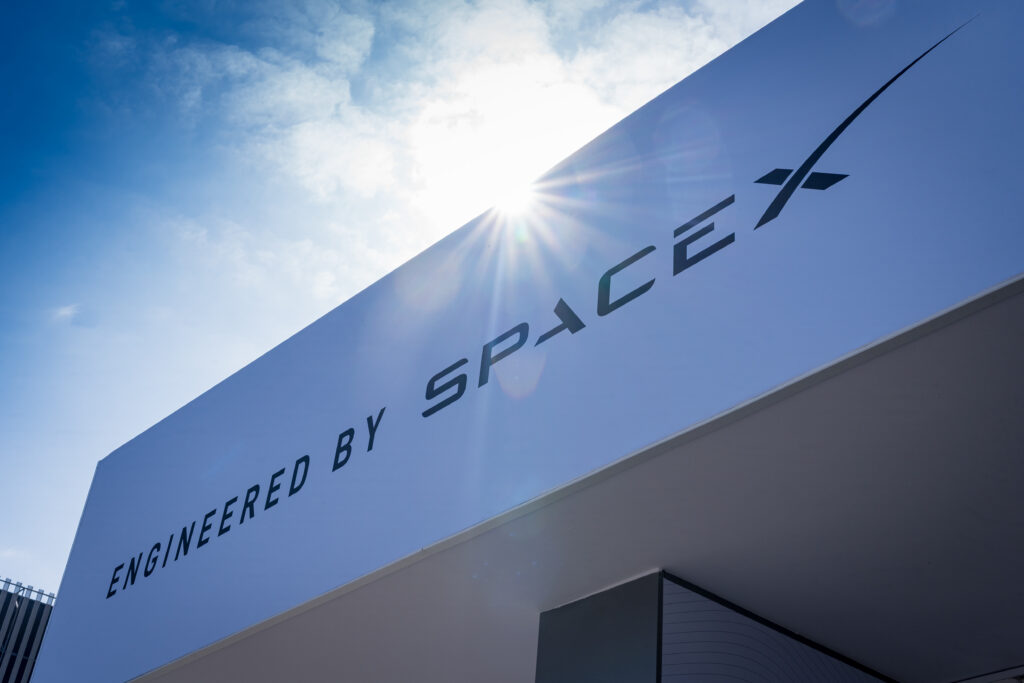
[Adobe Stock]

In a March 9, 2020 appearance at the Satellite 2020 conference in Washington, Elon Musk told the room that his company’s satellite internet network and service were not coming for the phone companies. “Starlink is not some huge threat to telcos. I want to be super clear: it is not,” he said. The service, he said, would “serve the three or four percent hardest to reach customers for telcos” and “take a significant load off the traditional telcos.”

Six years later, Musk is trying to sell phone service under SpaceX’s own name. SpaceX, which runs Starlink and is testing hardware for orbital data centers, is in talks to buy the wireless telecommunications brand Boost Mobile from EchoStar, the owner of DISH TV, Sling TV and Hughes, or to use the network Boost leases from AT&T and T-Mobile, The Washington Post reported Monday, citing people familiar with the negotiations. Musk apparently met EchoStar chairman Charlie Ergen in October, after Musk asked the heads of Verizon, AT&T and T-Mobile to let SpaceX use their networks and all three reportedly said no. Boost’s network agreements may require AT&T’s and T-Mobile’s consent before a new owner can use them. SpaceX and EchoStar did not immediately respond to Reuters.

EchoStar reported 7.375 million wireless subscribers at June 30, 2026, mostly under the Boost Mobile and Gen Mobile brands. Boost has run as a hybrid carrier since November 2025, on network services from T-Mobile and AT&T. SpaceX already holds rights to EchoStar spectrum. In September 2025, EchoStar agreed to sell SpaceX its AWS-4 and H-block licenses for about $17 billion, up to $8.5 billion in cash and up to $8.5 billion in SpaceX stock, and the companies agreed that Boost subscribers would reach SpaceX’s next-generation Starlink Direct to Cell service through EchoStar’s cloud-native 5G core. A November 5, 2025, amendment added unpaired AWS-3 licenses for $2.6 billion in SpaceX stock, raising the total to about $20 billion. The FCC approved the transactions on May 12, 2026, and on May 22 EchoStar transferred the licenses to a trust; the final closing, when SpaceX takes the licenses, is targeted for November 30, 2027, according to EchoStar’s second-quarter 10-Q. SpaceX plans to use the spectrum for its next-generation Direct to Cell constellation.
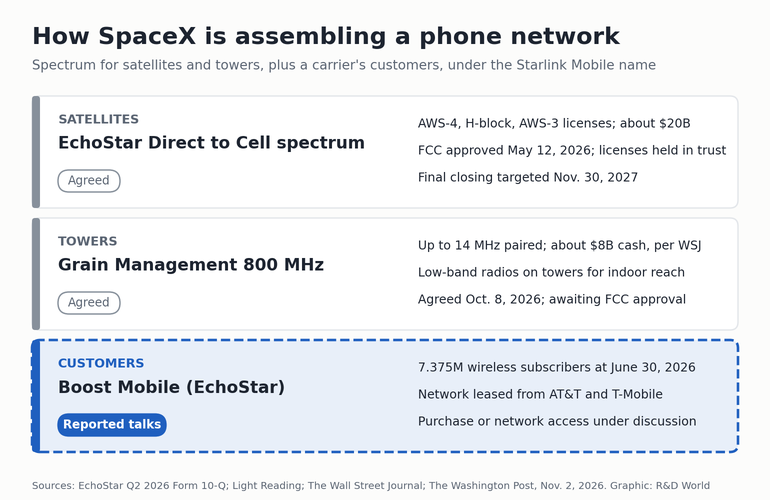
Diagram of three pieces of SpaceX's planned phone network: EchoStar satellite spectrum, Grain Management 800 MHz tower spectrum, and Boost Mobile's customers, with the Boost deal marked as reported talks.

Credit: R&D World graphic. Sources: EchoStar Q2 2026 Form 10-Q, Light Reading, The Wall Street Journal, The Washington Post

SpaceX is also buying spectrum for towers to supplement its satellite-based coverage. On October 8, the company agreed to acquire the 800 MHz portfolio of investment firm Grain Management, up to 14 MHz of paired low-band spectrum, subject to FCC approval. The companies kept the price private; The Wall Street Journal reported about $8 billion in cash. Low-band signals reach indoors through walls and roofs, and Light Reading reported that SpaceX plans to put standards-based radios on towers, rooftops and other structures alongside its satellite network. SpaceX said the spectrum would help “Starlink Mobile to become a major mobile carrier in the U.S.” Musk called it “the last critical piece of the spectrum puzzle needed for SpaceX to provide complete phone coverage in America.” Terrestrial coverage beyond those radios would still depend on access to AT&T’s and T-Mobile’s networks.

Starlink already reaches conventional phones in the U.S. through a partner. T-Mobile launched T-Satellite commercially with text messaging in July 2025, and on October 1, 2025, added app data for WhatsApp, Google Maps, AccuWeather, AllTrails and X on dozens of existing smartphone models, over more than 650 Starlink Direct to Cell satellites. Starlink Mobile is the service SpaceX now wants to offer in its own name. With the three national carriers reportedly refusing it wholesale access to their towers, an EchoStar agreement is another potential route.

Tell Us What You Think! Cancel reply

You must be logged in to post a comment.

Related Articles Read More >

Palantir wants to dominate AI. Anthropic spent 43 times as much on R&D in Q3.
Anthropic’s R&D spending passed Microsoft’s last quarter
NIH awarded more new grants in fiscal 2026, even as total awards fell
DOE will end single-investigator grants in accelerator basic research
rd newsletter
EXPAND YOUR KNOWLEDGE AND STAY CONNECTED
Get the latest info on technologies, trends, and strategies in Research & Development.

R&D World Digital Issues

Fall 2026 issue

Browse the most current issue of R&D World and back issues in an easy to use high quality format. Clip, share and download with the leading R&D magazine today.

R&D 100 Awards
Research & Development World
  • Subscribe to R&D World Magazine
  • Sign up for R&D World’s newsletter
  • Contact Us
  • About Us
  • Drug Discovery & Development
  • Pharmaceutical Processing
  • Global Funding Forecast

Copyright © 2026 Arrowfly LLC. All Rights Reserved. The material on this site may not be reproduced, distributed, transmitted, cached or otherwise used, except with the prior written permission of Arrowfly
Privacy Policy | Advertising | About Us

Search R&D World

  • R&D World Home
  • Topics
    • Aerospace
    • Automotive
    • Biotech
    • Careers
    • Chemistry
    • Environment
    • Energy
    • Life Science
    • Material Science
    • R&D Management
    • Physics
  • Technology
    • 3D Printing
    • A.I./Robotics
    • Software
    • Battery Technology
    • Controlled Environments
      • Cleanrooms
      • Graphene
      • Lasers
      • Regulations/Standards
      • Sensors
    • Imaging
    • Nanotechnology
    • Scientific Computing
      • Big Data
      • HPC/Supercomputing
      • Informatics
      • Security
    • Semiconductors
  • R&D Market Pulse
  • R&D 100
    • 2026 R&D 100 Award Winners
    • 2026 Professional Award Winners
    • 2026 Special Recognition Winners
    • R&D 100 Awards Event
    • R&D 100 Submissions
    • Winner Archive
  • Resources
    • Research Reports
    • Digital Issues
    • Educational Assets
    • Subscribe
    • Video
    • Webinars
    • PharmSci360
    • Content submission guidelines for R&D World
  • Global Funding Forecast
  • Top Labs
  • Advertise
  • SUBSCRIBE