Research & Development World

  • R&D World Home
  • Topics
    • Aerospace
    • Automotive
    • Biotech
    • Careers
    • Chemistry
    • Environment
    • Energy
    • Life Science
    • Material Science
    • R&D Management
    • Physics
  • Technology
    • 3D Printing
    • A.I./Robotics
    • Software
    • Battery Technology
    • Controlled Environments
      • Cleanrooms
      • Graphene
      • Lasers
      • Regulations/Standards
      • Sensors
    • Imaging
    • Nanotechnology
    • Scientific Computing
      • Big Data
      • HPC/Supercomputing
      • Informatics
      • Security
    • Semiconductors
  • R&D Market Pulse
  • R&D 100
    • 2025 R&D 100 Award Winners
    • 2025 Professional Award Winners
    • 2025 Special Recognition Winners
    • R&D 100 Awards Event
    • R&D 100 Submissions
    • Winner Archive
  • Resources
    • Research Reports
    • Digital Issues
    • Educational Assets
    • R&D Index
    • Subscribe
    • Video
    • Webinars
    • Content submission guidelines for R&D World
  • Global Funding Forecast
  • Top Labs
  • Advertise
  • SUBSCRIBE

SpaceX’s CRS-33 to deliver liver tissue, stem cells and edge computing to the ISS

By Brian Buntz | August 21, 2025

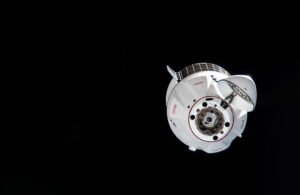
SpaceX Dragon will head to the ISS on NASA’s CRS-33 mission with groundbreaking research in organ engineering, stem cells and orbital computing.

SpaceX Dragon will head to the ISS on NASA’s CRS-33 mission with groundbreaking research in organ engineering, stem cells and orbital computing. [NASA]

SpaceX’s NASA-funded CRS-33 aims to launch no earlier than 2:45 a.m. EDT Sunday from Cape Canaveral with research focused on organ engineering, stem cells and space-based computing. The manifest features Wake Forest’s blood-vessel-containing liver tissue, Cedars-Sinai stem cell studies and Axiom Space’s Red Hat Device Edge demo, plus student experiments from Genes in Space and Higher Orbits.

The Wake Forest Institute for Regenerative Medicine project will test engineered liver tissue with integrated blood vessels in microgravity, building on NASA’s Vascular Tissue Challenge. The work aims to refine tissue engineering methods that could enable organ replacements for patients on Earth and support long-duration space missions.

On the tech side, Axiom Space and Red Hat will validate the Red Hat Device Edge platform on station to process data in real time, a step toward commercial orbital data centers. “Off-planet data processing is the next frontier, and edge computing is a crucial component,” said Tony James, Red Hat’s chief architect for science and space, in a press release.

Cedars-Sinai Medical Center’s experiment will check if induced pluripotent stem cells divide faster in microgravity, a finding that could hurry regenerative medicine advances. The project expands on the team’s past ISS work and targets in-space manufacturing of stem cell therapies for heart disease, neurodegenerative conditions and more.

NASA says Dragon will haul more than 5,000 pounds of cargo and experiments, with docking targeted for about 7:30 a.m. EDT on Monday, Aug. 25, at the station’s Harmony forward port. Launch coverage begins at 2:25 a.m. EDT Sunday on NASA+, with arrival coverage starting at 6 a.m. Monday. 

The manifest also includes bone-forming stem cells to study bone-loss prevention, materials to 3D-print medical implants that could aid nerve-repair, bioprinted liver tissue to examine blood-vessel development, and supplies to 3D-print metal test cubes in orbit. 

Student science rounds out the payload. The Genes in Space-12 project, by 2024 winners Julia Gross and Isabelle Chuang, will explore bacteriophages as therapeutic agents for microbial infections in space, and Higher Orbits’ Go For Launch! is sending multiple experiments from students in Florida, Michigan, Pennsylvania, Texas and Virginia. 

Looking ahead, NASA will also use hardware in Dragon’s trunk to demonstrate a station reboost kit beginning in September, with periodic burns planned through fall 2025; the spacecraft is expected to remain at the ISS until December before returning research to Earth. 

For related context on Cedars-Sinai’s stem cell work, principal investigator Arun Sharma said microgravity helps heart organoids from pluripotent stem cells “retain their three dimensional structure, because they’re able to float.” He added, in a broader article on the ISS, that space could enable more intricate structures like blood vessels, which “kind of fall apart” under gravity—part of broader efforts to advance regenerative medicine through in-orbit biomanufacturing.
Related Articles Read More >

Hubble Telescope finds dark-matter cloud
NASA rover detected “lightning” on Mars
NASA R&D 100 Winner enables high-speed data transfer from space
The Milky Way is glowing: these scientists think dark matter may be the cause
rd newsletter
EXPAND YOUR KNOWLEDGE AND STAY CONNECTED
Get the latest info on technologies, trends, and strategies in Research & Development.
RD 25 Power Index

R&D World Digital Issues

Fall 2025 issue

Browse the most current issue of R&D World and back issues in an easy to use high quality format. Clip, share and download with the leading R&D magazine today.

R&D 100 Awards
Research & Development World
  • Subscribe to R&D World Magazine
  • Sign up for R&D World’s newsletter
  • Contact Us
  • About Us
  • Drug Discovery & Development
  • Pharmaceutical Processing
  • Global Funding Forecast

Copyright © 2026 WTWH Media LLC. All Rights Reserved. The material on this site may not be reproduced, distributed, transmitted, cached or otherwise used, except with the prior written permission of WTWH Media
Privacy Policy | Advertising | About Us

Search R&D World

  • R&D World Home
  • Topics
    • Aerospace
    • Automotive
    • Biotech
    • Careers
    • Chemistry
    • Environment
    • Energy
    • Life Science
    • Material Science
    • R&D Management
    • Physics
  • Technology
    • 3D Printing
    • A.I./Robotics
    • Software
    • Battery Technology
    • Controlled Environments
      • Cleanrooms
      • Graphene
      • Lasers
      • Regulations/Standards
      • Sensors
    • Imaging
    • Nanotechnology
    • Scientific Computing
      • Big Data
      • HPC/Supercomputing
      • Informatics
      • Security
    • Semiconductors
  • R&D Market Pulse
  • R&D 100
    • 2025 R&D 100 Award Winners
    • 2025 Professional Award Winners
    • 2025 Special Recognition Winners
    • R&D 100 Awards Event
    • R&D 100 Submissions
    • Winner Archive
  • Resources
    • Research Reports
    • Digital Issues
    • Educational Assets
    • R&D Index
    • Subscribe
    • Video
    • Webinars
    • Content submission guidelines for R&D World
  • Global Funding Forecast
  • Top Labs
  • Advertise
  • SUBSCRIBE