By Stephanie G Seay
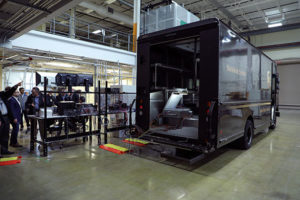
Oak Ridge National Laboratory researchers demonstrated on Feb. 27 a 20-kilowatt, bi-directional wireless charging system on a medium-class hybrid electric delivery truck. Credit: Brittany Cramer/Oak Ridge National Laboratory, U.S. Dept. of Energy
Researchers at the Department of Energy’s Oak Ridge National Laboratory (ORNL) in late February demonstrated a 20-kw bi-directional wireless charging system installed on a UPS medium-duty, plug-in hybrid electric delivery truck. The project is the first of its kind to achieve power transfer at this rate across an 11-in. air gap, advancing the technology to a new class of larger vehicles with higher ground clearance.
ORNL’s wireless charging technology transferred power between the truck and a charging pad across the 11-in. gap using two electromagnetic coupling coils at the demonstration. The system transferred electricity from the power grid to the vehicle battery terminals at more than 92% efficiency.
At a 20-kw level, it would take about three hours to charge the vehicle’s 60-kwh battery packs. Conventional wired charging typically takes between five to six hours using the existing onboard charging system.
With its bi-directional design, the system also supports use of the vehicle’s batteries for energy storage. Doing so would give energy flexibility to a fleet owner’s business, and help better manage on-site generation such as solar power. ORNL’s bidirectional technology is fully compliant with grid power quality standards.
“Scaling the technology to a fleet of 50 trucks gives you megawatt-scale energy storage,” noted ORNL’s Omer Onar, who led the technical team’s effort at the lab.
The technology takes energy from the grid and converts it to direct current (DC) voltage. Then a high-frequency inverter generates alternating current (AC), which in turn creates a magnetic field that transfers power across the air gap. Once the energy is transferred to the secondary coil across the air gap it is converted back to DC, charging the vehicle’s battery pack.
The system incorporates ORNL’s custom electromagnetic coil design and controls system, as well as wide bandgap power conversion systems. The technology was tested using grid and battery emulators before integration into the vehicle, utilizing two unique facilities at ORNL: the DOE National Transportation Research Center user facility, and the lab’s Grid Research Integration and Deployment Center.
The project leverages ORNL’s expertise in vehicle systems integration as well as power electronics engineering. “There’s no off-the-shelf solution that can deliver 20 kw across an 11-in. air gap with these efficiencies,” Onar said.
The technology “represents an integrated, holistic solution for vehicle electrification that also advances the next-generation smart grid,” Onar added. “The system expands the possibilities for fleets who want convenient, efficient EV charging as well as electricity storage solutions.”
“UPS appreciates the Department of Energy’s support on this effort,” said Mike Whitlatch, vice president of Global Energy and Procurement for UPS. “This project demonstrates innovative ways to utilize vehicle battery storage at fleet scale to power the vehicle, add resiliency to our facilities and support the grid.”
Oak Ridge researchers first demonstrated a 20-kilowatt wireless charging system on a light-duty passenger vehicle in 2016. The technology for light-duty applications has since been scaled up to 120 kw, advancing the goal of wirelessly charging a typical consumer’s electric vehicle in about the same time as a gas station fill-up.
The technology is undergoing further testing and analysis as part of the project, which is supported by the DOE Office of Energy Efficiency and Renewable Energy’s Vehicle Technologies Office.
For more information about ORNL, visit energy.gov/science.