Research & Development World

  • R&D World Home
  • Topics
    • Aerospace
    • Automotive
    • Biotech
    • Careers
    • Chemistry
    • Environment
    • Energy
    • Life Science
    • Material Science
    • R&D Management
    • Physics
  • Technology
    • 3D Printing
    • A.I./Robotics
    • Software
    • Battery Technology
    • Controlled Environments
      • Cleanrooms
      • Graphene
      • Lasers
      • Regulations/Standards
      • Sensors
    • Imaging
    • Nanotechnology
    • Scientific Computing
      • Big Data
      • HPC/Supercomputing
      • Informatics
      • Security
    • Semiconductors
  • R&D Market Pulse
  • R&D 100
    • 2025 R&D 100 Award Winners
    • 2025 Professional Award Winners
    • 2025 Special Recognition Winners
    • R&D 100 Awards Event
    • R&D 100 Submissions
    • Winner Archive
  • Resources
    • Research Reports
    • Digital Issues
    • Educational Assets
    • Subscribe
    • Video
    • Webinars
    • Content submission guidelines for R&D World
  • Global Funding Forecast
  • Top Labs
  • Advertise
  • SUBSCRIBE

Super-Resolution Microscope Reveals Secrets of Deadly Nipah Virus

By University of British Columbia | August 16, 2018

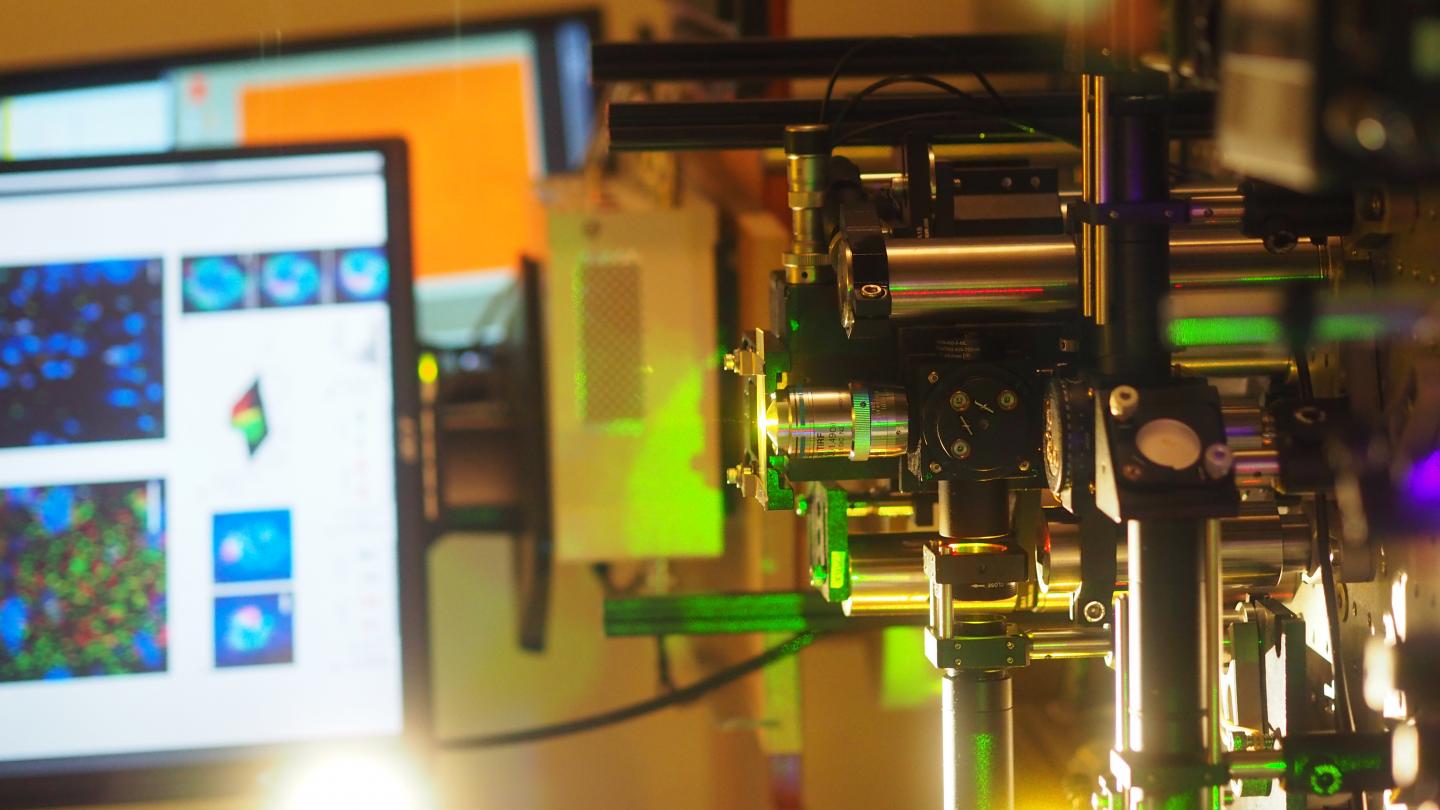
This optical super-resolution microscope patented by UBC allowed researchers to observe virus-like particles at higher resolutions than they could have just five years ago. Credit: Lou Corpuz-Bosshart / UBC

The deadly Nipah virus and others like it assemble themselves in a much more haphazard manner than previously thought, new UBC research has found. The discovery could allow scientists to develop more effective vaccines and rule out many approaches to fighting these viruses.

Chemistry professor Keng Chou and his team of researchers from UBC and Cornell University used a super-resolution microscope patented by UBC to observe whether viruses actually assemble in the way scientists have hypothesized.

“We looked at hundreds of images, and we couldn’t find anything that supported the current model,” said Chou. “For some of these deadly viruses, the replication process is actually not as complicated as some thought.”

Nipah is an example of an “enveloped” virus, which gets its outer wrapping from the infected host cell, much like the viruses that cause influenza, rabies, measles and AIDS. Nipah can cause severe diseases and fatal brain swelling in both humans and animals. Yearly outbreaks in southeast Asia kill 40 to 90 per cent of those infected. In 2018, only two out of 19 people infected by Nipah in India survived an outbreak.

Nipah virus has three structural proteins: a matrix protein that provides structure, and two envelope proteins that enable the virus to attach and fuse with host cells. Scientists have believed that matrix proteins “recruit” envelope proteins, sending out some sort of signal so they can all join together on the cell membrane and become a functional virus. Researchers have tried to identify this signal in hopes of finding ways to disrupt the process.

However, Chou and his team observed that envelope proteins tend to be scattered randomly on the cell membrane. They now believe these proteins are picked up purely by chance when they are incorporated into a virus. This produces virus particles more quickly than previously envisioned, but many matrix proteins don’t pick the envelope proteins up at all, and don’t become functional viruses.

This observation has implications for vaccination, not just against Nipah but potentially against influenza, HIV and other enveloped viruses. Vaccines work by exposing a person to a small amount of modified virus or viral proteins, which rallies the body’s natural defense. Currently, there is no Nipah vaccine approved for human use. One of the potential strategies under development is to use virus-like-particles, which are protein-based structures that mimic viruses, to stimulate immune response.

“If a vaccine contains a large percentage of virus-like particles that have only the matrix protein but not the envelope proteins, it won’t trigger a strong immune response to the proteins that are most essential for helping a virus enter cells,” said Qian Liu, a postdoctoral fellow in UBC’s chemistry department who was lead author of the study. “Vaccines could be made more effective if we find a way to exclude those non-functional particles from the mix.”
Related Articles Read More >

Alphabet-spinoff Isomorphic Labs raises $2.1 billion in quest to ‘solve all disease’ with AI-based drug discovery tools
We are still likely years away from a hantavirus vaccine
Study reveals fungal strains can survive sterilization procedures and Martian conditions
Trump administration canceled hantavirus research funding last year
rd newsletter
EXPAND YOUR KNOWLEDGE AND STAY CONNECTED
Get the latest info on technologies, trends, and strategies in Research & Development.

R&D World Digital Issues

Fall 2025 issue

Browse the most current issue of R&D World and back issues in an easy to use high quality format. Clip, share and download with the leading R&D magazine today.

R&D 100 Awards
Research & Development World
  • Subscribe to R&D World Magazine
  • Sign up for R&D World’s newsletter
  • Contact Us
  • About Us
  • Drug Discovery & Development
  • Pharmaceutical Processing
  • Global Funding Forecast

Copyright © 2026 WTWH Media LLC. All Rights Reserved. The material on this site may not be reproduced, distributed, transmitted, cached or otherwise used, except with the prior written permission of WTWH Media
Privacy Policy | Advertising | About Us

Search R&D World

  • R&D World Home
  • Topics
    • Aerospace
    • Automotive
    • Biotech
    • Careers
    • Chemistry
    • Environment
    • Energy
    • Life Science
    • Material Science
    • R&D Management
    • Physics
  • Technology
    • 3D Printing
    • A.I./Robotics
    • Software
    • Battery Technology
    • Controlled Environments
      • Cleanrooms
      • Graphene
      • Lasers
      • Regulations/Standards
      • Sensors
    • Imaging
    • Nanotechnology
    • Scientific Computing
      • Big Data
      • HPC/Supercomputing
      • Informatics
      • Security
    • Semiconductors
  • R&D Market Pulse
  • R&D 100
    • 2025 R&D 100 Award Winners
    • 2025 Professional Award Winners
    • 2025 Special Recognition Winners
    • R&D 100 Awards Event
    • R&D 100 Submissions
    • Winner Archive
  • Resources
    • Research Reports
    • Digital Issues
    • Educational Assets
    • Subscribe
    • Video
    • Webinars
    • Content submission guidelines for R&D World
  • Global Funding Forecast
  • Top Labs
  • Advertise
  • SUBSCRIBE