Research & Development World

  • R&D World Home
  • Topics
    • Aerospace
    • Automotive
    • Biotech
    • Careers
    • Chemistry
    • Environment
    • Energy
    • Life Science
    • Material Science
    • R&D Management
    • Physics
  • Technology
    • 3D Printing
    • A.I./Robotics
    • Software
    • Battery Technology
    • Controlled Environments
      • Cleanrooms
      • Graphene
      • Lasers
      • Regulations/Standards
      • Sensors
    • Imaging
    • Nanotechnology
    • Scientific Computing
      • Big Data
      • HPC/Supercomputing
      • Informatics
      • Security
    • Semiconductors
  • R&D Market Pulse
  • R&D 100
    • 2026 R&D 100 Award Winners
    • 2026 Professional Award Winners
    • 2026 Special Recognition Winners
    • R&D 100 Awards Event
    • R&D 100 Submissions
    • Winner Archive
  • Resources
    • Research Reports
    • Digital Issues
    • Educational Assets
    • Subscribe
    • Video
    • Webinars
    • PharmSci360
    • Content submission guidelines for R&D World
  • Global Funding Forecast
  • Top Labs
  • Advertise
  • SUBSCRIBE

SwRI researchers test natural gas foam’s ability to reduce water use in fracking

By Heather Hall | March 2, 2021


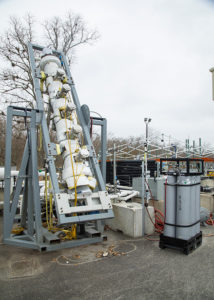
Southwest Research Institute has completed a pilot-scale facility to create and test natural gas foam as a safe and stable alternative to water for hydraulic fracturing, commonly known as “fracking.” Credit: SwRI

Southwest Research Institute has completed a pilot-scale facility to create and test natural gas foam as a safe and stable alternative to water for hydraulic fracturing, commonly known as “fracking.” The six-year project is part of an effort to show that stable natural gas foam can be generated on-site at fracking locations using commercially available products.

Fracking involves injecting high-pressure fluids into wells thousands of feet deep to fracture rock formations and stimulate the flow of oil and natural gas. This process typically requires millions of gallons of water to inject sand and chemicals into these fractures to enhance production.

“Fracking doesn’t always occur near water resources, so the water has to be trucked in,” said Griffin Beck, the project’s principal investigator. “That process is time consuming and can wreak havoc on local roads and related transportation infrastructures, not to mention the tens of millions of gallons of water consumed by the fracking process.”

In 2014, Beck and his SwRI colleagues began exploring natural gas foam as an alternative to water. Natural gas, they noted, is abundant in areas where fracking occurs and is often discarded through burning, which produces harmful carbon emissions. Additionally, pumping pressurized water can cause a hindrance in many reservoir types, especially clay, which swells in contact with water and prevents oil from escaping.

First, the SwRI team determined the most efficient way to create the natural gas foam was to use standard compressors to pressurize the natural gas, and then mix it with water to create the natural gas foam.

“The foam is created by jetting the natural gas stream into the pressurized water,” Beck said. “The process utilizes up to 80% less water than typical fracking treatments.”

The team then created a test facility to investigate the properties of the natural gas foam, demonstrating that it could be created on-site as an additional step to the fracking process. Beck and his colleagues created a foam generation apparatus capable of supplying high-pressure foam to a fracture test stand.

Beck found that the foam’s viscosity allowed it to carry sand particles into fractures as efficiently as pressurized water. Additionally, he found that the foam’s properties produced less swelling in clay environments and possibly even increased production rates. Currently only a fraction of the petroleum in most reservoirs can be extracted.

“We created a reservoir model to test the foam’s efficiency,” Beck said. “We compared production to a reservoir treated with water and with natural gas foam. The model showed a 25% improvement in cumulative oil production.”

Beck hopes to eventually see the foam tested in the field. The project is scheduled to complete in March 2021, with $2.67 million in funding from the U.S. Department of Energy.

For more information, visit swri.org/industry/fluids-engineering/foam-research-facility.
 

Related Articles Read More >

The Space Systems Division (05)-developed Parallelogram Synchronized Truss Assembly (PaSTA), seen Aug. 12, 2025, is a mechanism that will be integrated into the Life-Extension In-orbit Servicer (LEXI) and Astroscale Prototype Servicer for Refueling (APS-R) spacecrafts.
One SwRI R&D 100 winner turns buckled fiberglass into a spacecraft truss. The other models freight rail with 900 hours of BNSF field data
Inside the Lab: NETL’s Oil and Gas Center of Excellence focuses on technologies to enhance production   
Inside S&C Electric’s and Argonne National Lab’s CRADA partnership
As U.S. power demand surges, Brookhaven taps AWS in aim to drive 20-100x faster power grid decision-making with GridSearch AI
rd newsletter
EXPAND YOUR KNOWLEDGE AND STAY CONNECTED
Get the latest info on technologies, trends, and strategies in Research & Development.

R&D World Digital Issues

Fall 2025 issue

Browse the most current issue of R&D World and back issues in an easy to use high quality format. Clip, share and download with the leading R&D magazine today.

R&D 100 Awards
Research & Development World
  • Subscribe to R&D World Magazine
  • Sign up for R&D World’s newsletter
  • Contact Us
  • About Us
  • Drug Discovery & Development
  • Pharmaceutical Processing
  • Global Funding Forecast

Copyright © 2026 Arrowfly LLC. All Rights Reserved. The material on this site may not be reproduced, distributed, transmitted, cached or otherwise used, except with the prior written permission of Arrowfly
Privacy Policy | Advertising | About Us

Search R&D World

  • R&D World Home
  • Topics
    • Aerospace
    • Automotive
    • Biotech
    • Careers
    • Chemistry
    • Environment
    • Energy
    • Life Science
    • Material Science
    • R&D Management
    • Physics
  • Technology
    • 3D Printing
    • A.I./Robotics
    • Software
    • Battery Technology
    • Controlled Environments
      • Cleanrooms
      • Graphene
      • Lasers
      • Regulations/Standards
      • Sensors
    • Imaging
    • Nanotechnology
    • Scientific Computing
      • Big Data
      • HPC/Supercomputing
      • Informatics
      • Security
    • Semiconductors
  • R&D Market Pulse
  • R&D 100
    • 2026 R&D 100 Award Winners
    • 2026 Professional Award Winners
    • 2026 Special Recognition Winners
    • R&D 100 Awards Event
    • R&D 100 Submissions
    • Winner Archive
  • Resources
    • Research Reports
    • Digital Issues
    • Educational Assets
    • Subscribe
    • Video
    • Webinars
    • PharmSci360
    • Content submission guidelines for R&D World
  • Global Funding Forecast
  • Top Labs
  • Advertise
  • SUBSCRIBE