By Anne Trafton | MIT News Office
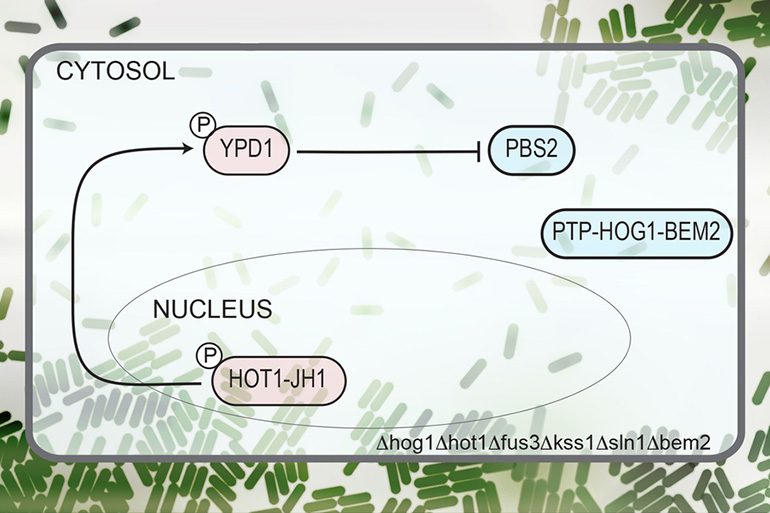
A new type of synthetic biology circuit can be turned on within seconds, much faster than its counterparts. Credits: Image: Courtesy of the researchers, edited by MIT News
Synthetic biology offers a way to engineer cells to perform novel functions, such as glowing with fluorescent light when they detect a certain chemical. Usually, this is done by altering cells so they express genes that can be triggered by a certain input.
However, there is often a long lag time between an event such as detecting a molecule and the resulting output, because of the time required for cells to transcribe and translate the necessary genes. MIT synthetic biologists have now developed an alternative approach to designing such circuits, which relies exclusively on fast, reversible protein-protein interactions. This means that there’s no waiting for genes to be transcribed or translated into proteins, so circuits can be turned on much faster — within seconds.
“We now have a methodology for designing protein interactions that occur at a very fast timescale, which no one has been able to develop systematically. We’re getting to the point of being able to engineer any function at timescales of a few seconds or less,” says Deepak Mishra, a research associate in MIT’s Department of Biological Engineering and the lead author of the new study.
This kind of circuit could be useful for creating environmental sensors or diagnostics that could reveal disease states or imminent events such as a heart attack, the researchers say.
Ron Weiss, a professor of biological engineering and of electrical engineering and computer science, is the senior author of the study, which appears today in Science. Other authors include Tristan Bepler, a former MIT postdoc; Bonnie Berger, the Simons Professor of Mathematics and head of the Computation and Biology group in MIT’s Computer Science and Artificial Intelligence Laboratory; Brian Teague, an assistant professor at the University of Wisconsin; and Jim Broach, chair of the Department of Biochemistry and Molecular Biology at Penn State Hershey Medical Center.
Protein interactions
Inside living cells, protein-protein interactions are essential steps in many signaling pathways, including those involved in immune cell activation and responses to hormones or other signals. Many of these interactions involve one protein activating or deactivating another by adding or removing chemical groups called phosphates.
In this study, the researchers used yeast cells to host their circuit and created a network of 14 proteins from species including yeast, bacteria, plants, and humans. The researchers modified these proteins so they could regulate each other in the network to yield a signal in response to a particular event.
Their network, the first synthetic circuit to consist solely of phosphorylation / dephosphorylation protein-protein interactions, is designed as a toggle switch — a circuit that can quickly and reversibly switch between two stable states, allowing it to “remember” a specific event such as exposure to a certain chemical. In this case, the target is sorbitol, a sugar alcohol found in many fruits.
Once sorbitol is detected, the cell stores a memory of the exposure, in the form of a fluorescent protein localized in the nucleus. This memory is also passed on to future cell generations. The circuit can also be reset by exposing it to a different molecule, in this case, a chemical called isopentenyl adenine.
These networks can also be programmed to perform other functions in response to an input. To demonstrate this, the researchers also designed a circuit that shuts down cells’ ability to divide after sorbitol is detected.
By using large arrays of these cells, the researchers can create ultrasensitive sensors that respond to concentrations of the target molecule as low as parts per billion. And because of the fast protein-protein interactions, the signal can be triggered in as little as one second. With traditional synthetic circuits, it could take hours or even days to see the output.
“That switch to extremely fast speeds is going to be really important moving forward in synthetic biology and expanding the type of applications that are possible,” said Weiss.
Complicated networks
The toggle network that the researchers designed in this study is larger and more complex than most synthetic circuits that have been previously designed. Once they built it, the researchers wondered if any similar networks might exist in living cells. Using a computational model that they designed, they discovered six naturally occurring, complicated toggle networks in yeast that had never been seen before.
“We wouldn’t think to look for those because they’re not intuitive. They’re not necessarily optimal or elegant, but we did find multiple examples of such toggle switch behaviors,” Weiss says. “This is a new, engineered-inspired approach to discovering regulatory networks in biological systems.”
The researchers now hope to use their protein-based circuits to develop sensors that could be used to detect environmental pollutants. Another potential application is deploying custom protein networks within mammalian cells that could act as diagnostic sensors within the human body to detect abnormal hormone or blood sugar levels. In the longer term, Weiss envisions designing circuits that could be programmed into human cells to report drug overdoses or an imminent heart attack.
“You could have a situation where the cell reports that information to an electronic device that would alert the patient or the doctor, and the electronic device could also have reservoirs of chemicals that could counteract a shock to the system,” he said.
The research was funded by the Siebel Scholars Award, an Eni-MIT Energy Research Fellowship, the National Science Foundation Graduate Research Fellowship Program, the Institute for Collaborative Biotechnologies through the U.S. Army Research Office, a SynBERC grant from the National Science Foundation, and the Center for Integrated Synthetic Biology through the National Institutes of Health.