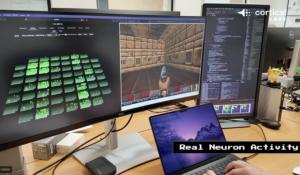
 When Cortical Labs posted a video this week showing living human neurons playing the 1993 shooter Doom, the internet did what the internet does. It memed it. But buried in the GitHub repository that accompanied the demo is a README file more revealing than the video itself. In it, independent researcher Sean Cole documents a system where the biological layer might not be doing what the headlines suggest. His decoder, he writes, “tends to start becoming a policy head,” meaning the conventional software may be learning to route around the neurons entirely. He built in ablation modes so others can test whether the cells matter at all. It is, by any measure, an honest piece of documentation for a demo that is making the rounds as a stunt.
Cole’s own CL1-side code is clear about the split. The program “runs on the CL1 device and acts as a neural hardware interface,” receiving stimulation commands over UDP, applying them to the neurons, then shipping spike counts back to a separate training system. “The CL1 device performs NO computation,” the docstring says, with the PyTorch models and game logic living elsewhere.
The official Cortical Labs video leans into this architectural split as a triumph. In the demo, Dr. Alon Loeffler acknowledges that the 200,000 human neurons currently play “a lot like a beginner” and die frequently, while emphasizing that the team has “solved the interface problem.” Their API translates the 3D chaos of Doom into patterns of electrical stimulation, a functional bridge between the game engine and living wetware. Loeffler’s pitch ends with an optimistic call to the community to develop “better learning, better encoding, better rewards, better feedback.” Cole’s repository shows what that work actually looks like: an ongoing fight to keep his digital translator from simply taking over and beating the game on its own.
The neurons serve as a biological filter: the training system translates screen pixels and ray-cast distances into electrical zaps, the living cells fire spikes, and those counts feed straight into a PyTorch decoder that maps them to Doom actions. The PPO agent, CNN encoder and entire reward loop run on ordinary silicon elsewhere. Cole’s ablation modes make the split testable, set decoder output to random or zero and the game still plays. The CL1 hardware interface works exactly as advertised. What remains unproven is whether 200,000 human neurons can ever carry the policy instead of just riding along.