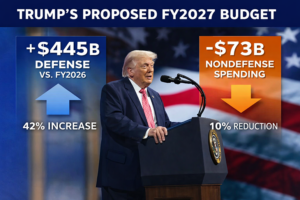
 The White House just proposed what the Committee for a Responsible Federal Budget calls the largest year-over-year defense spending increase likely since World War II: $1.5 trillion in total budgetary resources, a $445 billion (42%) increase from FY2026. Of that, $350 billion would bypass the Senate’s 60-vote threshold entirely, routed through budget reconciliation as mandatory spending.
$17.5 billion for a missile defense shield called Golden Dome, $17.1 billion of it contingent on reconciliation passing. $65.8 billion for warships. $1.2 billion for AI supercomputers at Argonne and Oak Ridge.
The other side of the ledger: NIH cut $5 billion, to roughly $41 billion. Advanced Research Projects Agency for Health (ARPA-H) would be cut from $1.5 billion to $945 million. Three institutes eliminated outright: National Institute on Minority Health and Health Disparities (NIMHD), the Fogarty International Center (FIC) (international research partnerships) and National Center for Complementary and Integrative Health (NCCIH).
In addition, NSF would be cut 55%, from $8.8 billion to $4 billion, its entire Social, Behavioral and Economic Sciences directorate dissolved.
While Congress rejected nearly identical cuts last year, those writing grant proposals can see that framing around national security, AI, energy dominance, or critical minerals have White House support. The one bright spot for research agencies is the Department of Energy, which gets a $4.8 billion (10%) increase to $53.9 billion, with AI and nuclear security as the favored children.
Research that gets funded or protected:
All of it is applied, defense-adjacent or energy/minerals-focused. Nuclear weapons design (NNSA, up 12%). Defense R&D ($220B in the base budget alone, per Breaking Defense). AI and high-performance computing at national labs. Quantum information science. Fusion energy. Critical minerals processing. Space-based missile defense sensors. Lunar landing systems. Combat medicine. Energy-water security. The one “biotechnology” mention in the entire budget is about AI-enabled earth-energy modeling at DOE, not therapeutics.
Research that gets cut:
Essentially all civilian basic and biomedical science. NIH ($5B cut). ARPA-H ($555M cut). NSF (55% cut, $4.8B). NASA Science ($3.4B cut, 40+ missions killed). NOAA research ($1.6B cut). NIST ($993M cut). AHRQ ($129M cut). EPA R&D slashed to $277M. USDA university grants ($510M cut). DOE Office of Science ($1.1B cut, though AI/quantum/fusion are protected within that envelope). And a government-wide ban on paying for journal subscriptions or publication fees.
The full proposal is titled Budget of the U.S. Government | Office of Management and Budget Fiscal Year 2027.