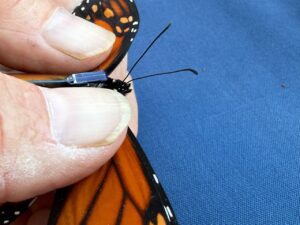
A transmitter on a monarch at the Cape May Arts & Science Center as shown on Monarch Joint Venture.
Cellular Tracking Technologies (CTT) engineers have developed a transmitter light enough to track a monarch butterfly from New Jersey, where the company is based, to Mexico, where the butterflies spend the winter.
For decades, the 5% body-mass rule made it nearly impossible to make a tracker light enough for a butterfly. Monarch butterflies weigh about 500 mg, which means the tracker would need to be 25 mg based on a common rule-of-thumb threshold.
Engineers at CTT were able to make a tracker that weighs 60 mg, approximately 12% of a butterfly’s weight, finding that exceeding the 5% rule did not interfere with butterfly flight.
The solar-powered transmitter operates at Bluetooth frequency, allowing smartphones to become receivers, which enabled the first high-resolution track of monarch migration ever recorded, according to CTT. The butterfly, named Lionel, was detected hundreds of times on its way to Florida.
The project serves as a successful proof-of-concept for extreme miniaturization and distributed, crowd-sourced sensing networks.
Solving the weight challenge
Scientists have been fascinated by monarchs’ migration for decades, but tracking the butterflies without disrupting their flight is nearly impossible. In 2015, a naturalist, Mark Garland from NJ Audubon’s Monarch Monitoring Project, brought the challenge to CTT.
It took the company two years to develop a proof of concept, but the device was still too heavy at 150 mg. To make the transmitter light enough, CTT had to eliminate the battery, which accounted for most of the device’s weight.
In 2021, the company had a breakthrough when engineer Eric Johnson identified a new ultra-low-power chipset that could handle data without traditional processors. However, commercial components were still too heavy.

Tagged Monarch image courtesy of Sheldon Blackshire.
CTT shifted to in-house manufacturing, allowing the company to use custom surface-mount technology (SMT) techniques. By integrating a solar panel the size of a grain of rice with the circuitry, the engineers minimized the PCB substrate weight and achieved the 60 mg weight.
This still did not follow the 5% rule, but initial flights proved the device did not interfere with flight. Lee Brown, a biology professor at James Madison University, and her team found that the BluMorpho tags have minimal impact on monarch movement. The engineers took a risk with their device, and it paid off.
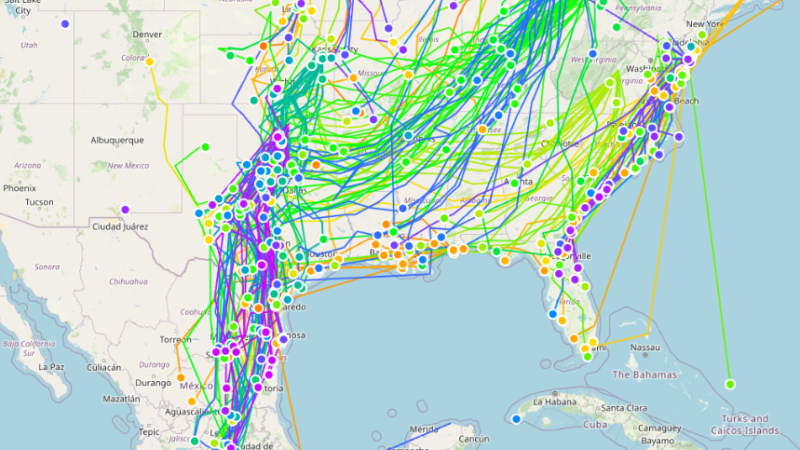
A Monarch butterfly migration map as shown on Monarch Joint Venture
Solely solar power
The transmitters operate without a battery, so they are light enough to be carried by the butterflies, but this also means that the device cannot store energy, leaving it at the mercy of available sunlight.
The tag can transmit signals as fast as 1Hz, or one per second, in full sunlight. However, the device needed to work in shade and cloudy conditions. Using the 2.4 GHz Bluetooth frequency allows for shorter bursts of signals, which are more energy efficient than lower frequencies. This approach reduces the time the system has to hold a charge, making it viable for the battery-less transmitter.
Validating in the real world
The transmitters were deployed in 2023, along with the Project Monarch App, which allows any smartphone to become a receiver. Thus, Project Monarch was born. The tags continued to be deployed in 2024, the year that Lionel embarked on its groundbreaking flight.
“Lionel’s track was a pivotal moment for us,” said Sean Burcher, senior R&D scientist at CTT and science director at CMPASC. “With hundreds of millions of devices all acting as passive receivers, we were able to watch the fine-scale movements of Lionel in near-real time.”
Other applications
The success of the app turned hundreds of thousands of smartphones into passive receivers. CTT built a game within the app, allowing users to collect points for collecting data, encouraging them to keep the app running in the background. This proves the potential of crowdsourced data from smartphones via Bluetooth connection, which could be used for scientific and industrial monitoring.
The BluMorpho trackers are an impressive feat of research and development. The Monarch Project also offers a blueprint for tracking other pollinators, such as bees, or non-biological applications, such as micro-drones or floating sensors used to monitor air and water quality. The tags could be used to manage sub-gram inventory, tracking individual components and valuable parts.