Research & Development World

  • R&D World Home
  • Topics
    • Aerospace
    • Automotive
    • Biotech
    • Careers
    • Chemistry
    • Environment
    • Energy
    • Life Science
    • Material Science
    • R&D Management
    • Physics
  • Technology
    • 3D Printing
    • A.I./Robotics
    • Software
    • Battery Technology
    • Controlled Environments
      • Cleanrooms
      • Graphene
      • Lasers
      • Regulations/Standards
      • Sensors
    • Imaging
    • Nanotechnology
    • Scientific Computing
      • Big Data
      • HPC/Supercomputing
      • Informatics
      • Security
    • Semiconductors
  • R&D Market Pulse
  • R&D 100
    • 2026 R&D 100 Award Winners
    • 2026 Professional Award Winners
    • 2026 Special Recognition Winners
    • R&D 100 Awards Event
    • R&D 100 Submissions
    • Winner Archive
  • Resources
    • Research Reports
    • Digital Issues
    • Educational Assets
    • Subscribe
    • Video
    • Webinars
    • PharmSci360
    • Content submission guidelines for R&D World
  • Global Funding Forecast
  • Top Labs
  • Advertise
  • SUBSCRIBE

Ultra-Precise Chip-Scale Sensor Finds Nanoscale Changes

By The Hebrew University Of Jerusalem | January 23, 2017

The Hebrew University is a leader in research and development at the nanoscale. Image: Patricia Alvarado Núñez – graziosopictures.com

Chip scale high precision measurements of physical quantities such as temperature, pressure and refractive index have become common with nanophotonics and nanoplasmonics resonance cavities. As excellent transducers to convert small variations in the local refractive index into measurable spectral shifts, resonance cavities are being used extensively in a variety of disciplines ranging from bio-sensing and pressure gauges to atomic and molecular spectroscopy. Chip-scale microring and microdisk resonators (MRRs) are widely used for these purposes owing to their miniaturized size, relative ease of design and fabrication, high quality factor, and versatility in the optimization of their transfer function.

The principle of operation of such resonative sensors is based on monitoring the spectrum dependence of the resonator subject to minute variation in its surrounding (e.g., different types of atoms and molecules, gases, pressure, temperature).  Yet despite several important accomplishments, such optical sensors are still limited in their performances, and their miniaturization is highly challenging.

Now, a team from the Hebrew University of Jerusalem has demonstrated an on-chip sensor capable of detecting unprecedentedly small frequency changes. The approach consists of two cascaded microring resonators, with one serving as the sensing device and the other playing the role of a reference — thus eliminating environmental and system fluctuations such as temperature and laser frequency.

“Here we demonstrate a record-high sensing precision on a device with a small footprint that can be integrated with standard CMOS technology, paving the way for even more exciting measurements such as single particle detection and high precision chip scale thermometry,” says Professor Uriel Levy, Director of the Harvey M. Krueger Family Center for Nanoscience and Nanotechnology at the Hebrew University of Jerusalem, and a faculty member at the Department of Applied Physics in the Rachel and Selim Benin School of Computer Science and Engineering.

Among the innovations that made this development possible are chip scale integration of reference measurement, and a servo-loop locking scheme that translates the measured effects from the optical domain to the radio frequency domain. These enabled the researchers to quantify their system capabilities using well-established RF technologies, such as frequency counters, spectrum analyzers, and atomic standards.

The research appears in the peer-reviewed journal Optica, published by The Optical Society. The MRRs were fabricated at the Hebrew University’s Center for Nanoscience and Nanotechnology.

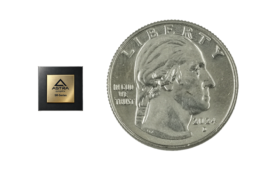
Source: The Hebrew University of Jerusalem

Related Articles Read More >

Illustration of an antiferromagnetic tunnel junction pillar beside the two spin configurations of platinum-manganese that store a bit.
Northwestern and Western Digital demonstrate a new way to write magnetic memory
Google teases Synaptics edge AI chip ahead of Oct. 20 launch
Materials startup Thintronics takes aim at Ajinomoto’s chip packaging film, with surging AI demand widening the opening
OpenAI and Synopsys plan a specialized model for chip design
rd newsletter
EXPAND YOUR KNOWLEDGE AND STAY CONNECTED
Get the latest info on technologies, trends, and strategies in Research & Development.

R&D World Digital Issues

Fall 2025 issue

Browse the most current issue of R&D World and back issues in an easy to use high quality format. Clip, share and download with the leading R&D magazine today.

R&D 100 Awards
Research & Development World
  • Subscribe to R&D World Magazine
  • Sign up for R&D World’s newsletter
  • Contact Us
  • About Us
  • Drug Discovery & Development
  • Pharmaceutical Processing
  • Global Funding Forecast

Copyright © 2026 Arrowfly LLC. All Rights Reserved. The material on this site may not be reproduced, distributed, transmitted, cached or otherwise used, except with the prior written permission of Arrowfly
Privacy Policy | Advertising | About Us

Search R&D World

  • R&D World Home
  • Topics
    • Aerospace
    • Automotive
    • Biotech
    • Careers
    • Chemistry
    • Environment
    • Energy
    • Life Science
    • Material Science
    • R&D Management
    • Physics
  • Technology
    • 3D Printing
    • A.I./Robotics
    • Software
    • Battery Technology
    • Controlled Environments
      • Cleanrooms
      • Graphene
      • Lasers
      • Regulations/Standards
      • Sensors
    • Imaging
    • Nanotechnology
    • Scientific Computing
      • Big Data
      • HPC/Supercomputing
      • Informatics
      • Security
    • Semiconductors
  • R&D Market Pulse
  • R&D 100
    • 2026 R&D 100 Award Winners
    • 2026 Professional Award Winners
    • 2026 Special Recognition Winners
    • R&D 100 Awards Event
    • R&D 100 Submissions
    • Winner Archive
  • Resources
    • Research Reports
    • Digital Issues
    • Educational Assets
    • Subscribe
    • Video
    • Webinars
    • PharmSci360
    • Content submission guidelines for R&D World
  • Global Funding Forecast
  • Top Labs
  • Advertise
  • SUBSCRIBE