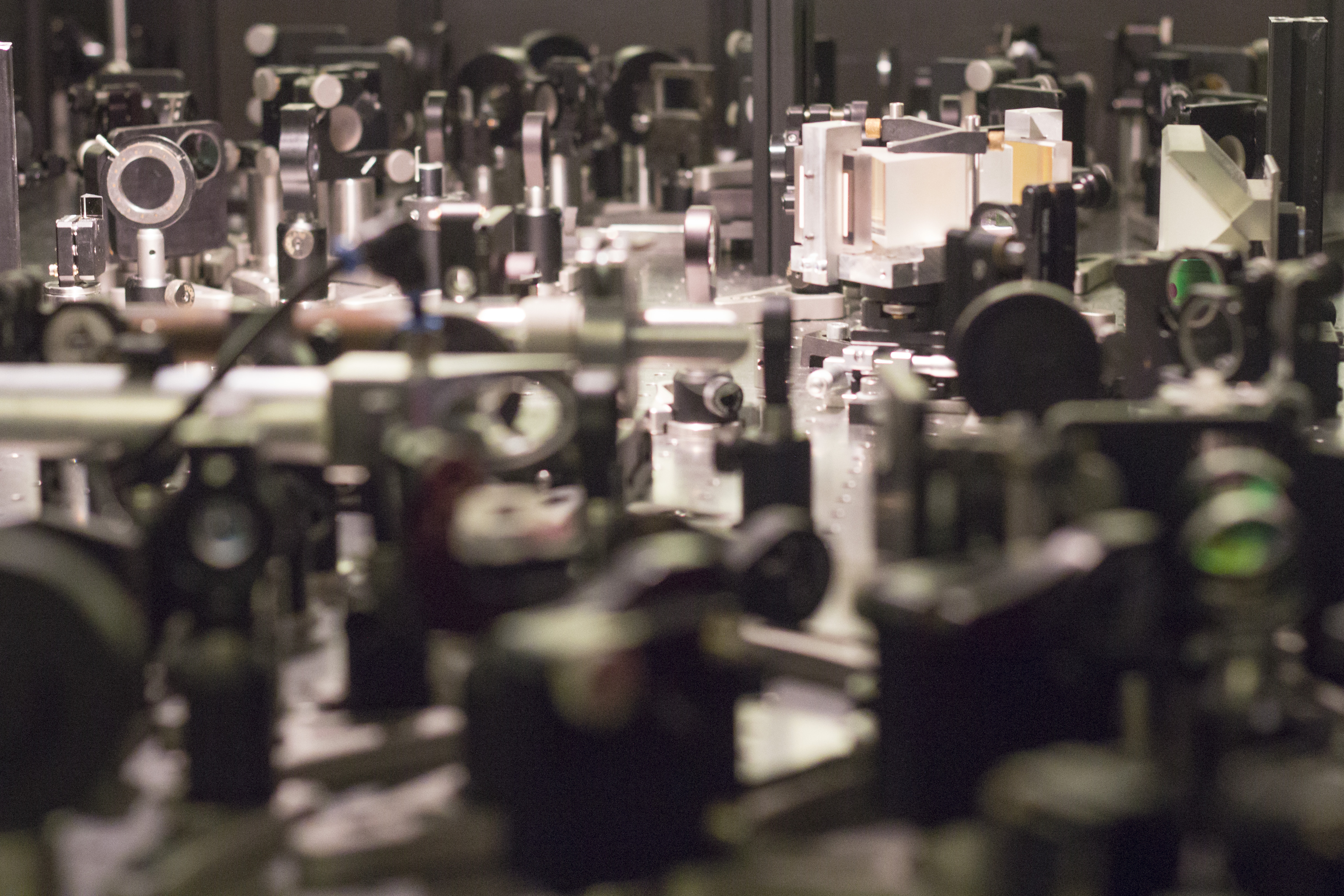
Optical table at the Photonics Institute, TU Wien.
It is a very unusual kind of laser: researchers at the photonics institute at Technische Universität Wien (TU Wien) have built a device which emits ultrashort flashes of infrared light with extremely high energy. “It is very hard to combine these three properties — long infrared wavelength, short duration and high energy,” says Valentina Shumakova. “But this combination is exactly what we need for many interesting strong-field applications.”
Now the team has achieved a major breakthrough: By sending very energetic pulses in the infrared regime through a solid medium, the pulses can be compressed in time and space. The energy stays roughly the same, but it can now be deposited in an even shorter period of time, resulting in an incredible peak power of up to half a terawatt. This power corresponds to the output of hundreds of nuclear reactors. But unlike power plants, which produce the power steadily, the compressed laser pulse only lasts 30 femtoseconds (millionths of a billionth of a second). The new results have now been published in the journal Nature Communications.
“Under certain conditions, laser pulses can self-compress and become shorter. This is a well-known phenomenon in laser science,” says Audrius Pugzlys. “But until now, people used to believe that self-compression in solid media at extremely high intensities is impossible.”
Unlike the light of a simple laser pointer, an ultrashort laser pulse does not only have one specific color. It is a mixture of a spectrum of different wavelengths — in this case, centered around 3.9 micrometers, in the long infrared region, invisible to the human eye.
In vacuum, light always travels at the same speed, regardless of its wavelength. But this is not the case for light traversing a solid material. “The material causes some components of the laser pulse to move faster than others. If this effect is cleverly used, the laser pulse is compressed, it becomes shorter just by travelling through the material,” says Skirmantas Alisauskas.
This technique, however, is not always applicable. “If a pulsed laser beam of very high intensities is sent through a material, the beams tends to collapse chaotically into many separate filaments,” says Pugzlys. “It is like a bolt of lightning that spontaneously breaks up into various branches.” Each of the branches only carries a small part of the energy of the original beam, the resulting laser beam cannot be used for advanced strong-field laser experiments any more.
The Viennese research group, in collaboration with researchers from Moscow State University, has now identified conditions which lead to self-compression and an extremely high peak power without causing the beam to collapse into filaments. “As it turns out, we are dealing with two different length scales”, says Shumakova. “The length scale of the unwanted filamentation is longer than the length on which self-compression occurs. Therefore, it is possible to find a parameter regime in which the pulse is compressed but filamentation does not yet set in.” The power of the lase pulse is 10,000 times higher than the filamentation threshold — and still it does not collapse.
The team used an Yttrium aluminum garnet (YAG) crystal with a width of only a few millimeters — and the results are remarkable: By sending the laser pulse through the crystal, its duration decreases from 94 femtoseconds to a mere 30 femtoseconds. Its energy stays almost the same, and the power (energy per time) increases by a factor three, to almost half a terawatt. “As the pulse is very short, its extremely high power opens the door to many exciting experiments and maybe even to new technologies in laser science,” says Pugzlys.
Source: Technische Universität Wien