Research & Development World

  • R&D World Home
  • Topics
    • Aerospace
    • Automotive
    • Biotech
    • Careers
    • Chemistry
    • Environment
    • Energy
    • Life Science
    • Material Science
    • R&D Management
    • Physics
  • Technology
    • 3D Printing
    • A.I./Robotics
    • Software
    • Battery Technology
    • Controlled Environments
      • Cleanrooms
      • Graphene
      • Lasers
      • Regulations/Standards
      • Sensors
    • Imaging
    • Nanotechnology
    • Scientific Computing
      • Big Data
      • HPC/Supercomputing
      • Informatics
      • Security
    • Semiconductors
  • R&D Market Pulse
  • R&D 100
    • 2025 R&D 100 Award Winners
    • 2025 Professional Award Winners
    • 2025 Special Recognition Winners
    • R&D 100 Awards Event
    • R&D 100 Submissions
    • Winner Archive
  • Resources
    • Research Reports
    • Digital Issues
    • Educational Assets
    • R&D Index
    • Subscribe
    • Video
    • Webinars
    • Content submission guidelines for R&D World
  • Global Funding Forecast
  • Top Labs
  • Advertise
  • SUBSCRIBE

Unveiling the structure of a photosynthetic catalyst that turns light into hydrogen fuel

By R&D Editors | December 12, 2024

Argonne National Laboratory and Yale University researchers have used cryo-electron microscopy (cryo-EM) to obtain a high-resolution structural view of a photosystem I (PSI)-platinum nanoparticle biohybrid catalyst. This finding provides critical insights into the design of efficient systems for solar-driven hydrogen production.

Background and context
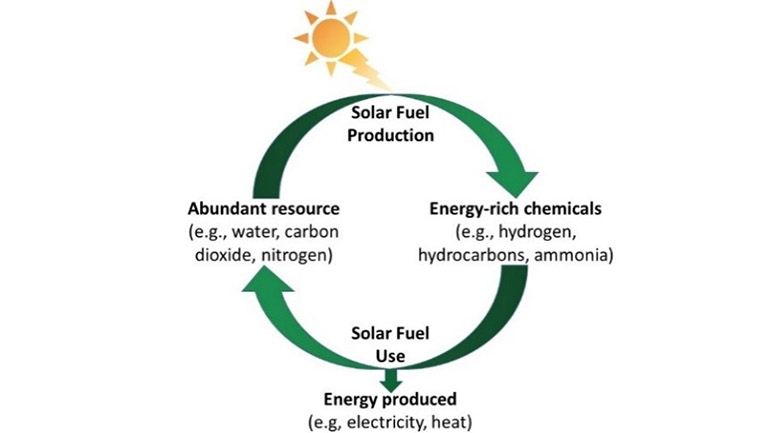
Image courtesy of the Department of Energy Office of Science

Photosystem I (PSI) is a protein complex integral to the photosynthetic process, which converts sunlight into chemical energy. PSI exhibits near-unity quantum efficiency, generating one electron for nearly every photon absorbed. This characteristic makes it a good candidate for integrating into biohybrid systems for sustainable energy production.

Platinum nanoparticles, known for their catalytic properties, facilitate the reduction of protons to produce hydrogen gas. By combining PSI with platinum nanoparticles, researchers have created a biohybrid catalyst where the light absorbed by PSI drives the catalytic production of hydrogen.

High-resolution structural determination

Previous studies have demonstrated the functionality of PSI-platinum biohybrids. Still, the precise binding sites of the platinum nanoparticles on PSI remained unknown. Using cryo-EM, the research team identified two distinct binding sites for the nanoparticles on the PSI protein complex. This finding contradicts earlier assumptions that nanoparticle attachment occurs exclusively at electron transfer partner sites.

Implications for catalyst optimization

Identifying multiple binding sites provides a foundation for the rational design and optimization of biohybrid catalysts. Researchers can enhance the system’s catalytic efficiency by engineering specific interactions between PSI and platinum nanoparticles. Strategies may include modifying the PSI protein or nanoparticle properties to improve electron transfer and hydrogen production rates.

Research contributions and methodology

The structural characterization represents the culmination of 13 years of research. In earlier work, the team successfully demonstrated hydrogen production using PSI-based systems. The current study leverages cryo-EM to achieve sub-nanometer resolution of the biohybrid complex, enabling precise mapping of protein-nanoparticle interactions.

The research team includes Lisa M. Utschig, Christopher J. Gisriel, Tirupathi Malavath, Tianyin Qiu, Jan Paul Menzel, Victor S. Batista, and Gary W. Brudvig. The U.S. Department of Energy’s Office of Basic Energy Sciences and the National Institute of General Medical Sciences of the National Institutes of Health provided funding for this work.

Conclusion and future directions

The elucidation of PSI-platinum nanoparticle binding sites offers a pathway for engineering advanced biohybrid systems with improved functionality. Further research will focus on optimizing protein-nanoparticle interactions and scaling up these systems for practical applications in hydrogen fuel production.

The findings were published in Nature Communications.

Related Articles Read More >

R&D 100 Winner Spotlight: Energy storing and efficient air conditioner (ESEAC)
R&D 100 Spotlight: Universal GridEdge Analyzer (UGA)
Engineered enzymes turn industrial pollutant Into pharmaceutical building block
How X-ray absorption spectroscopy is making hydrogen fuel more efficient
rd newsletter
EXPAND YOUR KNOWLEDGE AND STAY CONNECTED
Get the latest info on technologies, trends, and strategies in Research & Development.
RD 25 Power Index

R&D World Digital Issues

Fall 2025 issue

Browse the most current issue of R&D World and back issues in an easy to use high quality format. Clip, share and download with the leading R&D magazine today.

R&D 100 Awards
Research & Development World
  • Subscribe to R&D World Magazine
  • Sign up for R&D World’s newsletter
  • Contact Us
  • About Us
  • Drug Discovery & Development
  • Pharmaceutical Processing
  • Global Funding Forecast

Copyright © 2026 WTWH Media LLC. All Rights Reserved. The material on this site may not be reproduced, distributed, transmitted, cached or otherwise used, except with the prior written permission of WTWH Media
Privacy Policy | Advertising | About Us

Search R&D World

  • R&D World Home
  • Topics
    • Aerospace
    • Automotive
    • Biotech
    • Careers
    • Chemistry
    • Environment
    • Energy
    • Life Science
    • Material Science
    • R&D Management
    • Physics
  • Technology
    • 3D Printing
    • A.I./Robotics
    • Software
    • Battery Technology
    • Controlled Environments
      • Cleanrooms
      • Graphene
      • Lasers
      • Regulations/Standards
      • Sensors
    • Imaging
    • Nanotechnology
    • Scientific Computing
      • Big Data
      • HPC/Supercomputing
      • Informatics
      • Security
    • Semiconductors
  • R&D Market Pulse
  • R&D 100
    • 2025 R&D 100 Award Winners
    • 2025 Professional Award Winners
    • 2025 Special Recognition Winners
    • R&D 100 Awards Event
    • R&D 100 Submissions
    • Winner Archive
  • Resources
    • Research Reports
    • Digital Issues
    • Educational Assets
    • R&D Index
    • Subscribe
    • Video
    • Webinars
    • Content submission guidelines for R&D World
  • Global Funding Forecast
  • Top Labs
  • Advertise
  • SUBSCRIBE