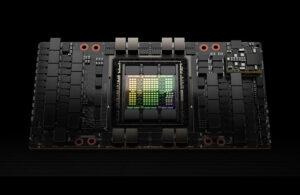
An H100 GPU. Image from NVIDIA.
Verily, a Dallas-based Alphabet subsidiary that Alphabet is preparing to spin off or sell, announced Tuesday it is integrating NVIDIA’s AI software stack into Pre platform, its platform for analyzing health data. Specifically, NVIDIA NeMo, Parabricks and CUDA-X Data Science are now available as pre-configured applications within Verily Workbench, the company’s trusted research environment (TRE), a type of secure cloud platform that allows researchers to collaborate and jointly analyze data.
Pre consists of three products: Refinery, which ingests and harmonizes multimodal health data into a standardized format; Exchange, a catalog for accessing biomedical datasets; and Workbench, a governed environment where researchers can analyze data and collaborate. Verily markets Pre to health systems, life science companies, payers and government agencies.
GPU acceleration for genomics and AI model training
Verily, an Alphabet subsidiary, has added three NVIDIA tools to Workbench: NeMo for training and fine-tuning AI models, Parabricks for genomic data analysis, and CUDA-X Data Science for GPU-accelerated data processing. The company also said it will use NVIDIA’s Blackwell architecture GPUs.The integration targets two bottlenecks in health research. For genomic analysis, NVIDIA reports Parabricks can process whole-genome sequencing data 35-50 times faster than CPU-based pipelines—reducing a 30x genome analysis from hours to roughly 28 minutes on eight A100 GPUs. For AI model development, Verily said it trained a multimodal foundation model using electronic health records and genomic data approximately 10 times faster with NVIDIA NeMo AutoModel on H100 GPUs compared to its previous approach, according to the press release.
Verily plans to expand NVIDIA tools to its other Pre components: Refinery, which processes and standardizes health data, and Exchange, its dataset catalog. The company said it will also make NVIDIA NIM microservices—pre-built containers for deploying AI models—available across the platform.
Verily CEO Stephen Gillett said in the press release that the collaboration aims to “enhance the speed and efficiency of AI model development and omics analysis.”
NIH ‘All of Us’ workbench integration
The collaboration will also accelerate analyses in the NIH All of Us Researcher Workbench, which is migrating to Verily’s platform starting this fall. The NIH All of Us Research Program collects electronic health records, genomic data, survey responses and wearable device data from participants across the U.S. Researchers use the dataset—which includes data from nearly 20,000 registered researchers—to study how genetics, environment and lifestyle affect health outcomes, with a focus on including populations underrepresented in biomedical research.
As an example of the platform’s capabilities, Verily researchers developed a multimodal foundation model using the All of Us dataset that combines electronic health records with genomic data. The model uses polygenic risk scores—calculations that estimate disease risk based on multiple genetic variants—to predict health outcomes. Using NVIDIA NeMo AutoModel and H100 GPUs, the researchers trained the model approximately 10 times faster than their previous CPU-based approach, according to the press release.