Research & Development World

  • R&D World Home
  • Topics
    • Aerospace
    • Automotive
    • Biotech
    • Careers
    • Chemistry
    • Environment
    • Energy
    • Life Science
    • Material Science
    • R&D Management
    • Physics
  • Technology
    • 3D Printing
    • A.I./Robotics
    • Software
    • Battery Technology
    • Controlled Environments
      • Cleanrooms
      • Graphene
      • Lasers
      • Regulations/Standards
      • Sensors
    • Imaging
    • Nanotechnology
    • Scientific Computing
      • Big Data
      • HPC/Supercomputing
      • Informatics
      • Security
    • Semiconductors
  • R&D Market Pulse
  • R&D 100
    • 2025 R&D 100 Award Winners
    • 2025 Professional Award Winners
    • 2025 Special Recognition Winners
    • R&D 100 Awards Event
    • R&D 100 Submissions
    • Winner Archive
  • Resources
    • Research Reports
    • Digital Issues
    • Educational Assets
    • R&D Index
    • Subscribe
    • Video
    • Webinars
    • Content submission guidelines for R&D World
  • Global Funding Forecast
  • Top Labs
  • Advertise
  • SUBSCRIBE

Water sees through graphene

By R&D Editors | January 23, 2012

/sites/rdmag.com/files/legacyimages/RD/News/2012/01/graphenewetx500.jpg

click to enlarge

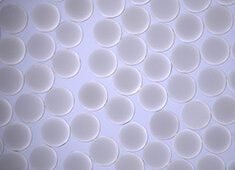
Drops of water on a piece of silicon and on silicon covered by a layer of graphene show a minimal change in the contact angle between the water and the base material. Researchers at Rice University and Rensselaer Polytechnic Institute determined that when applied to most metals and silicon, a single layer of graphene is transparent to water. Source: Rahul Rao/Rensselaer Polytechnic Institute

Graphene is largely transparent to the eye and, as it turns out, largely
transparent to water.

A new study by scientists at Rice
University and Rensselaer
Polytechnic Institute (RPI) has determined that gold, copper, and silicon get
just as wet when clad by a single continuous layer of graphene as they would
without.

The research, reported in an online edition of Nature Materials, is significant for scientists learning to
fine-tune surface coatings for a variety of applications.

“The extreme thinness of graphene makes it a totally non-invasive
coating,” said Pulickel Ajayan, Rice’s Benjamin M. and Mary Greenwood
Anderson Professor in Mechanical Engineering and Materials Science and of
chemistry. “A drop of water sitting on a surface ‘sees through’ the
graphene layers and conforms to the wetting forces dictated by the surface
beneath. It’s quite an interesting phenomenon unseen in any other coatings and
once again proves that graphene is really unique in many different ways.”
Ajayan is co-principal investigator of the study with Nikhil Koratkar, a
professor of mechanical, aerospace, and nuclear engineering at RPI.

A typical surface of graphite, the form of carbon most commonly known as
pencil lead, should be hydrophobic, Ajayan said. But in the present study, the
researchers found to their surprise that a single-atom-thick layer of the
carbon lattice presents a negligible barrier between water and a hydrophilic—water-loving—surface.
Piling on more layers reduces wetting; at about six layers, graphene
essentially becomes graphite.

An interesting aspect of the study, Ajayan said, may be the ability to
change such surface properties as conductivity while retaining wetting
characteristics. Because pure graphene is highly conductive, the discovery
could lead to a new class of conductive, yet impermeable, surface coatings, he
said.

The caveat is that wetting transparency was observed only on surfaces (most
metals and silicon) where interaction with water is dominated by weak van der
Waals forces, and not for materials like glass, where wettability is dominated
by strong chemical bonding, the team reported.

But such applications as condensation heat transfer—integral to heating,
cooling, dehumidifying, water harvesting, and many industrial processes—may
benefit greatly from the discovery, according to the paper. Copper is commonly
used for its high thermal conductivity, but it corrodes easily. The team coated
a copper sample with a single layer of graphene and found the subnanometer
barrier protected the copper from oxidation with no impact on its interaction
with water; in fact, it enhanced the copper’s thermal effectiveness by 30 to
40%.

“The finding is interesting from a fundamental point of view as well as
for practical uses,” Ajayan said. “Graphene could be one of a kind as
a coating, allowing the intrinsic physical nature of surfaces, such as wetting
and optical properties, to be retained while altering other specific
functionalities like conductivity.”


SOURCE

Related Articles Read More >

U.S.–China pause eases rare-earth shock risk, but supply security questions remain
Materials driving the next phase in semiconductor performance
An easier way to separate rare earth elements
ORNL named on 20 R&D 100 Awards, including carbon-capture and AM tools
rd newsletter
EXPAND YOUR KNOWLEDGE AND STAY CONNECTED
Get the latest info on technologies, trends, and strategies in Research & Development.
RD 25 Power Index

R&D World Digital Issues

Fall 2024 issue

Browse the most current issue of R&D World and back issues in an easy to use high quality format. Clip, share and download with the leading R&D magazine today.

Research & Development World
  • Subscribe to R&D World Magazine
  • Sign up for R&D World’s newsletter
  • Contact Us
  • About Us
  • Drug Discovery & Development
  • Pharmaceutical Processing
  • Global Funding Forecast

Copyright © 2025 WTWH Media LLC. All Rights Reserved. The material on this site may not be reproduced, distributed, transmitted, cached or otherwise used, except with the prior written permission of WTWH Media
Privacy Policy | Advertising | About Us

Search R&D World

  • R&D World Home
  • Topics
    • Aerospace
    • Automotive
    • Biotech
    • Careers
    • Chemistry
    • Environment
    • Energy
    • Life Science
    • Material Science
    • R&D Management
    • Physics
  • Technology
    • 3D Printing
    • A.I./Robotics
    • Software
    • Battery Technology
    • Controlled Environments
      • Cleanrooms
      • Graphene
      • Lasers
      • Regulations/Standards
      • Sensors
    • Imaging
    • Nanotechnology
    • Scientific Computing
      • Big Data
      • HPC/Supercomputing
      • Informatics
      • Security
    • Semiconductors
  • R&D Market Pulse
  • R&D 100
    • 2025 R&D 100 Award Winners
    • 2025 Professional Award Winners
    • 2025 Special Recognition Winners
    • R&D 100 Awards Event
    • R&D 100 Submissions
    • Winner Archive
  • Resources
    • Research Reports
    • Digital Issues
    • Educational Assets
    • R&D Index
    • Subscribe
    • Video
    • Webinars
    • Content submission guidelines for R&D World
  • Global Funding Forecast
  • Top Labs
  • Advertise
  • SUBSCRIBE