Research & Development World

  • R&D World Home
  • Topics
    • Aerospace
    • Automotive
    • Biotech
    • Careers
    • Chemistry
    • Environment
    • Energy
    • Life Science
    • Material Science
    • R&D Management
    • Physics
  • Technology
    • 3D Printing
    • A.I./Robotics
    • Software
    • Battery Technology
    • Controlled Environments
      • Cleanrooms
      • Graphene
      • Lasers
      • Regulations/Standards
      • Sensors
    • Imaging
    • Nanotechnology
    • Scientific Computing
      • Big Data
      • HPC/Supercomputing
      • Informatics
      • Security
    • Semiconductors
  • R&D Market Pulse
  • R&D 100
    • 2026 R&D 100 Award Winners
    • 2026 Professional Award Winners
    • 2026 Special Recognition Winners
    • R&D 100 Awards Event
    • R&D 100 Submissions
    • Winner Archive
  • Resources
    • Research Reports
    • Digital Issues
    • Educational Assets
    • Subscribe
    • Video
    • Webinars
    • PharmSci360
    • Content submission guidelines for R&D World
  • Global Funding Forecast
  • Top Labs
  • Advertise
  • SUBSCRIBE

Wearable Technology Turns Body Heat into Electricity

By Matt Shipman, North Carolina State University | September 13, 2016

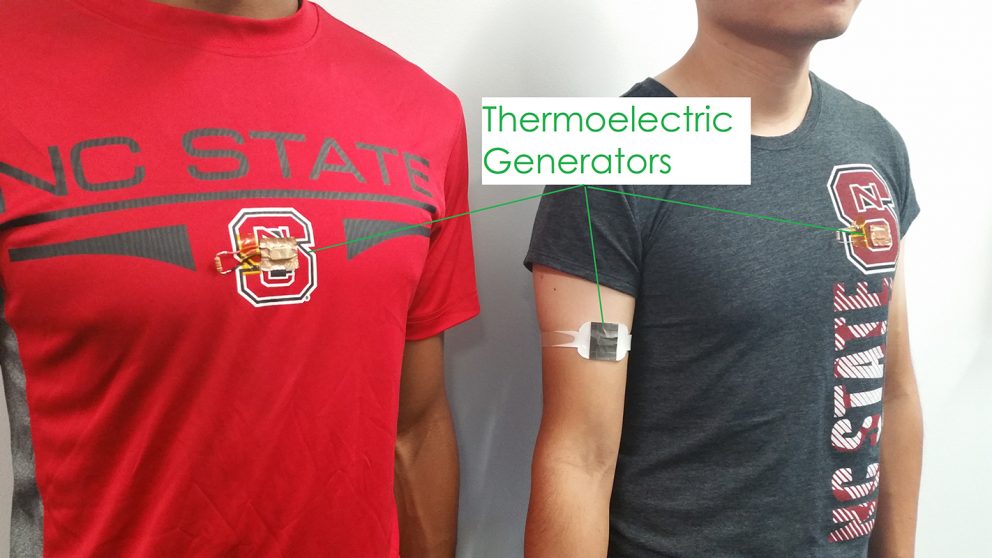
TEG-embedded T-shirt (left) and TEG armband (right).

Researchers at North Carolina State University have developed a new design for harvesting body heat and converting it into electricity for use in wearable electronics. The experimental prototypes are lightweight, conform to the shape of the body, and can generate far more electricity than previous lightweight heat harvesting technologies.

The researchers also identified the optimal site on the body for heat harvesting.

“Wearable thermoelectric generators (TEGs) generate electricity by making use of the temperature differential between your body and the ambient air,” says Daryoosh Vashaee, an associate professor of electrical and computer engineering at NC State and corresponding author of a paper on the work. “Previous approaches either made use of heat sinks — which are heavy, stiff and bulky — or were able to generate only one microwatt or less of power per centimeter squared (µW/cm2). Our technology generates up to 20 µW/cm2 and doesn’t use a heat sink, making it lighter and much more comfortable.”

The new design begins with a layer of thermally conductive material that rests on the skin and spreads out the heat. The conductive material is topped with a polymer layer that prevents the heat from dissipating through to the outside air. This forces the body heat to pass through a centrally-located TEG that is one cm2. Heat that is not converted into electricity passes through the TEG into an outer layer of thermally conductive material, which rapidly dissipates the heat. The entire system is thin — only 2 millimeters — and flexible.

“In this prototype, the TEG is only one centimeter squared, but we can easily make it larger, depending on a device’s power needs,” says Vashaee, who worked on the project as part of the National Science Foundation’s Nanosystems Engineering Research Center for Advanced Self-Powered Systems of Integrated Sensors and Technologies (ASSIST) at NC State.
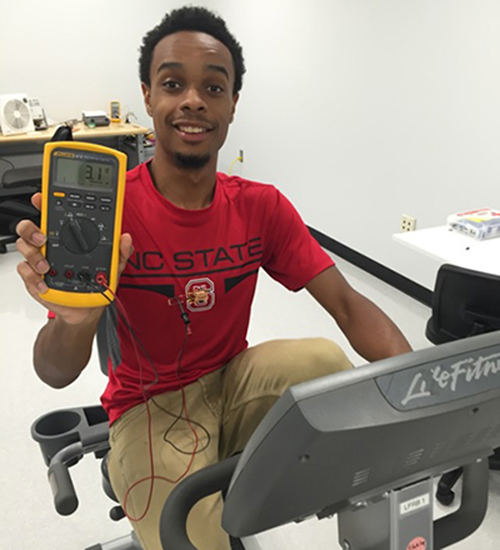
Study co-lead Haywood Hunter shows off the TEG-embedded T-shirt at work.

The researchers also found that the upper arm was the optimal location for heat harvesting. While the skin temperature is higher around the wrist, the irregular contour of the wrist limited the surface area of contact between the TEG band and the skin. Meanwhile, wearing the band on the chest limited air flow — limiting heat dissipation — since the chest is normally covered by a shirt.

In addition, the researchers incorporated the TEG into T-shirts. The researchers found that the T-shirt TEGs were still capable of generating 6 µW/cm2 — or as much as 16 µW/cm2 if a person is running.

“T-shirt TEGs are certainly viable for powering wearable technologies, but they’re just not as efficient as the upper arm bands,” Vashaee says.

“The goal of ASSIST is to make wearable technologies that can be used for long-term health monitoring, such as devices that track heart health or monitor physical and environmental variables to predict and prevent asthma attacks,” he says.

“To do that, we want to make devices that don’t rely on batteries. And we think this design and prototype moves us much closer to making that a reality.”

The paper, “Wearable thermoelectric generators for human body heat harvesting,” is published in the journal Applied Energy. Lead authors of the paper are Melissa Hyland, a graduate student at NC State, and Haywood Hunter, an undergraduate at NC State. They worked on the project while undergraduates, with support from an NSF Research Experiences for Undergraduates grant. Co-authors include Jie Liu, a postdoctoral researcher at NC State; and Elena Veety, education director of ASSIST at NC State. The work was funded by the NSF under grants EEC-1160483, ECCS-1351533 and CMMI-1363485; and by the Air Force Office of Scientific Research under grant FA9550-12-1-0225.

Source: North Carolina State University

Related Articles Read More >

INL’s $60 million nuclear AI project will spend the first year testing where AI agents can help and where they might hurt 
The Space Systems Division (05)-developed Parallelogram Synchronized Truss Assembly (PaSTA), seen Aug. 12, 2025, is a mechanism that will be integrated into the Life-Extension In-orbit Servicer (LEXI) and Astroscale Prototype Servicer for Refueling (APS-R) spacecrafts.
One SwRI R&D 100 winner turns buckled fiberglass into a spacecraft truss. The other models freight rail with 900 hours of BNSF field data
Inside the Lab: NETL’s Oil and Gas Center of Excellence focuses on technologies to enhance production   
Inside S&C Electric’s and Argonne National Lab’s CRADA partnership
rd newsletter
EXPAND YOUR KNOWLEDGE AND STAY CONNECTED
Get the latest info on technologies, trends, and strategies in Research & Development.

R&D World Digital Issues

Fall 2025 issue

Browse the most current issue of R&D World and back issues in an easy to use high quality format. Clip, share and download with the leading R&D magazine today.

R&D 100 Awards
Research & Development World
  • Subscribe to R&D World Magazine
  • Sign up for R&D World’s newsletter
  • Contact Us
  • About Us
  • Drug Discovery & Development
  • Pharmaceutical Processing
  • Global Funding Forecast

Copyright © 2026 Arrowfly LLC. All Rights Reserved. The material on this site may not be reproduced, distributed, transmitted, cached or otherwise used, except with the prior written permission of Arrowfly
Privacy Policy | Advertising | About Us

Search R&D World

  • R&D World Home
  • Topics
    • Aerospace
    • Automotive
    • Biotech
    • Careers
    • Chemistry
    • Environment
    • Energy
    • Life Science
    • Material Science
    • R&D Management
    • Physics
  • Technology
    • 3D Printing
    • A.I./Robotics
    • Software
    • Battery Technology
    • Controlled Environments
      • Cleanrooms
      • Graphene
      • Lasers
      • Regulations/Standards
      • Sensors
    • Imaging
    • Nanotechnology
    • Scientific Computing
      • Big Data
      • HPC/Supercomputing
      • Informatics
      • Security
    • Semiconductors
  • R&D Market Pulse
  • R&D 100
    • 2026 R&D 100 Award Winners
    • 2026 Professional Award Winners
    • 2026 Special Recognition Winners
    • R&D 100 Awards Event
    • R&D 100 Submissions
    • Winner Archive
  • Resources
    • Research Reports
    • Digital Issues
    • Educational Assets
    • Subscribe
    • Video
    • Webinars
    • PharmSci360
    • Content submission guidelines for R&D World
  • Global Funding Forecast
  • Top Labs
  • Advertise
  • SUBSCRIBE