Artemis II splashed down last week, ending the first American lunar mission in over 50 years. But the Artemis initiative is far from over. Artemis III was originally envisioned as a lunar landing mission, but it was significantly revised in February 2026 to ensure safety and technology readiness. Now, it will instead serve as a crewed rehearsal in Earth orbit, similar to Apollo 9, with a target date of mid-2027.
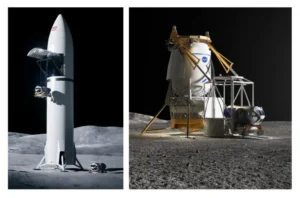
Artist’s concepts courtesy of SpaceX & Blue Origin
The primary goal will be to test the integration of the Orion spacecraft with two Human Landing Systems (HLS) developed by SpaceX and Blue Origin. The mission will launch crew in the Orion spacecraft on top of the Space Launch System (SLS) rocket to test rendezvous and docking capabilities between Orion and commercial spacecraft needed to land astronauts on the Moon.
Artemis III will also test the transfer of crew and long-term reliability of life support within the landing vehicles, as well as the Axiom Extravehicular Mobility Unit (AxEMU), the next-generation suits designed for the lunar environment.
The shift from a landing to an orbital test was driven by HLS development and risk mitigation. The orbital refueling process requires more test flights than originally planned. NASA is also planning to use the mission to troubleshoot potential failures while the crew is hours away from Earth instead of days.
Integrating commercial landing systems
NASA’s HLS Program is working with SpaceX to develop landers that will safely carry astronauts from lunar orbit to the surface of the Moon and back for Artemis III and IV. Blue Origin will develop the HLS for Artemis V.
Starting with Artemis III, the lander will be launched uncrewed to lunar orbit to wait for the crew. Launching atop NASA’s SLS rocket, the Orion spacecraft will bring the astronauts from Earth to the lander in lunar orbit. A crew of two will transfer to the lander from Orion and descend to the Moon’s surface. For later missions, astronauts will use NASA’s Gateway for a lunar space station for crew transfer.
NASA is working with SpaceX to develop a lunar lander version of the company’s Starship to carry astronauts from lunar orbit to the Moon’s surface and back during Artemis III. For this mission, the Starship HLS will dock directly with Orion in lunar orbit.
The Starship HLS is a 171-foot-tall stainless steel tower. Unlike the Apollo landers, it does not leave behind a descent stage; the entire vehicle takes off. On April 14, 2026, SpaceX completed a full-duration static fire of the Starship V3 booster and ship, clearing the way for Flight 12, the first flight of the V3 architecture in May.
Refining the starship V3 architecture for lunar missions
The NASA version will vary from SpaceX’s Starship in a few important ways. The standard Starship is covered in thousands of black, hexagonal ceramic tiles for the heat of Earth reentry. It also has four large fins to steer through the air. The NASA version will not have either of these features, as it will not reenter Earth’s atmosphere.
Additionally, the Raptor engines on the Starship are too powerful to touchdown on the moon without blasting a crater into the lunar surface. The new version will instead have a ring of high-thrust landing engines located halfway up the fuselage. These will fire for the final 100 meters of the descent, keeping the exhaust away from the lunar surface.
It will also feature a permanent band of solar panels, specialized radiators and micrometeoroid protection tiles, a pressurized external elevator, a modified version of the Dragon 2 docking system and two dedicated Extravehicular Activity (EVA) airlocks.
For the Artemis IV mission, NASA is working with SpaceX to further develop the Starship HLS to meet an extended set of requirements, such as docking with Gateway for crew transfer and landing more mass on the lunar surface.
To ensure a robust landing capability, NASA is also working with Blue Origin to develop a crewed lunar version of the company’s Blue Moon lander. The Blue Moon HLS will be used during the Artemis V mission and will meet the same set of requirements as the Starship HLS for Artemis IV.
In addition to the landers that will be used for astronauts, the HLS program is also working with its industry providers to develop cargo versions of their crew landers to deliver large pieces of equipment and infrastructure, such as rovers and habitats, to the Moon’s surface in support of exploration.