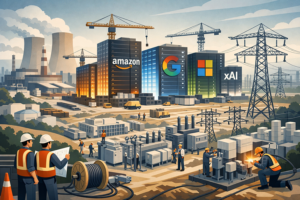
 When a major commercial development goes up in the U.S., the builder typically pays for nearby road improvements, projects that can run into the millions of dollars per mile. On Wednesday, the White House applied that same logic at a vastly different scale, announcing that seven of the world’s largest tech companies have pledged to build, bring or buy their own power plants and grid infrastructure for AI data centers, commitments that could run into the tens of billions.
The “Ratepayer Protection Pledge,” signed by Amazon, Google, Meta, Microsoft, OpenAI, Oracle, and xAI, comes as data center opposition has intensified in communities across the country, with residents blaming the facilities for surging electricity bills and straining aging grid infrastructure.
Under the pledge, the companies commit to build, bring, or purchase new power generation and pay for grid upgrades required to supply their data centers, rather than shifting those costs to ratepayers. The companies will negotiate dedicated electricity rate structures with utilities and state governments and agree to pay for the power infrastructure serving their facilities whether or not they fully use the electricity. They will also coordinate with grid operators to provide backup generation during emergencies and commit to hiring and training workers from local communities where the data centers are built.
A shadow grid is emerging
Whether the pledge represents a genuine policy shift or formalizes what’s already happening is an open question. Analysis from Cleanview shows that many data center developers are already moving toward what analysts call a “shadow grid,” building dedicated power supplies behind the meter. The firm identified 46 planned data centers with a combined capacity of about 56 gigawatts that intend to supply their own electricity, roughly 30% of all planned U.S. data center capacity. About 90% of those projects, representing approximately 50 GW, were announced in 2025 alone.
The approaches range widely. Meta is building a data center campus in Ohio with on-site natural gas generation from pipeline company Williams, a deal reportedly worth $1.6 billion in power and pipeline infrastructure. Equinix runs fuel cells at more than a dozen U.S. sites. One developer, unable to secure conventional turbines, placed a $1.25 billion order with Boom Supersonic, a company that has never sold a power generation product. At one point, Elon Musk’s xAI trucked in semitrailer-mounted natural gas generators to build what was at the time the world’s largest data center in Memphis.
The grid is already feeling the strain
The surge in power demand from data centers is reshaping electricity markets in regions such as PJM Interconnection, the nation’s largest grid operator, which serves more than 67 million people across 13 states in the Mid-Atlantic and Midwest. Monitoring Analytics, PJM’s independent market monitor, found that data center forecasts accounted for $21.3 billion, or 45%, of the $47.2 billion in capacity costs across PJM’s last three auctions. Data centers now represent 97% of the 5,250 MW of projected load growth in the region. PJM, however, had ratcheted down its projections for the eastern U.S.
Still, prices have risen from $28.92 per megawatt-day for the 2024–2025 delivery year to $269.92 for 2025–2026 and $329.17 for 2026–2027, more than a tenfold increase in two years. Utility supply rates across the PJM region have already risen between 5% and 44%, and PJM’s most recent capacity auction fell 6,500 MW short of its reliability target for the first time. A price cap negotiated with Pennsylvania’s governor kept costs from climbing even higher, but that cap is set to expire before the next auction in summer 2026.
The Natural Resources Defense Council estimates that if current trends continue, cumulative capacity costs could reach $163 billion through 2033, translating to roughly $70 per month in additional costs for the average household in the PJM region.
The research infrastructure squeeze
Those capacity cost increases hit supercomputers, too. Oak Ridge National Laboratory’s Frontier supercomputer, the nation’s first exascale system, draws approximately 21 megawatts in continuous operation, enough to power roughly 15,000 homes. At a representative electricity cost of $0.20 per kilowatt-hour, that translates to an annual power bill of roughly $40 million. Argonne National Laboratory’s Aurora system, the other U.S. exascale machine, consumes around 39 MW, with its facility provisioned for up to 60 MW to support future computing systems. Both labs sit in or near PJM’s service territory.
When capacity prices increase tenfold, those operating costs rise accordingly, even though these facilities contribute negligibly to the demand surge driving the increases. University high-performance computing clusters, pharmaceutical R&D campuses running clean rooms and cryogenic systems, and other energy-intensive research operations face the same dynamic. They are, in effect, paying for the AI boom’s infrastructure whether or not they participate in it.
The Department of Energy’s own national labs have demonstrated that extreme efficiency is possible: DOE exascale computing facilities have achieved a Power Usage Effectiveness of 1.03, among the best in the world. But efficiency gains at the facility level can only do so much to offset grid-level cost increases driven by external demand.
One note: the $40 million annual power cost comes from the Enterprise Viewpoint analysis rather than an official DOE source. ORNL’s own project page confirms the 40 MW power and cooling envelope