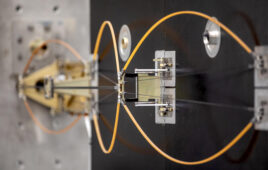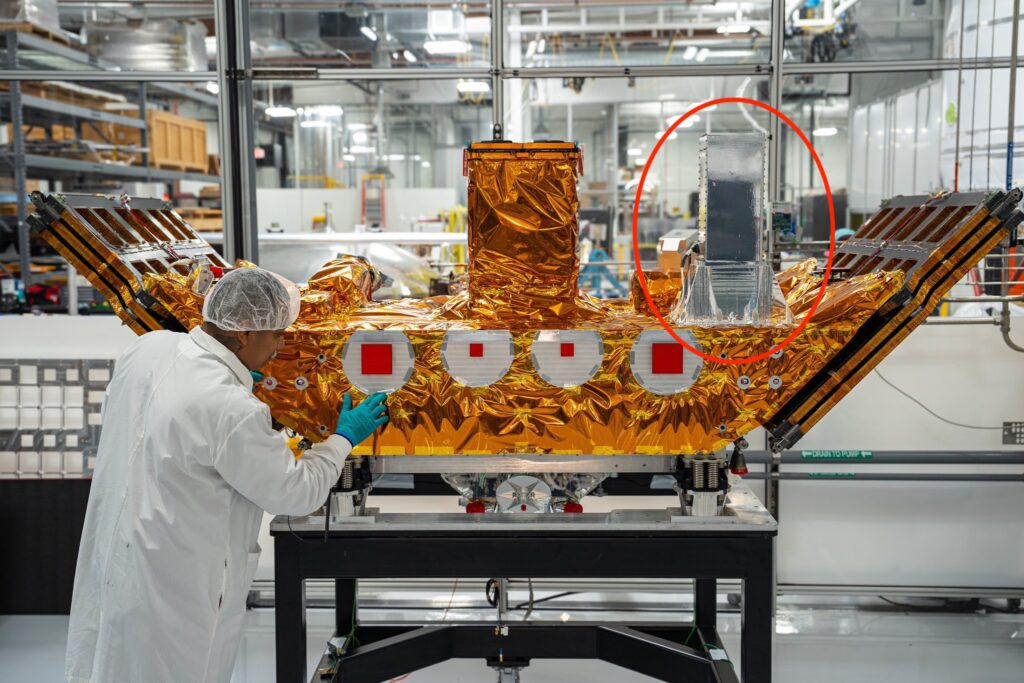
The Z01 Supertorquer (circled) during integration onto Impulse Space’s Mira spacecraft ahead of the LEO Express 3 mission. Credit: Zenno Astronautics
The space superconductor company Zenno Astronautics says its Z01 Supertorquer has made it the first company to operate a superconducting product in space. The Auckland-founded company is framing the milestone as the moment its core technology stopped being a science project and became a sellable product.

Max Arshavsky
Zenno flew a superconducting magnet once before, in late 2023 aboard a D-Orbit ION satellite carrier, but CEO Max Arshavsky says the recent flight was materially different. “2023 was a technology demonstration,” he said. “It was the world’s first high-temperature superconducting electromagnet in space, so there was no prior heritage on this technology for anyone, including academics.” Arshavsky described the 2023 unit as having roughly 10 amp-meters squared of dipole moment, enough to validate the concept but far from a functional product.
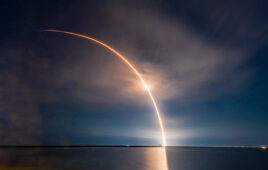
Arshavsky described the unit that flew aboard Impulse Space’s Mira spacecraft on the LEO Express 3 mission, which launched in November 2025, as a different machine entirely. “It was a full commercial array generating ten times the field strength across three axes,” he said.
Over the following months, Zenno validated every subsystem in orbit. That included verifying thermal management, avionics, power delivery, magnetic field sensing, and temperature regulation, then powered the magnets up incrementally before running several in parallel. The team ultimately demonstrated that the device could change the spacecraft’s orientation on command using magnetic fields, exactly as designed. By mid-2026 the company had accumulated hundreds of hours of successful operation.
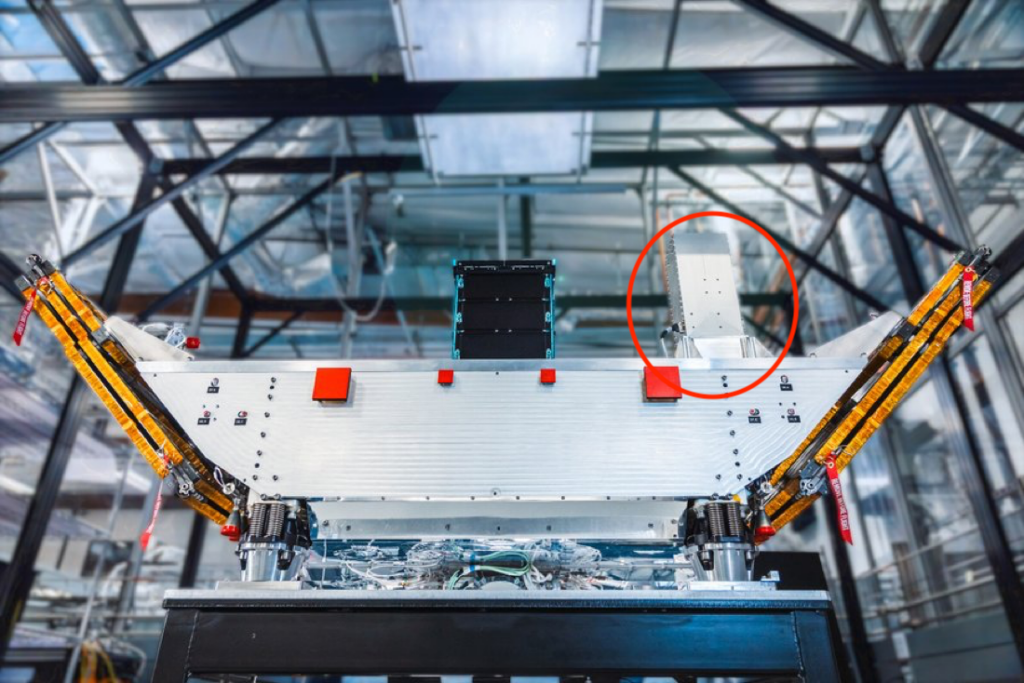
The Z01 Supertorquer (circled) mounted on Impulse Space’s Mira spacecraft during integration, ahead of the LEO Express 3 mission. Credit: Zenno Astronautics
The Z01 Supertorquer system’s magnets are cooled to 77 kelvin (-196°C), the boiling point of liquid nitrogen and the standard operating benchmark for high-temperature superconducting systems, well below the wire’s actual critical temperature, the point at which electrical resistance drops to zero. Cooling draws only a few tens of watts of orbit-average power, with this unit pulling 46 to 48 watts at peak and roughly half that on average, consistent with Zenno’s other units. Once energized, the magnets hold their field through a near-persistent current: below its critical temperature, the superconducting wire has effectively zero resistance, so rather than drawing power continuously, the system needs only occasional re-energizing to maintain the field.
“We’ve had around US$16 million in funding during our seed stage, done in two installments, a seed and a seed expansion,” Arshavsky said. He said Zenno has fulfilled a contract with Mitsubishi Electric, with further work under discussion, and is currently fulfilling a contract with SPRIND, Germany’s federal innovation agency, both tied to capabilities enabled by the Supertorquer. He added that the company signed another, still-unnamed launch agreement the day after the operational milestone was announced.
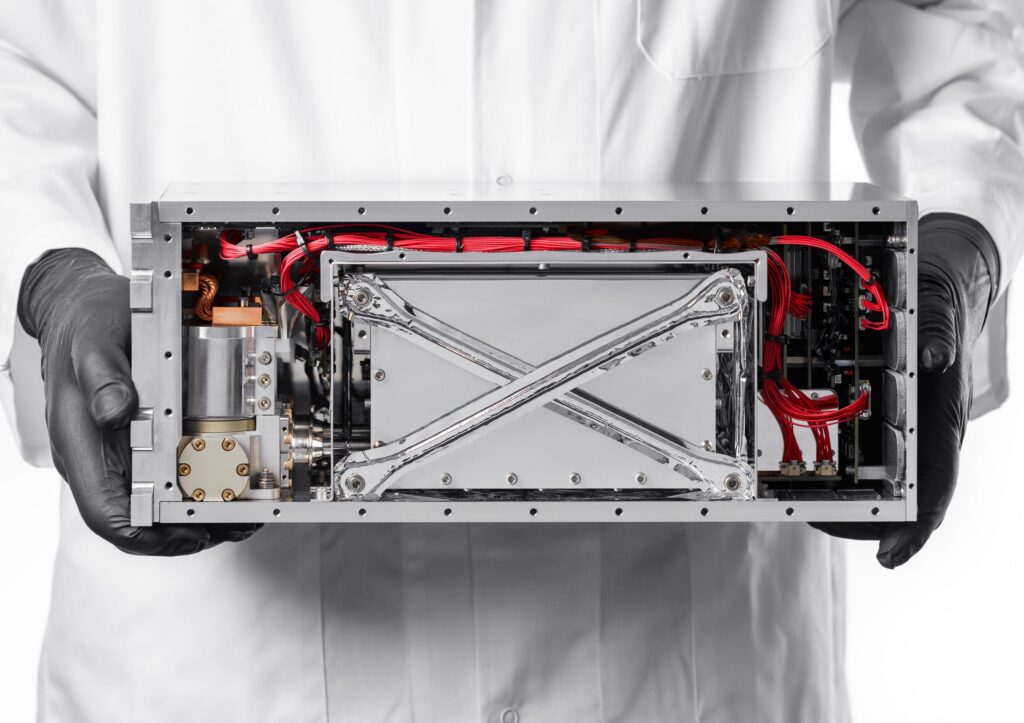
Zenno’s Z01 Supertorquer, shown with its housing open to reveal the internal cryocooler, structural truss, and wiring harness. Credit: Zenno Astronautics
Rush joins board

Andrew Rush
Zenno is also adding to its board: Andrew Rush, co-founder and CEO of Star Catcher, which is building infrastructure to beam power between satellites in orbit. He joins as Chair Peter Crabtree steps down after four years.
Rush is an industry veteran. He previously served as President and Chief Operating Officer of Redwire, where he helped lead the company through its 2021 public listing. Before that, he was CEO of Made In Space, the in-space manufacturing company Redwire acquired in 2020.
“Star Catcher’s business is energy acquisition and energy distribution in space, like a power utility in space, and Zenno’s business is adjacent, because Zenno is ultimately about energy utilization in space. The reason Zenno exists is that energy in space is abundant, and one of the [most efficient] ways to harness this energy is to use electromagnetic systems for useful work in space. So the theses are adjacent, Star Catcher and Zenno, and Andrew is a great fit, so I’m very happy he joined our board,” Arshavsky said.
The second wave of the space industry
Zenno’s milestone lands in the middle of an active stretch for the space industry. SpaceX went public on the Nasdaq on June 12, 2026, the largest IPO on record, raising $75 billion at $135 a share and pushing its market value past $2 trillion on its first day of trading. The company’s own IPO filing ties directly back to the kind of work Zenno is doing: SpaceX says it expects to begin deploying orbital AI compute satellites, the “orbital data centers” Musk has been talking up, as early as 2028.
Asked how the year is shaping up for the space industry broadly, Arshavsky said: “It’s looking good.” He frames it as a second wave of investment following the first. “SpaceX was obviously the first wave, one of the few survivors of it, and they’re changing it up, doing crazy things,” he said.
Several launch startups that went public or raised large rounds in the early 2020s didn’t make it: Virgin Orbit filed for bankruptcy in 2023, and Astra Space went private the following year after its stock collapsed. Others came through. Rocket Lab posted record first-quarter revenue in 2026 and is widely seen as the industry’s clear number two behind SpaceX, while Firefly Aerospace, which went public in 2025, became the first commercial company to land successfully on the moon with its Blue Ghost lander. Star Catcher and Portal Space Systems, the companies Arshavsky points to as part of the new wave, are building on that surviving infrastructure rather than starting from scratch.
NASA had its own milestone the same season. Artemis II splashed down in April after a roughly nine-day crewed lunar flyby, the first time astronauts have traveled beyond Earth orbit in more than fifty years, with a landing attempt now targeted for 2028. Not everything has gone smoothly: Blue Origin’s New Glenn rocket failed to deliver a payload to its intended orbit this spring, and the FAA grounded the rocket pending an investigation.
“I think the space industry is here to stay this time,” Arshavsky said.