Research & Development World

  • R&D World Home
  • Topics
    • Aerospace
    • Automotive
    • Biotech
    • Careers
    • Chemistry
    • Environment
    • Energy
    • Life Science
    • Material Science
    • R&D Management
    • Physics
  • Technology
    • 3D Printing
    • A.I./Robotics
    • Software
    • Battery Technology
    • Controlled Environments
      • Cleanrooms
      • Graphene
      • Lasers
      • Regulations/Standards
      • Sensors
    • Imaging
    • Nanotechnology
    • Scientific Computing
      • Big Data
      • HPC/Supercomputing
      • Informatics
      • Security
    • Semiconductors
  • R&D Market Pulse
  • R&D 100
    • 2026 R&D 100 Award Winners
    • 2026 Professional Award Winners
    • 2026 Special Recognition Winners
    • R&D 100 Awards Event
    • R&D 100 Submissions
    • Winner Archive
  • Resources
    • Research Reports
    • Digital Issues
    • Educational Assets
    • Subscribe
    • Video
    • Webinars
    • PharmSci360
    • Content submission guidelines for R&D World
  • Global Funding Forecast
  • Top Labs
  • Advertisers
    • Advertise
    • PR Submissions
    • Eblast Submissions
  • SUBSCRIBE

Northwestern researchers create “rubber-band electronics”

By R&D Editors | July 3, 2012

For
people with heart conditions and other ailments that require
monitoring, life can be complicated by constant hospital visits and
time-consuming tests. But what if much of the testing done at hospitals
could be conducted in the patient’s home, office, or car?

Scientists
foresee a time when medical monitoring devices are integrated
seamlessly into the human body, able to track a patient’s vital signs
and transmit them to his doctors. But one major obstacle continues to
hinder technologies like these: electronics are too rigid.

Researchers
at the McCormick School of Engineering, working with a team of
scientists from the United States and abroad, have recently developed a
design that allows electronics to bend and stretch to more than 200
percent their original size, four times greater than is possible with
today’s technology. The key is a combination of a porous polymer and
liquid metal.

A
paper about the findings, “Three-dimensional Nanonetworks for Giant
Stretchability in Dielectrics and Conductors,” was published June 26 in
the journal Nature Communications.

“With
current technology, electronics are able to stretch a small amount, but
many potential applications require a device to stretch like a rubber
band,” said Yonggang Huang, Joseph Cummings Professor of Civil and
Environmental Engineering and Mechanical Engineering, who conducted the
research with partners at the Korea Advanced Institute of Science and
Technology (South Korea), Dalian University of Technology (China), and
the University of Illinois at Urbana-Champaign. “With that level of
stretchability we could see medical devices integrated into the human
body.”

In
the past five years, Huang and collaborators at the University of
Illinois have developed electronics with about 50 percent
stretchability, but this is not high enough for many applications.

One
challenge facing these researchers has been overcoming a loss of
conductivity in stretchable electronics. Circuits made from solid metals
that are on the market today can survive a small amount of stretch, but
their electrical conductivity plummets by 100 times when stretched.
“This conductivity loss really defeats the point of stretchable
electronics,” Huang said.

Huang’s
team has found a way to overcome these challenges. First, they created a
highly porous three-dimensional structure using a polymer material,
poly(dimethylsiloxane) (PDMS),  that can stretch to three times its
original size. Then they placed a liquid metal (EGaIn) inside the pores,
allowing electricity to flow consistently even when the material is
excessively stretched.

The result is a material that is both highly stretchable and extremely conductive.

“By
combining a liquid metal in a porous polymer, we achieved 200%
stretchability in a material that does not suffer from stretch,” Huang
said. “Once you achieve that technology, any electronic can behave like a
rubber band.”

The graduate student Shuodao Wang at Northwestern University is a co-author of the paper.

Three-dimensional Nanonetworks for Giant Stretchability in Dielectrics and Conductors

Northwestern University

Related Articles Read More >

Inside the Lab: Can AI Solve the Critical Materials Challenge?
Two Science papers catch altermagnets by handedness
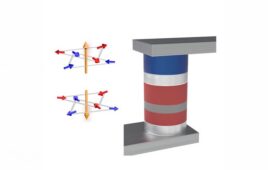
Illustration of an antiferromagnetic tunnel junction pillar beside the two spin configurations of platinum-manganese that store a bit.
Northwestern and Western Digital demonstrate a new way to write magnetic memory
Eggshell-inspired shield cut projectile speed by 65% in simulation, but light-gas gun testing has not confirmed it 
rd newsletter
EXPAND YOUR KNOWLEDGE AND STAY CONNECTED
Get the latest info on technologies, trends, and strategies in Research & Development.

R&D World Digital Issues

Fall 2026 issue

Browse the most current issue of R&D World and back issues in an easy to use high quality format. Clip, share and download with the leading R&D magazine today.

R&D 100 Awards
Research & Development World
  • Subscribe to R&D World Magazine
  • Sign up for R&D World’s newsletter
  • Contact Us
  • About Us
  • Drug Discovery & Development
  • Pharmaceutical Processing
  • Global Funding Forecast

Copyright © 2026 Arrowfly LLC. All Rights Reserved. The material on this site may not be reproduced, distributed, transmitted, cached or otherwise used, except with the prior written permission of Arrowfly
Privacy Policy | Advertising | About Us

Search R&D World

  • R&D World Home
  • Topics
    • Aerospace
    • Automotive
    • Biotech
    • Careers
    • Chemistry
    • Environment
    • Energy
    • Life Science
    • Material Science
    • R&D Management
    • Physics
  • Technology
    • 3D Printing
    • A.I./Robotics
    • Software
    • Battery Technology
    • Controlled Environments
      • Cleanrooms
      • Graphene
      • Lasers
      • Regulations/Standards
      • Sensors
    • Imaging
    • Nanotechnology
    • Scientific Computing
      • Big Data
      • HPC/Supercomputing
      • Informatics
      • Security
    • Semiconductors
  • R&D Market Pulse
  • R&D 100
    • 2026 R&D 100 Award Winners
    • 2026 Professional Award Winners
    • 2026 Special Recognition Winners
    • R&D 100 Awards Event
    • R&D 100 Submissions
    • Winner Archive
  • Resources
    • Research Reports
    • Digital Issues
    • Educational Assets
    • Subscribe
    • Video
    • Webinars
    • PharmSci360
    • Content submission guidelines for R&D World
  • Global Funding Forecast
  • Top Labs
  • Advertisers
    • Advertise
    • PR Submissions
    • Eblast Submissions
  • SUBSCRIBE