Research & Development World

  • R&D World Home
  • Topics
    • Aerospace
    • Automotive
    • Biotech
    • Careers
    • Chemistry
    • Environment
    • Energy
    • Life Science
    • Material Science
    • R&D Management
    • Physics
  • Technology
    • 3D Printing
    • A.I./Robotics
    • Software
    • Battery Technology
    • Controlled Environments
      • Cleanrooms
      • Graphene
      • Lasers
      • Regulations/Standards
      • Sensors
    • Imaging
    • Nanotechnology
    • Scientific Computing
      • Big Data
      • HPC/Supercomputing
      • Informatics
      • Security
    • Semiconductors
  • R&D Market Pulse
  • R&D 100
    • 2026 R&D 100 Award Winners
    • 2026 Professional Award Winners
    • 2026 Special Recognition Winners
    • R&D 100 Awards Event
    • R&D 100 Submissions
    • Winner Archive
  • Resources
    • Research Reports
    • Digital Issues
    • Educational Assets
    • Subscribe
    • Video
    • Webinars
    • PharmSci360
    • Content submission guidelines for R&D World
  • Global Funding Forecast
  • Top Labs
  • Advertisers
    • Advertise
    • PR Submissions
    • Eblast Submissions
  • SUBSCRIBE

Research yields promising advance in solar cells based on nanocarbon

By R&D Editors | September 27, 2012

An exciting advance in solar
cell technology developed at the University of Kansas (KU) has produced the
world’s most efficient photovoltaic (PV) cells made from nanocarbons, materials
that have the potential to dramatically drop the costs of PV technology in the
future.

“We actually broke the all-carbon
PV efficiency record,” says Shenqiang Ren, assistant professor of chemistry at
KU, who spearheaded the research with colleagues from Massachusetts Institute
of Technology. “Carbon nanotube-based solar cells, in the past, averaged less
than 1% in efficiency. Even though these materials show such a large potential,
there are so many problems. But we’re addressing them. So now, our efficiency
has risen to 1.3%. It doesn’t get to the commercial level of efficiency, but
we’re still working on it, trying to optimize it, trying to get better efficiency
out of it.”

To be commercially viable, Ren
says a photovoltaic panel must cross a 10% efficiency threshold—meaning it must
covert a tenth of the sunlight input energy into solar cell output power.
Today’s commercially available silicone PV panels are 17 to 22% efficient, but
they come with a very high price tag.

The KU researcher said that PV
panels made from carbon nanomaterial could advance solar technology because
they are made from cheap, easy-to-get, and environmentally sustainable carbon
materials; have high optical absorption; and much better photostability—meaning
their performance doesn’t degrade after exposure to sunlight.

“In our research, we use carbon
buckyballs, carbon nanotubes and a graphene derivative,” says Ren. “The
nanocarbon materials show remarkable photostablility without traditional
packaging required in organic solar cells. We actually compared two types of
solar cells in the laboratory. We had a standard organic solar cell, and then
we made exactly the same all-carbon solar cell. Then, we compared the
photodegradation without any protective packaging. The organic degraded so
rapidly that after 100 hrs the organic solar cell wasn’t functional at all, but
the all-carbon solar cell was functioning really well.”

While the 1.3% efficiency rate
of Ren’s nanocarbon PV cells falls short of today’s commercially available
solar technology, the theoretical limit for all-carbon PV cells is 13%. If Ren
and his colleagues can achieve in the real world what they theorize is possible
using nanocarbon, the technology would thrive in the marketplace and could have
a broader impact on technology beyond solar.

“Our target is to move forward
this performance, and in the meantime we want to better understand the exciton
dynamic and charge transfer,” says Ren. “This carbon material is very new to
photophysics, and a PV cell is just one of emerging applications from the
all-carbon framework. It could open up a completely new carbon optoelectronics.
For instance, we could use this carbon for photo detector or a sensor. Once we
address these fundamental problems, there’s a whole new field that can be
opened up by this discovery.”

Ren’s findings appear in ACS Nano.

Source: University of Kansas

Related Articles Read More >

Inside the Lab: Can AI Solve the Critical Materials Challenge?
Two Science papers catch altermagnets by handedness
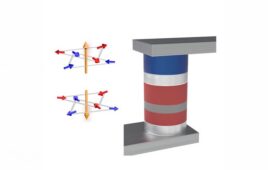
Illustration of an antiferromagnetic tunnel junction pillar beside the two spin configurations of platinum-manganese that store a bit.
Northwestern and Western Digital demonstrate a new way to write magnetic memory
Eggshell-inspired shield cut projectile speed by 65% in simulation, but light-gas gun testing has not confirmed it 
rd newsletter
EXPAND YOUR KNOWLEDGE AND STAY CONNECTED
Get the latest info on technologies, trends, and strategies in Research & Development.

R&D World Digital Issues

Fall 2026 issue

Browse the most current issue of R&D World and back issues in an easy to use high quality format. Clip, share and download with the leading R&D magazine today.

R&D 100 Awards
Research & Development World
  • Subscribe to R&D World Magazine
  • Sign up for R&D World’s newsletter
  • Contact Us
  • About Us
  • Drug Discovery & Development
  • Pharmaceutical Processing
  • Global Funding Forecast

Copyright © 2026 Arrowfly LLC. All Rights Reserved. The material on this site may not be reproduced, distributed, transmitted, cached or otherwise used, except with the prior written permission of Arrowfly
Privacy Policy | Advertising | About Us

Search R&D World

  • R&D World Home
  • Topics
    • Aerospace
    • Automotive
    • Biotech
    • Careers
    • Chemistry
    • Environment
    • Energy
    • Life Science
    • Material Science
    • R&D Management
    • Physics
  • Technology
    • 3D Printing
    • A.I./Robotics
    • Software
    • Battery Technology
    • Controlled Environments
      • Cleanrooms
      • Graphene
      • Lasers
      • Regulations/Standards
      • Sensors
    • Imaging
    • Nanotechnology
    • Scientific Computing
      • Big Data
      • HPC/Supercomputing
      • Informatics
      • Security
    • Semiconductors
  • R&D Market Pulse
  • R&D 100
    • 2026 R&D 100 Award Winners
    • 2026 Professional Award Winners
    • 2026 Special Recognition Winners
    • R&D 100 Awards Event
    • R&D 100 Submissions
    • Winner Archive
  • Resources
    • Research Reports
    • Digital Issues
    • Educational Assets
    • Subscribe
    • Video
    • Webinars
    • PharmSci360
    • Content submission guidelines for R&D World
  • Global Funding Forecast
  • Top Labs
  • Advertisers
    • Advertise
    • PR Submissions
    • Eblast Submissions
  • SUBSCRIBE