Research & Development World

  • R&D World Home
  • Topics
    • Aerospace
    • Automotive
    • Biotech
    • Careers
    • Chemistry
    • Environment
    • Energy
    • Life Science
    • Material Science
    • R&D Management
    • Physics
  • Technology
    • 3D Printing
    • A.I./Robotics
    • Software
    • Battery Technology
    • Controlled Environments
      • Cleanrooms
      • Graphene
      • Lasers
      • Regulations/Standards
      • Sensors
    • Imaging
    • Nanotechnology
    • Scientific Computing
      • Big Data
      • HPC/Supercomputing
      • Informatics
      • Security
    • Semiconductors
  • R&D Market Pulse
  • R&D 100
    • 2026 R&D 100 Award Winners
    • 2026 Professional Award Winners
    • 2026 Special Recognition Winners
    • R&D 100 Awards Event
    • R&D 100 Submissions
    • Winner Archive
  • Resources
    • Research Reports
    • Digital Issues
    • Educational Assets
    • Subscribe
    • Video
    • Webinars
    • PharmSci360
    • Content submission guidelines for R&D World
  • Global Funding Forecast
  • Top Labs
  • Advertise
  • SUBSCRIBE

Mysterious Quantum State of Matter Observed

By R&D Editors | April 5, 2016

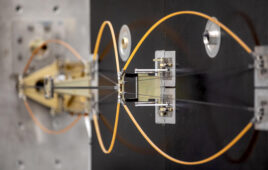
Excitation of a spin liquid on a honeycomb lattice with neutrons. Courtesy of Genevieve Martin, Oak Ridge National LaboratoryAn international team of researchers have found evidence of a mysterious new state of matter, first predicted 40 years ago, in a real material. This state, known as a quantum spin liquid, causes electrons—thought to be indivisible building blocks of nature—to break into pieces.

The researchers, including physicists from the University of Cambridge, measured the first signatures of these fractional particles, known as Majorana fermions, in a two-dimensional material with a structure similar to graphene. Their experimental results successfully matched with one of the main theoretical models for a quantum spin liquid, known as a Kitaev model. The results are reported in the journal Nature Materials.

Quantum spin liquids are mysterious states of matter which are thought to be hiding in certain magnetic materials, but had not been conclusively sighted in nature.

The observation of one of their most intriguing properties—electron splitting, or fractionalization—in real materials is a breakthrough. The resulting Majorana fermions may be used as building blocks of quantum computers, which would be far faster than conventional computers and would be able to perform calculations that could not be done otherwise.

“This is a new quantum state of matter, which has been predicted but hasn’t been seen before,” said Dr Johannes Knolle of Cambridge’s Cavendish Laboratory, one of the paper’s co-authors.

In a typical magnetic material, the electrons each behave like tiny bar magnets. And when a material is cooled to a low enough temperature, the ‘magnets’ will order themselves over long ranges, so that all the north magnetic poles point in the same direction, for example.

But in a material containing a spin liquid state, even if that material is cooled to absolute zero, the bar magnets would not align but form an entangled soup caused by quantum fluctuations.

“Until recently, we didn’t even know what the experimental fingerprints of a quantum spin liquid would look like,” said paper co-author Dmitry Kovrizhin, also from the Theory of Condensed Matter group of the Cavendish Laboratory. “One thing we’ve done in previous work is to ask, if I were performing experiments on a possible quantum spin liquid, what would I observe?”

Knolle and Kovrizhin’s co-authors, led by Arnab Banerjee and Stephen Nagler from Oak Ridge National Laboratory, used neutron scattering techniques to look for experimental evidence of fractionalization in alpha-ruthenium chloride (α-RuCl3). The researchers tested the magnetic properties of α-RuCl3 powder by illuminating it with neutrons, and observing the pattern of ripples that the neutrons produced on a screen when they scattered from the sample.

A regular magnet would create distinct sharp lines, but it was a mystery what sort of pattern the Majorana fermions in a quantum spin liquid would make. The theoretical prediction of distinct signatures by Knolle and his collaborators in 2014 match well with the broad humps instead of sharp lines which experimentalists observed on the screen, providing for the first time direct evidence of a quantum spin liquid and the fractionalization of electrons in a two-dimensional material.

“This is a new addition to a short list of known quantum states of matter,” said Knolle.

“It’s an important step for our understanding of quantum matter,” said Kovrizhin. “It’s fun to have another new quantum state that we’ve never seen before—it presents us with new possibilities to try new things.”

Reference
A. Banerjee et al. ‘Proximate Kitaev quantum spin liquid behaviour in a honeycomb magnet.’ Nature Materials (2016). DOI: 10.1038/nmat4604
Related Articles Read More >

Illustration of an antiferromagnetic tunnel junction pillar beside the two spin configurations of platinum-manganese that store a bit.
Northwestern and Western Digital demonstrate a new way to write magnetic memory
Eggshell-inspired shield cut projectile speed by 65% in simulation, but light-gas gun testing has not confirmed it 
The Space Systems Division (05)-developed Parallelogram Synchronized Truss Assembly (PaSTA), seen Aug. 12, 2025, is a mechanism that will be integrated into the Life-Extension In-orbit Servicer (LEXI) and Astroscale Prototype Servicer for Refueling (APS-R) spacecrafts.
One SwRI R&D 100 winner turns buckled fiberglass into a spacecraft truss. The other models freight rail with 900 hours of BNSF field data
Researchers develop sawdust-based foam as polystyrene bans force industry to adapt
rd newsletter
EXPAND YOUR KNOWLEDGE AND STAY CONNECTED
Get the latest info on technologies, trends, and strategies in Research & Development.

R&D World Digital Issues

Fall 2026 issue

Browse the most current issue of R&D World and back issues in an easy to use high quality format. Clip, share and download with the leading R&D magazine today.

R&D 100 Awards
Research & Development World
  • Subscribe to R&D World Magazine
  • Sign up for R&D World’s newsletter
  • Contact Us
  • About Us
  • Drug Discovery & Development
  • Pharmaceutical Processing
  • Global Funding Forecast

Copyright © 2026 Arrowfly LLC. All Rights Reserved. The material on this site may not be reproduced, distributed, transmitted, cached or otherwise used, except with the prior written permission of Arrowfly
Privacy Policy | Advertising | About Us

Search R&D World

  • R&D World Home
  • Topics
    • Aerospace
    • Automotive
    • Biotech
    • Careers
    • Chemistry
    • Environment
    • Energy
    • Life Science
    • Material Science
    • R&D Management
    • Physics
  • Technology
    • 3D Printing
    • A.I./Robotics
    • Software
    • Battery Technology
    • Controlled Environments
      • Cleanrooms
      • Graphene
      • Lasers
      • Regulations/Standards
      • Sensors
    • Imaging
    • Nanotechnology
    • Scientific Computing
      • Big Data
      • HPC/Supercomputing
      • Informatics
      • Security
    • Semiconductors
  • R&D Market Pulse
  • R&D 100
    • 2026 R&D 100 Award Winners
    • 2026 Professional Award Winners
    • 2026 Special Recognition Winners
    • R&D 100 Awards Event
    • R&D 100 Submissions
    • Winner Archive
  • Resources
    • Research Reports
    • Digital Issues
    • Educational Assets
    • Subscribe
    • Video
    • Webinars
    • PharmSci360
    • Content submission guidelines for R&D World
  • Global Funding Forecast
  • Top Labs
  • Advertise
  • SUBSCRIBE