In this week of research and development (R&D) updates, we see early signs of demand for clean energy plummeting after emerging as one of the fastest growing sectors among industries, with jobs in wind and solar power benefiting from that upswing. The shift comes as new legislation threatens to reshape America’s energy landscape with far-reaching consequences for power generation and AI development. Meanwhile, scientific breakthroughs offer hope: researchers have developed a potential game-changer for the 8 million people living with type 1 diabetes, Japanese scientists demonstrate that AI models can achieve more by working together than alone, and Moderna’s mRNA flu vaccine shows promising results. Read on to learn how these developments could impact everything from your electricity bills to your healthcare.
Demand for residential solar plummets

The story: Trump’s Big Beautiful Bill cancels subsidies for green projects like solar and wind power and electric vehicles while initiating a tax break for fossil fuels. The bill requires the federal government to provide opportunities for oil and gas drilling on public lands, including in the Gulf of Mexico and off the coast of Alaska.
The numbers:
- Royalty fees for offshore drilling will decrease from 16.67% to 12.5%
- Coal mining royalty fees from 12.5% to 7%
- Investment in electricity and clean fuels production could decrease by $500 billion by 2035, according to Princeton University’s REPEAT Project
- The REPEAT Project also estimated that the bill will
- Increase US household and business energy costs by $28 billion in 2030 and over $50 billion in 2035
- Decrease clean electricity generation by more than 820 terawatt-hours in 2035
- Increase US greenhouse gas emissions by 190 million metric tons per year in 2030
Why it matters: The Bill will slow America’s planned increases in power generation. This means less power for everyone: tech and manufacturing industries, as well as the growing American population. It could also mean losing the battle for AI dominance to China. Generative AI notoriously needs enormous amounts of power, meaning any slowdown in US generation will greatly impact the industry.
Watch for: Projects in green energy will race to be completed by the tax credit deadlines, while regional utilities and smaller developers may cancel clean energy pursuits. Household electricity and heating bills will likely increase alongside a push for more fossil fuels.
Tesla/EVs’ latest political earthquake
The story: Tesla’s stock is tumbling as CEO Elon Musk announced he would form a centrist “America Party,” prompting investor concerns about his focus on Tesla’s operations. The former DOGE chief has entered a public dispute with Trump, calling the president’s “Big Beautiful Bill” a “disgusting abomination.” The Congressional Budget Office projected the “One Big Beautiful Bill Act,” which recently was signed into law, would add approximately $2.4 trillion to the federal deficit over the next decade. Adding to Tesla’s woes, the very bill Musk denounces terminates the $7,500 EV tax credit after September 30, 2025.
The numbers:
- Tesla stock down 21.9% YTD, 7% this past week alone
- $7,500 new EV credit / $4,000 used EV credit ending September 30
- EVs average $57,700 vs gas cars at $48,100 (Kelley Blue Book, May 2025)
Why it matters: The public feud underscores how Musk’s political activities are directly impacting Tesla’s market performance and investor confidence. For Tesla, already reeling from its CEO’s divergent focus, the elimination of tax credits threatens a demand cliff—a bitter irony given Musk’s opposition to the very legislation dealing this blow.
Watch for: September 30 deadline sparking “summer of the EV” rush; whether Musk’s America Party gains traction targeting 2-3 Senate seats and 8-10 House districts.
Sakana AI reveals team-based genAI approach to crack problems none could solve alone
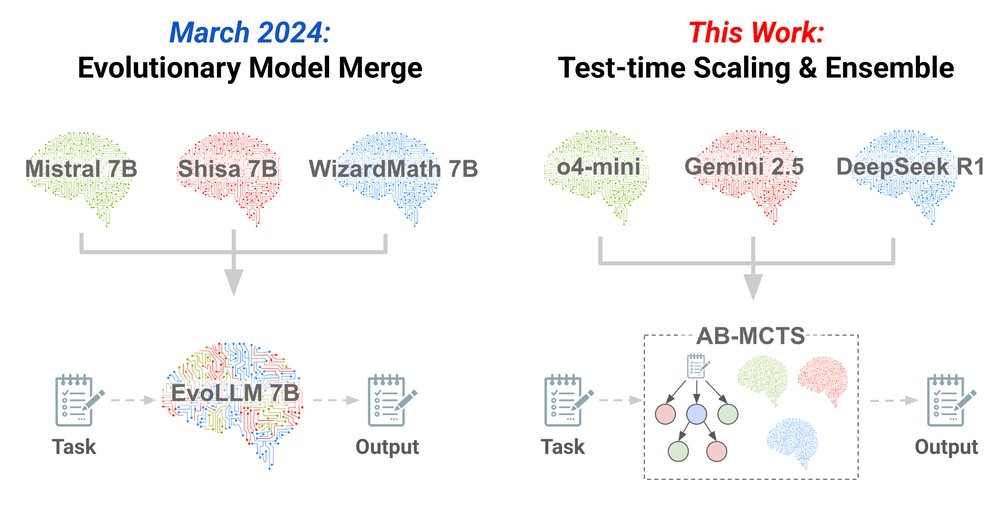
The story: The Japanese AI company Sakana AI has unveiled AB-MCTS, a new algorithm that enables multiple frontier AI models such as variants of ChatGPT, Gemini and DeepSeek to collaborate and solve problems through collective intelligence. The system dynamically allocates different models based on their strengths. For instance, one might excel at strategy while another writes better code. On the challenging ARC-AGI-2 benchmark, the combined AI team solved over 30% of problems, significantly outperforming any individual model’s 23% success rate.
The numbers:
- 30%+ problems solved by AI collaboration vs 23% by single models
- 250 maximum LLM calls per problem in experiments
- 3 frontier models combined: o4-mini + Gemini-2.5-Pro + DeepSeek-R1
Why it matters: This research announcement shows that genAI models, like humans, can achieve more through collaboration than working alone, potentially jointly solving problems that no single model could. For instance, in one example, o4-mini’s incorrect solution became a hint that enabled the open-source DeepSeek-R1 and proprietary Gemini-2.5-Pro models to find the correct answer.
Watch for: Commercial applications where AI teams tackle enterprise problems; potential cost implications of running multiple models; whether competitors will adopt similar collaborative approaches.
Moderna’s mRNA flu vaccine shows 26.6% better protection than standard shots in Phase 3 study
The story: Moderna’s mRNA-1010 flu vaccine demonstrated superior protection compared to standard flu shots in a Phase 3 trial of 40,805 adults aged 50 and older across 11 countries, according to the company. The trial showed 26.6% better relative efficacy overall, with especially strong results for those 65+ (27.4% better).
The numbers:
- 26.6% better protection than standard flu vaccines (95% CI: 16.7%-35.4%)
- 40,805 participants aged 50+ across 11 countries
- Strong efficacy against all strains: H1N1 (29.6%), H3N2 (22.2%), B/Victoria (29.1%)
Why it matters: The news promises a significant advance in flu prevention technology, using the same mRNA platform that formed the backbone for the COVID vaccination strategy in many parts of the world. The superior efficacy could significantly reduce hospitalizations among older adults most vulnerable to severe flu. The mRNA approach also enables faster strain matching and opens the door for combination COVID-flu vaccines.
Watch for: Regulatory filing timelines and potential approval dates; pricing strategy versus existing high-dose flu vaccines; whether this accelerates development of Moderna’s combination respiratory vaccines targeting flu, COVID and RSV simultaneously.
Meanwhile, open questions swirl as the vaccine approaches potential FDA approval amid unprecedented changes at the FDA and CDC. HHS Secretary RFK Jr. has dismissed the CDC’s entire vaccine advisory committee, replacing it with mostly vaccine skeptics. He has also trimmed FDA staff, including food and vaccine safety personnel. In addition, there are questions about tolerability and durability of immune response from mRNA vaccines.
Astronomers track interstellar comet

The story: NASA telescopes in Chile first spotted the object on Tuesday. More than 100 observations have been made of the comet, named 3I/ATLAS, from telescopes all over the world. Astronomers determined that the comet was moving too fast to be gravitationally bound to the sun, meaning that it originated from outside our solar system. The origins of the comet are unknown; it may be the remnant of an explosion or collision in another solar system millions of years ago. Once it leaves our solar system, its orbit indicates that it will not be back.
The numbers:
- The comet is between 12 and 25 miles wide
- The closest it will be to the sun is about 200 million miles, around Oct. 29
- It is traveling at about 150,000 mph and could break the record for the fastest-moving visitor in our solar system
- This is the third interstellar object to be observed in our solar system
Why it matters: Studying interstellar objects like this one can give scientists clues to other interstellar visitors and whether they may pose a threat to Earth. It could also help scientists learn about the formation of other star systems.
Watch for: It will reach its closest point to the sun at the end of October, a distance about twice as far as the Earth is from the sun. As it gets closer, it may also get brighter. This object was spotted early enough that astronomers will have time to make many observations before it is out of view.
A new treatment for type 1 diabetes could replace insulin injections
 The story: A single infusion of lab-grown pancreatic cells allows patients’ bodies to make the necessary amount of insulin, according to a study published in the New England Journal of Medicine. One year after the treatment, 10 out of 12 patients no longer needed insulin injections. Vertex developed a method to grow pancreatic islet cells in the lab using human stem cells. The islet cells settle in the liver, not the pancreas, where they sense blood sugar levels and produce insulin. Side effects of the therapy, called zimislecel, include diarrhea, headache, nausea and COVID-19 infection. These side effects were due to immunosuppressive drugs that prevent the body from attacking and rejecting the new islet cells.
The numbers:
- Over 8 million people worldwide have type 1 diabetes
- 10 participants no longer needed insulin injections after one full dose
- 2 other patients were able to reduce insulin doses by up to 70%
Why it matters: Insulin injections are not a perfect treatment. Too much insulin causes kidney, nerve and eye damage. Too little insulin can cause people to pass out or become confused. Patients can receive pancreatic cells from deceased donors, but the number of donors is limited and patients often need infusions from multiple donors. A new treatment that solves these issues could help millions of patients.
Watch for: Giacomo Lanzoni, Ph.D. of the Diabetes Research Institute at the University of Miami Miller School of Medicine and others in the field are working on a diabetes cell therapy that does not require long-term immunosuppression, which is used to prevent the immune system from attacking the islet cells. Vertex has expanded its study to 50 patients and is hoping to have data from those patients and apply for regulatory approval in 2026.