Research & Development World

  • R&D World Home
  • Topics
    • Aerospace
    • Automotive
    • Biotech
    • Careers
    • Chemistry
    • Environment
    • Energy
    • Life Science
    • Material Science
    • R&D Management
    • Physics
  • Technology
    • 3D Printing
    • A.I./Robotics
    • Software
    • Battery Technology
    • Controlled Environments
      • Cleanrooms
      • Graphene
      • Lasers
      • Regulations/Standards
      • Sensors
    • Imaging
    • Nanotechnology
    • Scientific Computing
      • Big Data
      • HPC/Supercomputing
      • Informatics
      • Security
    • Semiconductors
  • R&D Market Pulse
  • R&D 100
    • 2025 R&D 100 Award Winners
    • 2025 Professional Award Winners
    • 2025 Special Recognition Winners
    • R&D 100 Awards Event
    • R&D 100 Submissions
    • Winner Archive
  • Resources
    • Research Reports
    • Digital Issues
    • Educational Assets
    • Subscribe
    • Video
    • Webinars
    • PharmSci360
    • Content submission guidelines for R&D World
  • Global Funding Forecast
  • Top Labs
  • Advertise
  • SUBSCRIBE

New Wheel Units Could Bring Vehicle Costs Down

By University of Waterloo | March 15, 2019

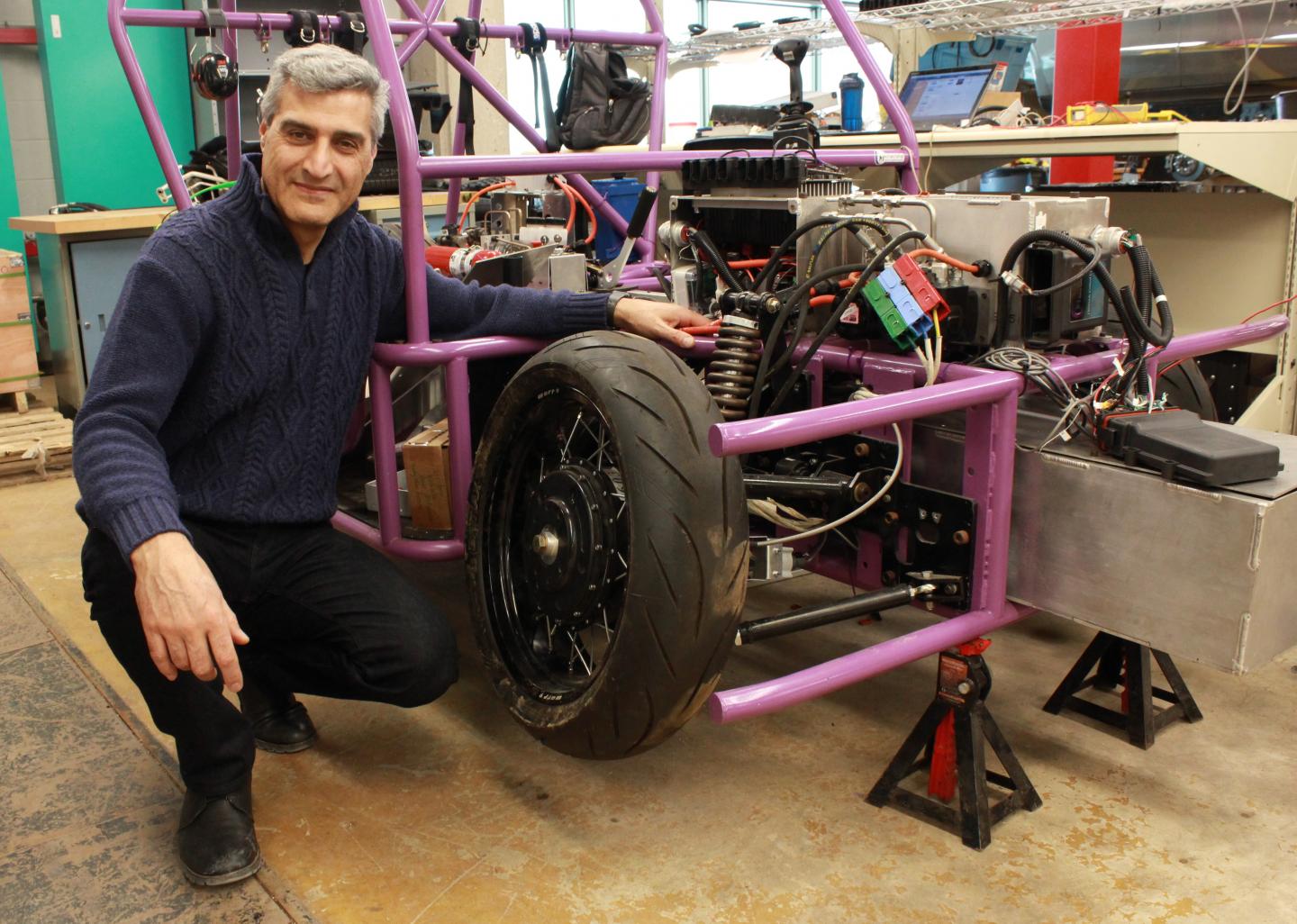
Prof. Amir Khajepour stands next to a vehicle containing his new wheel unit. Credit: University of Waterloo

Vehicles could be affordably produced for a wide variety of specialized purposes using a sophisticated wheel unit developed by researchers at the University of Waterloo.

The self-contained unit combines a wheel and an electric motor with braking, suspension, steering and a control system in a single module designed to be bolted to any vehicle frame.

It would free manufacturers from making huge investments to develop those components from scratch and enable the economical production of specialized vehicles in even small quantities.

“The idea is modularity and plug-and-play control capability,” said Amir Khajepour, a mechanical and mechatronics engineering professor at Waterloo. “Our wheel unit, in a sense, is a full vehicle with only one wheel. All that’s missing is a body.”

Automotive researchers first applied the concept to electric, two-seater urban cars, which promise to ease congestion and reduce pollution, but make up only a tiny fraction of sales because of high prices, space limitations and safety concerns.

Mass-produced wheel units would significantly reduce production costs while also creating space for passengers that would otherwise be devoted to mechanical components such as steering columns.

To improve the stability of the tall, narrow cars, researchers also designed and prototyped the units – which weigh about 40 kilograms and have about 25 horsepower – to enable active wheel cambering, or tilting.

“Companies will be able to produce a smaller car that is cheaper, too,” said Khajepour, director of the Mechatronic Vehicle Systems Lab. “Right now, we are not there. You have to pay more to get a smaller car, to get less.”

The next step in the research involves scaling up the wheel unit, technically called a corner module, for large utility and commercial vehicles.

That would pave the way for more cost-effective production of low-volume, specialized vehicles with customized bodies in fields including mining, forestry and rescue operations.

“It’s an economy of scale problem,” Khajepour said. “Corner modules would allow us, without enormous development costs, to make vehicles that are specific for each application, for each function, by concentrating only on the design of the body and the user interface.”


Related Articles Read More >

BYD’s EV megawatt leap is a 1,000-hp supercar with flash charging
175 Wh/kg: How CATL’s Naxtra Architecture Moves Sodium-Ion Beyond the Lab
Rewriting the EV cost curve: The tech that has already pushed Chinese EVs below gasoline parity
GM XFC Cell: EV battery charges from 10% to 70% in approximately 5.6 minutes | Inside the R&D 100 win
rd newsletter
EXPAND YOUR KNOWLEDGE AND STAY CONNECTED
Get the latest info on technologies, trends, and strategies in Research & Development.

R&D World Digital Issues

Fall 2025 issue

Browse the most current issue of R&D World and back issues in an easy to use high quality format. Clip, share and download with the leading R&D magazine today.

R&D 100 Awards
Research & Development World
  • Subscribe to R&D World Magazine
  • Sign up for R&D World’s newsletter
  • Contact Us
  • About Us
  • Drug Discovery & Development
  • Pharmaceutical Processing
  • Global Funding Forecast

Copyright © 2026 WTWH Media LLC. All Rights Reserved. The material on this site may not be reproduced, distributed, transmitted, cached or otherwise used, except with the prior written permission of WTWH Media
Privacy Policy | Advertising | About Us

Search R&D World

  • R&D World Home
  • Topics
    • Aerospace
    • Automotive
    • Biotech
    • Careers
    • Chemistry
    • Environment
    • Energy
    • Life Science
    • Material Science
    • R&D Management
    • Physics
  • Technology
    • 3D Printing
    • A.I./Robotics
    • Software
    • Battery Technology
    • Controlled Environments
      • Cleanrooms
      • Graphene
      • Lasers
      • Regulations/Standards
      • Sensors
    • Imaging
    • Nanotechnology
    • Scientific Computing
      • Big Data
      • HPC/Supercomputing
      • Informatics
      • Security
    • Semiconductors
  • R&D Market Pulse
  • R&D 100
    • 2025 R&D 100 Award Winners
    • 2025 Professional Award Winners
    • 2025 Special Recognition Winners
    • R&D 100 Awards Event
    • R&D 100 Submissions
    • Winner Archive
  • Resources
    • Research Reports
    • Digital Issues
    • Educational Assets
    • Subscribe
    • Video
    • Webinars
    • PharmSci360
    • Content submission guidelines for R&D World
  • Global Funding Forecast
  • Top Labs
  • Advertise
  • SUBSCRIBE