Research & Development World

  • R&D World Home
  • Topics
    • Aerospace
    • Automotive
    • Biotech
    • Careers
    • Chemistry
    • Environment
    • Energy
    • Life Science
    • Material Science
    • R&D Management
    • Physics
  • Technology
    • 3D Printing
    • A.I./Robotics
    • Software
    • Battery Technology
    • Controlled Environments
      • Cleanrooms
      • Graphene
      • Lasers
      • Regulations/Standards
      • Sensors
    • Imaging
    • Nanotechnology
    • Scientific Computing
      • Big Data
      • HPC/Supercomputing
      • Informatics
      • Security
    • Semiconductors
  • R&D Market Pulse
  • R&D 100
    • 2025 R&D 100 Award Winners
    • 2025 Professional Award Winners
    • 2025 Special Recognition Winners
    • R&D 100 Awards Event
    • R&D 100 Submissions
    • Winner Archive
  • Resources
    • Research Reports
    • Digital Issues
    • Educational Assets
    • Subscribe
    • Video
    • Webinars
    • PharmSci360
    • Content submission guidelines for R&D World
  • Global Funding Forecast
  • Top Labs
  • Advertise
  • SUBSCRIBE

Nanosensors Identify Terrorist Threats, Pollution

By Moscow Institute of Physics and Technology | November 1, 2016

Scientists from the Semenov Institute of Chemical Physics of the Russian Academy of Sciences (ICP RAS) and the Moscow Institute of Physics and Technology (MIPT) have demonstrated that sensors based on binary metal oxide nanocomposites are sensitive enough to identify terrorist threats and detect environmental pollutants. The results of their study have been published in Sensors and Actuators B: Chemical (“The mechanisms of sensory phenomena in binary metal-oxide nanocomposites”).

Due to rapid industrial growth and the degradation of the environment, there is a growing need for the development of highly effective and selective sensors for pollutant detection. In addition, gas sensors could also be used to monitor potential terrorist threats.

“Choosing the right sensor composition can make a device at least ten times more effective and enable an exceptionally fast response, which is crucial for preventing terrorist attacks,” says Professor Leonid Trakhtenberg of the Department of Molecular and Chemical Physics at MIPT, who is the leader of the research team and the head of the Laboratory of Functional Nanocomposites at ICP RAS.

According to the research findings, the most promising detection systems are binary metal oxide sensors, in which one component provides a high density of conductive electrons and another is a strong catalyst.
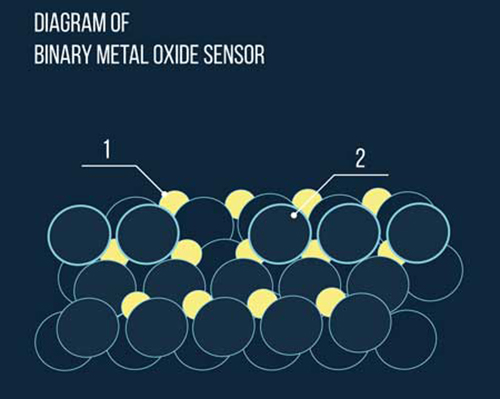
A schematic representation of a binary sensor based on two metal oxides, with the nanoparticles of the catalytically active component (1) in yellow and the nanoparticles of the electron donor component (2) represented by the unshaded circles. Read more: Nanosensors on the alert for terrorist threats

A mixed system of that kind has the two necessary components for effective gas detection, viz., an electron donor and a substance “accommodating” the reaction. An additional factor contributing to faster sensor response is the formation of chemisorption centers, i.e., the chemically active spots on the nanocrystals that facilitate gas molecule adsorption.

“We are planning further research into the possibilities for sensor design presented by the multicomponent metal oxide nanocomposites incorporating nanofibers. The development of new effective sensor compositions will be based on a reasonably balanced approach involving both the experimental tests and the advancement of our theoretical understanding of the sensing mechanisms,” comments Trakhtenberg.

A rather promising approach to the development of new gas detection systems is the use of “core-shell type” composite metal oxide nanofibers, where the “core” and the “shell” are composed of two different oxides.
Source: Moscow Institute of Physics and Technology

Related Articles Read More >

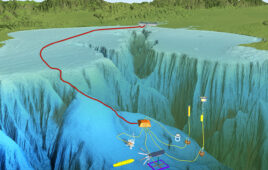
MBARI's Monterey Accelerated Research System (MARS) connects seafloor instruments to shore through a roughly 51-kilometer power and fiber-optic cable (red line) ending at a node about 891 meters down. The Geo-Sense system described in the new paper takes the opposite approach: a portable, battery-powered cable that records locally with no link to shore. Researchers used MARS's own fiber data to cross-check Geo-Sense's earthquake detections. Credit: MBARI
How lightweight AI startup Lightscline helped turn one to two years of seafloor data analysis into a two-month sprint
UC Riverside’s $5 fake drug detector uses toy robot sensors to catch counterfeit medications
R&D 100 winner flags even unknown fentanyl analogs
New nanopore sensor paves the way for fast, accurate, low-cost DNA sequencing
rd newsletter
EXPAND YOUR KNOWLEDGE AND STAY CONNECTED
Get the latest info on technologies, trends, and strategies in Research & Development.

R&D World Digital Issues

Fall 2025 issue

Browse the most current issue of R&D World and back issues in an easy to use high quality format. Clip, share and download with the leading R&D magazine today.

R&D 100 Awards
Research & Development World
  • Subscribe to R&D World Magazine
  • Sign up for R&D World’s newsletter
  • Contact Us
  • About Us
  • Drug Discovery & Development
  • Pharmaceutical Processing
  • Global Funding Forecast

Copyright © 2026 WTWH Media LLC. All Rights Reserved. The material on this site may not be reproduced, distributed, transmitted, cached or otherwise used, except with the prior written permission of WTWH Media
Privacy Policy | Advertising | About Us

Search R&D World

  • R&D World Home
  • Topics
    • Aerospace
    • Automotive
    • Biotech
    • Careers
    • Chemistry
    • Environment
    • Energy
    • Life Science
    • Material Science
    • R&D Management
    • Physics
  • Technology
    • 3D Printing
    • A.I./Robotics
    • Software
    • Battery Technology
    • Controlled Environments
      • Cleanrooms
      • Graphene
      • Lasers
      • Regulations/Standards
      • Sensors
    • Imaging
    • Nanotechnology
    • Scientific Computing
      • Big Data
      • HPC/Supercomputing
      • Informatics
      • Security
    • Semiconductors
  • R&D Market Pulse
  • R&D 100
    • 2025 R&D 100 Award Winners
    • 2025 Professional Award Winners
    • 2025 Special Recognition Winners
    • R&D 100 Awards Event
    • R&D 100 Submissions
    • Winner Archive
  • Resources
    • Research Reports
    • Digital Issues
    • Educational Assets
    • Subscribe
    • Video
    • Webinars
    • PharmSci360
    • Content submission guidelines for R&D World
  • Global Funding Forecast
  • Top Labs
  • Advertise
  • SUBSCRIBE