Research & Development World

  • R&D World Home
  • Topics
    • Aerospace
    • Automotive
    • Biotech
    • Careers
    • Chemistry
    • Environment
    • Energy
    • Life Science
    • Material Science
    • R&D Management
    • Physics
  • Technology
    • 3D Printing
    • A.I./Robotics
    • Software
    • Battery Technology
    • Controlled Environments
      • Cleanrooms
      • Graphene
      • Lasers
      • Regulations/Standards
      • Sensors
    • Imaging
    • Nanotechnology
    • Scientific Computing
      • Big Data
      • HPC/Supercomputing
      • Informatics
      • Security
    • Semiconductors
  • R&D Market Pulse
  • R&D 100
    • 2025 R&D 100 Award Winners
    • 2025 Professional Award Winners
    • 2025 Special Recognition Winners
    • R&D 100 Awards Event
    • R&D 100 Submissions
    • Winner Archive
  • Resources
    • Research Reports
    • Digital Issues
    • Educational Assets
    • Subscribe
    • Video
    • Webinars
    • Content submission guidelines for R&D World
  • Global Funding Forecast
  • Top Labs
  • Advertise
  • SUBSCRIBE

Martian Labyrinth

By R&D Editors | January 28, 2016

This perspective view in Noctis Labyrinthus was generated from the main camera’s stereo channels on ESA’s Mars Express. It shows the beautiful details of landslides in the steep-sided walls of the flat-topped graben in the foreground, and in the valley walls in the background. The scene is part of region imaged by the High Resolution Stereo Camera on Mars Express during orbit 14632. The image is centered on 6°S / 265°E; the ground resolution is about 16 meters per pixel. Courtesy of ESA/DLR/FU Berlin, CC BY-SA 3.0 IGO -- Click to enlargeThis block of Martian terrain, etched with an intricate pattern of landslides and wind-blown dunes, is a small segment of a vast labyrinth of valleys, fractures and plateaus.

The region, known as Noctis Labyrinthus — the “labyrinth of the night” — lies on the western edge of Valles Marineris, the Grand Canyon of the Solar System. It was imaged by ESA’s Mars Express on July 15, 2015.

It is part of a complex feature whose origin lies in the swelling of the crust owing to tectonic and volcanic activity in the Tharsis region, home to Olympus Mons and other large volcanoes.

As the crust bulged in the Tharsis province, it stretched apart the surrounding terrain, ripping fractures several kilometers deep and leaving blocks — graben — stranded within the resulting trenches.

The entire network of graben and fractures spans some 1,200 kilometers, about the equivalent length of the river Rhine from the Alps to the North Sea.

The segment presented here captures a roughly 120-kilometer-wide portion of that network, with one large, flat-topped block taking center stage.

Landslides are seen in extraordinary detail in the flanks of this unit and along the valley walls (most notable in the perspective view, top), with eroded debris lying at the base of the steep walls.

In some places, particularly notable in the lower-right corner of the plan view image (above), wind has drawn the dust into dune fields that extend up onto the surrounding plateaus.

Near-linear features are also visible on the flat elevated surfaces: fault lines crossing each other in different directions, suggesting many episodes of tectonic stretching in the complex history of this region.

Related Articles Read More >

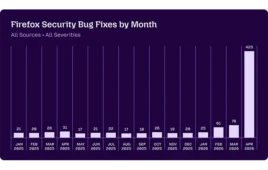
Who has access to Claude Mythos-tier models (and beyond) will redefine cybersecurity, including in R&D
Abstract of modern high tech internet data center room with rows of racks with network and server hardware. 3d rendering
A startup says it found hidden memory behavior in NVIDIA GPUs and is building a security layer around it
NTT Research launches Scale Academy with SaltGrain, a zero-trust data security suite
LabWare advances SaaS LIMS strategy at Pittcon 2026, one year after ASSURE launch
rd newsletter
EXPAND YOUR KNOWLEDGE AND STAY CONNECTED
Get the latest info on technologies, trends, and strategies in Research & Development.

R&D World Digital Issues

Fall 2025 issue

Browse the most current issue of R&D World and back issues in an easy to use high quality format. Clip, share and download with the leading R&D magazine today.

R&D 100 Awards
Research & Development World
  • Subscribe to R&D World Magazine
  • Sign up for R&D World’s newsletter
  • Contact Us
  • About Us
  • Drug Discovery & Development
  • Pharmaceutical Processing
  • Global Funding Forecast

Copyright © 2026 WTWH Media LLC. All Rights Reserved. The material on this site may not be reproduced, distributed, transmitted, cached or otherwise used, except with the prior written permission of WTWH Media
Privacy Policy | Advertising | About Us

Search R&D World

  • R&D World Home
  • Topics
    • Aerospace
    • Automotive
    • Biotech
    • Careers
    • Chemistry
    • Environment
    • Energy
    • Life Science
    • Material Science
    • R&D Management
    • Physics
  • Technology
    • 3D Printing
    • A.I./Robotics
    • Software
    • Battery Technology
    • Controlled Environments
      • Cleanrooms
      • Graphene
      • Lasers
      • Regulations/Standards
      • Sensors
    • Imaging
    • Nanotechnology
    • Scientific Computing
      • Big Data
      • HPC/Supercomputing
      • Informatics
      • Security
    • Semiconductors
  • R&D Market Pulse
  • R&D 100
    • 2025 R&D 100 Award Winners
    • 2025 Professional Award Winners
    • 2025 Special Recognition Winners
    • R&D 100 Awards Event
    • R&D 100 Submissions
    • Winner Archive
  • Resources
    • Research Reports
    • Digital Issues
    • Educational Assets
    • Subscribe
    • Video
    • Webinars
    • Content submission guidelines for R&D World
  • Global Funding Forecast
  • Top Labs
  • Advertise
  • SUBSCRIBE