Research & Development World

  • R&D World Home
  • Topics
    • Aerospace
    • Automotive
    • Biotech
    • Careers
    • Chemistry
    • Environment
    • Energy
    • Life Science
    • Material Science
    • R&D Management
    • Physics
  • Technology
    • 3D Printing
    • A.I./Robotics
    • Software
    • Battery Technology
    • Controlled Environments
      • Cleanrooms
      • Graphene
      • Lasers
      • Regulations/Standards
      • Sensors
    • Imaging
    • Nanotechnology
    • Scientific Computing
      • Big Data
      • HPC/Supercomputing
      • Informatics
      • Security
    • Semiconductors
  • R&D Market Pulse
  • R&D 100
    • 2025 R&D 100 Award Winners
    • 2025 Professional Award Winners
    • 2025 Special Recognition Winners
    • R&D 100 Awards Event
    • R&D 100 Submissions
    • Winner Archive
  • Resources
    • Research Reports
    • Digital Issues
    • Educational Assets
    • Subscribe
    • Video
    • Webinars
    • Content submission guidelines for R&D World
  • Global Funding Forecast
  • Top Labs
  • Advertise
  • SUBSCRIBE

What is an atomic absorption spectrophotometer

By Heather Hall | August 6, 2020

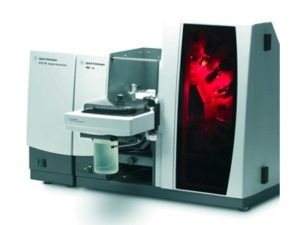
Atomic absorption spectrophotometerAtomic absorption spectrophotometry analyzes the concentration of elements in a liquid sample based on energy absorbed from certain wavelengths of light (usually 190 to 900 nm). Atomic absorption spectrophotometers typically include a flame burner to atomize the sample (most commonly a hollow cathode lamp), a monochromator and a photon detector. Depending on the model, some atomic absorption spectrometers are equipped with a turret or fixed lamp socket that can hold multiple lamps (up to eight) to reduce downtime between samples or allow for sequential analysis.

Atomic absorption spectrometers are used in the pharmaceutical industry during drug development. In atomic absorption spectrometry, a sample is atomized, usually by a flame or graphite furnace, and dispersed into the light. A detector measures the amount of absorption in the sample and compares it to a reference with a known concentration of the element in question to determine its concentration in the sample. Some of the specifications to be aware of before purchasing an atomic absorption spectrometer are its wavelength range, what type of atomizer it uses, if it can do multiple tests for multiple elements, and if it has a single beam, double beam or both types of light source.

AAS is also used in food and beverage, water, and clinical analysis. It is also used in mining operations, such as to determine the percentage of precious metal in rocks.
Comments

  1. Zulfiqar Samo says

    December 4, 2023 at 2:52 am

    a good website

Related Articles Read More >

group of scientists working at the laboratory
Benchling bets lab automation can ground AI co-scientists in the physical world
For AI co-scientists to scale, scientists have to trust them. The architectural bets to earn it vary.
scientist working with microplate in a pharmaceutical lab / biomedical engineer working with samples in microplate in the laboratory
Pistoia Alliance on why 69% of life sciences firms can’t measure AI’s impact, and the architectural shift that could change that
AI co-scientist startup CTO on ‘hypothesis slop,’ deterministic code and the goal of compressing a century of science into a decade
rd newsletter
EXPAND YOUR KNOWLEDGE AND STAY CONNECTED
Get the latest info on technologies, trends, and strategies in Research & Development.

R&D World Digital Issues

Fall 2025 issue

Browse the most current issue of R&D World and back issues in an easy to use high quality format. Clip, share and download with the leading R&D magazine today.

R&D 100 Awards
Research & Development World
  • Subscribe to R&D World Magazine
  • Sign up for R&D World’s newsletter
  • Contact Us
  • About Us
  • Drug Discovery & Development
  • Pharmaceutical Processing
  • Global Funding Forecast

Copyright © 2026 WTWH Media LLC. All Rights Reserved. The material on this site may not be reproduced, distributed, transmitted, cached or otherwise used, except with the prior written permission of WTWH Media
Privacy Policy | Advertising | About Us

Search R&D World

  • R&D World Home
  • Topics
    • Aerospace
    • Automotive
    • Biotech
    • Careers
    • Chemistry
    • Environment
    • Energy
    • Life Science
    • Material Science
    • R&D Management
    • Physics
  • Technology
    • 3D Printing
    • A.I./Robotics
    • Software
    • Battery Technology
    • Controlled Environments
      • Cleanrooms
      • Graphene
      • Lasers
      • Regulations/Standards
      • Sensors
    • Imaging
    • Nanotechnology
    • Scientific Computing
      • Big Data
      • HPC/Supercomputing
      • Informatics
      • Security
    • Semiconductors
  • R&D Market Pulse
  • R&D 100
    • 2025 R&D 100 Award Winners
    • 2025 Professional Award Winners
    • 2025 Special Recognition Winners
    • R&D 100 Awards Event
    • R&D 100 Submissions
    • Winner Archive
  • Resources
    • Research Reports
    • Digital Issues
    • Educational Assets
    • Subscribe
    • Video
    • Webinars
    • Content submission guidelines for R&D World
  • Global Funding Forecast
  • Top Labs
  • Advertise
  • SUBSCRIBE