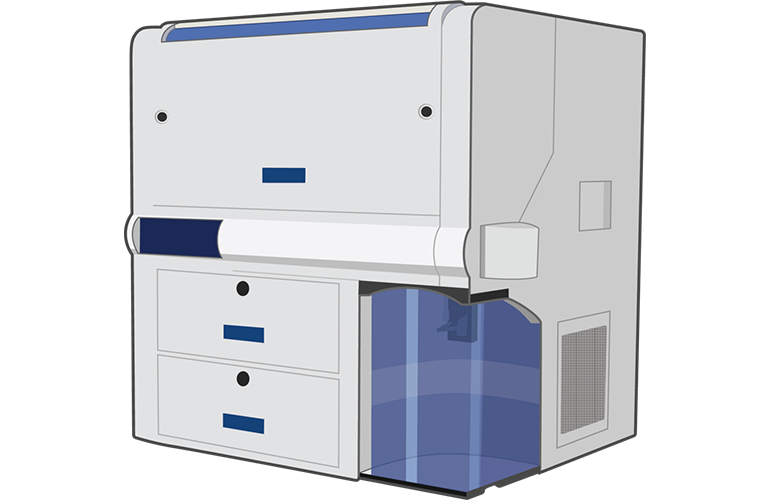
A flow cytometer, shown in an NIH BioArt illustration. Credit: Ryan Kissinger / NIAID BioArt Source (public domain)
In 2023, David Leclerc, technical director of the University of Chicago’s Cytometry and Antibody Technology core facility, wrote about a retirement that came early. The facility had bought a BD FACSAria II cell sorter in 2009. Its operating system, Windows XP, was older still, having debuted in 2001. When the computer’s motherboard failed, no modern computer could take the sorter’s video card. The facility pulled the instrument in 2022. “Long story short, the AriaII was a victim of computer obsolescence,” Leclerc wrote. “So this perfectly functional cell sorter was dismissed because we couldn’t connect a computer to it.” He called it “a sad ending for that instrument,” which is “stuck in a closet now.”
The story is not be an anomaly as many labs with flow cytometers have had them for several years. A June 2020 survey of 146 flow cytometry core facilities, published in 2023 in the Journal of Biomolecular Techniques, found the average analyzer then was 9 years old and the average sorter 8.5 years old. Asked what would push them to replace a sorter, 31.5% of respondents cited the manufacturer ending service. Changing user needs and chronic breakdowns each drew 21.3%.
Some core facilities are retiring their filter-based cell sorters in favor of spectral ones. Rockefeller University’s Flow Cytometry Resource Center, for instance, scheduled its BD FACSAria sorters to be phased out in January and February 2026, leaving three spectral sorters (one BD FACSDiscover S8 and two Cytek Aurora CS) and one conventional sorter. Cytek reported an installed base of 3,933 instruments after adding 142 units in the second quarter of 2026.
Replacing a sorter today often means buying a spectral instrument, and comparison-shopping remains difficult. Vendors, of course, do not tend to post U.S. list prices, configurations vary, and the service contract is usually sold separately. Public records fill in part of the picture: NIH shared-instrumentation grants, federal purchase orders and European tenders, although, if anything, they only provide a rough sense of pricing. Across those sources, the middle half of recorded prices for the three spectral sorters with enough records runs from about $570,000 to $760,000, compared with $410,000 to $536,000 for BD’s conventional high-speed cell sorters. The aforementioned survey put a sorter’s average annual maintenance at about $25,000.
The flow cytometer lineup has also changed quickly over the years. Since May 2024:
- Agilent launched the NovoCyte Opteon (May 2024).
- Beckman Coulter Life Sciences began selling the CytoFLEX mosaic (March 2025), a spectral detection module that attaches to certain existing CytoFLEX analyzers.
- BD launched the FACSDiscover A8 (May 2025), which adds real-time cell imaging to spectral analysis.
- Thermo Fisher’s Attune Xenith and Cytek’s Aurora Evo both launched on May 29, 2025.
- Cytek showed the Borealis at CYTO 2026 in June, with seven lasers and 110 fluorescence detectors, sold for now only through an early access program.
- Waters launched the BD FACSDiscover A7 on Sept. 14, 2026.
BD remains the legal manufacturer of the instruments after Waters completed its combination with the former’s Biosciences and Diagnostic Solutions unit.
What public buyers paid for spectral cytometers
Public records put spectral analyzers on a wide ladder with compact three-laser systems often landing near $110,000–$150,000. Meanwhile, five-laser workhorses such as the Cytek Aurora commonly fall in the mid-$200,000s to low-$400,000s, and high-detector Sony and BD platforms can surpass $500,000. Spectral sorters sit a tier higher. Prices below come (methodology note below the table) from public purchase records and are rough context. Configurations vary, and about a quarter of the records bundle service, warranty or accessories.
Prices are nominal and span 2016 to 2026 For rough scale of inflation, the Bureau of Labor Statistics’ producer price index for analytical laboratory instrument manufacturing rose about 31% from mid-2018 to August 2026, so a 2018 purchase would be roughly a third higher in today’s dollars.
| Instrument | Type | Launched | Lasers / detectors (max) | Public purchase prices (USD; configurations vary) |
|---|---|---|---|---|
| Spectral analyzers | ||||
| Cytek Northern Lights Cytek Biosciences |
Full spectrum | 2018 | 3 / 38 | 3 records, 2021–2022: $112K, $125K, $152K |
| Cytek Aurora Cytek Biosciences |
Full spectrum | 2017 | 5 / 64 | 41 records, 2018–2026. Middle half: $[TK]–$427K |
| Cytek Aurora Evo Cytek Biosciences |
Full spectrum | 2025 | 5 / 64 | 2 records, 2026: $200K, $532K. GSA ceiling: $749K |
| Sony ID7000 Sony Biotechnology |
Full spectrum | 2019 | 7 / 184 3- to 7-laser configurations |
13 records, 2020–2026. Middle half: $[TK]–$543K |
| BD FACSymphony A5 SE Waters (BD brand) |
Spectral mode, conventional design | 2021 | 5 / 48 | 8 records, 2022–2025. Middle half: $[TK]–$638K |
| BD FACSDiscover A8 Waters (BD brand) |
Spectral with imaging | 2025 | 5 / 78 | 3 records (all European), 2025–2026: $517K, $556K, $643K |
| Invitrogen Attune Xenith Thermo Fisher Scientific |
Spectral mode, conventional design | 2025 | 6 / 51 | 1 record, 2026: $350K |
| BD FACSDiscover A7 Waters (BD brand) |
Full spectrum | 2026 | 5 / 78 Not yet CE marked |
None yet |
| Agilent NovoCyte Opteon Agilent Technologies |
Full spectrum | 2024 | 5 / 73 | None found |
| CytoFLEX with mosaic module Beckman Coulter Life Sciences |
Spectral mode, conventional design | 2025 | 6 / 81 mosaic 88 on a CytoFLEX LX |
None for a full system; one NIH order for the module alone: $153K (2026) |
| Cytek Borealis Cytek Biosciences |
Full spectrum | 2026 | 7 / 110 Early access; preliminary specs |
None found |
| Spectral cell sorters | ||||
| Cytek Aurora CS Cytek Biosciences |
Full spectrum | 2021 | 5 / 64 | 13 records, 2021–2026. Middle half: $567K–$633K. GSA ceiling: $900K |
| Invitrogen Bigfoot Spectral Thermo Fisher Scientific |
Spectral mode, conventional design | By 2021 | 9 / 55 | 10 records, 2020–2023. Middle half: $[TK]–$745K |
| BD FACSymphony S6 SE Waters (BD brand) |
Spectral mode, conventional design | By 2023 | Up to 9 / 48 From base S6 sheet |
3 records, 2023–2025: $644K, $680K, $689K |
| BD FACSDiscover S8 Waters (BD brand) |
Spectral with imaging | 2023 | 5 / 78 | 17 records, 2023–2026. Middle half: $[TK]–$761K |
| Sony FP7000 Sony Biotechnology |
Full spectrum | 2023 | 5 / 182 Shipping status unclear |
None found |
| Conventional benchmarks | ||||
| Invitrogen Attune NxT Thermo Fisher Scientific |
Analyzer | 4 / 14 | 18 records, 2016–2026. Middle half: $[TK]–$164K | |
| Agilent NovoCyte Penteon Agilent Technologies |
Analyzer | 5 / 30 | GSA ceiling only: $322K | |
| Sony MA900 Sony Biotechnology |
Sorter | 4 / 12 | 12 records, 2019–2024. Middle half: $[TK]–$392K | |
| Beckman CytoFLEX SRT Beckman Coulter Life Sciences |
Sorter | 2021 | 4 / 15 | 5 records, 2022–2024. Middle half: $[TK]–$406K |
| BD FACSAria Fusion Waters (BD brand) |
Sorter | 5 / 18 | 17 records, 2017–2026. Middle half: $410K–$536K | |
Methodology and caveats
Prices come from U.S. federal orders on USAspending.gov, NIH S10 grants in NIH RePORTER, European and UK tenders (TED, Contracts Finder and Find a Tender) and GSA Advantage schedule listings, searched through Sept. 23, 2026. Of about 2,400 records reviewed, 166 awards and grants name a model in the table; records that only implied a model were left out. Figures are per unit where a record states a count and the whole order otherwise. Specifications are vendor-stated maximums. “Middle half” is the 25th-to-75th percentile of recorded prices.
Individual records can swing widely. GSA figures are schedule ceilings that include five-year service packages. A USDA order for a FACSDiscover S8 with imaging came in at $304,769 in July 2026, about half of other S8 orders, and the record does not explain why. The Borealis and FP7000 appear only in European notices listing a €1 placeholder value (Leiden, Amsterdam). Public procurement is also only one slice of the market: industrial buyers, framework contracts and volume deals do not show up in these records.

Tell Us What You Think!
You must be logged in to post a comment.