Research & Development World

  • R&D World Home
  • Topics
    • Aerospace
    • Automotive
    • Biotech
    • Careers
    • Chemistry
    • Environment
    • Energy
    • Life Science
    • Material Science
    • R&D Management
    • Physics
  • Technology
    • 3D Printing
    • A.I./Robotics
    • Software
    • Battery Technology
    • Controlled Environments
      • Cleanrooms
      • Graphene
      • Lasers
      • Regulations/Standards
      • Sensors
    • Imaging
    • Nanotechnology
    • Scientific Computing
      • Big Data
      • HPC/Supercomputing
      • Informatics
      • Security
    • Semiconductors
  • R&D Market Pulse
  • R&D 100
    • 2026 R&D 100 Award Winners
    • 2026 Professional Award Winners
    • 2026 Special Recognition Winners
    • R&D 100 Awards Event
    • R&D 100 Submissions
    • Winner Archive
  • Resources
    • Research Reports
    • Digital Issues
    • Educational Assets
    • Subscribe
    • Video
    • Webinars
    • PharmSci360
    • Content submission guidelines for R&D World
  • Global Funding Forecast
  • Top Labs
  • Advertise
  • SUBSCRIBE

What is artificial intelligence (AI)?

By Paul Heney | March 10, 2021

When computers display the type of intelligence that humans and animals possess, this is known as artificial intelligence (AI). Intelligence involves perceiving the environment and using this information to take actions that maximize the likelihood of achieving objectives. Specific AI capabilities include learning, perception, reasoning, planning, knowledge representation and natural language processing.

Ultimately, it is hoped these can be combined into a ‘general intelligence.’ These functions contrast with the clearly defined algorithms of non-AI computing. AI is a general term for any artificial entity that has these abilities, but in practice, it is generally realized using a neural network to perform machine learning.

Artificial general intelligence (AGI) is the ultimate aim for many AI researchers. It would enable a machine to understand or learn anything that a human can, without requiring an pre-programming or being pre-configured by a human operator. AGI is sometimes referred to as ‘strong AI,’ in contrast with the ‘weak AI’ or ‘narrow AI.’ Weak AI is currently used to perform a very specific task for which it has been given clear success criteria and training data.

AI should not be confused with self-awareness, or artificial consciousness. AI can already perform certain narrow tasks with a far higher capability than a human, without any reason to believe it has any self-awareness. It therefore seems possible that a general intelligence would not require self-awareness. Understanding the nature of self-awareness is highly philosophical and we are far from reaching any consensus on how it arises in humans, never mind how it might be artificially created.

Artificial intelligence is sometimes regarded as a catch-all term for tasks not yet, or only recently, resolved by computing technology. Therefore, functions such as optical character recognition, which was once regarded as AI, are no longer considered to be ‘intelligent.’ Similar capabilities, which remain at the cutting edge of computing, are still considered to be examples of AI — for example, speech recognition and autonomous vehicles.

Most current developments in AI use artificial neural networks, networks of connections that can store and process information. These are well-suited to learning, requiring only an objective, with no need for precise instructions on how to perform the task. The way that neural networks learn, using mathematical models, is closely related to regression in non-linear statistics. However, while regression might be used to fit a line to data with two dimensions, neural networks fit models to data with much larger numbers of dimensions. This means they require very large datasets, although it is interesting to note that human intelligence can sometimes learn much more quickly with little data.

Related Articles Read More >

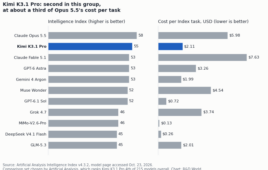
Bar charts of Artificial Analysis Intelligence Index scores and cost per index task for 11 AI models, with Kimi K3.1 Pro at 55 and $2.11 per task.
How Kimi K3.1 Pro stacks up against Claude Opus 5.5 and GPT-6 Astra
Schematic of the M2PC lab interior showing rows of Ginkgo Bioworks automated instrument carts for media prep, strain engineering, cell culturing, functional testing, sample prep and phenotyping analysis, linked by automated connectivity
PNNL breaks ground on a 100-instrument autonomous microbe lab that will open to outside researchers in 2029
Jack Clark speaking at a podium during the Per Jacobsson Foundation Lecture
Anthropic co-founder Jack Clark says a billion virtual scientists are coming. Or 10 billion.
Claude Duet phone notification reading: Morning, Nicole! For today: Health permit. Hiring decisions. Northfield renewal.
Anthropic joins the race for AI agents that keep working between conversations
rd newsletter
EXPAND YOUR KNOWLEDGE AND STAY CONNECTED
Get the latest info on technologies, trends, and strategies in Research & Development.

R&D World Digital Issues

Fall 2025 issue

Browse the most current issue of R&D World and back issues in an easy to use high quality format. Clip, share and download with the leading R&D magazine today.

R&D 100 Awards
Research & Development World
  • Subscribe to R&D World Magazine
  • Sign up for R&D World’s newsletter
  • Contact Us
  • About Us
  • Drug Discovery & Development
  • Pharmaceutical Processing
  • Global Funding Forecast

Copyright © 2026 Arrowfly LLC. All Rights Reserved. The material on this site may not be reproduced, distributed, transmitted, cached or otherwise used, except with the prior written permission of Arrowfly
Privacy Policy | Advertising | About Us

Search R&D World

  • R&D World Home
  • Topics
    • Aerospace
    • Automotive
    • Biotech
    • Careers
    • Chemistry
    • Environment
    • Energy
    • Life Science
    • Material Science
    • R&D Management
    • Physics
  • Technology
    • 3D Printing
    • A.I./Robotics
    • Software
    • Battery Technology
    • Controlled Environments
      • Cleanrooms
      • Graphene
      • Lasers
      • Regulations/Standards
      • Sensors
    • Imaging
    • Nanotechnology
    • Scientific Computing
      • Big Data
      • HPC/Supercomputing
      • Informatics
      • Security
    • Semiconductors
  • R&D Market Pulse
  • R&D 100
    • 2026 R&D 100 Award Winners
    • 2026 Professional Award Winners
    • 2026 Special Recognition Winners
    • R&D 100 Awards Event
    • R&D 100 Submissions
    • Winner Archive
  • Resources
    • Research Reports
    • Digital Issues
    • Educational Assets
    • Subscribe
    • Video
    • Webinars
    • PharmSci360
    • Content submission guidelines for R&D World
  • Global Funding Forecast
  • Top Labs
  • Advertise
  • SUBSCRIBE