Research & Development World

  • R&D World Home
  • Topics
    • Aerospace
    • Automotive
    • Biotech
    • Careers
    • Chemistry
    • Environment
    • Energy
    • Life Science
    • Material Science
    • R&D Management
    • Physics
  • Technology
    • 3D Printing
    • A.I./Robotics
    • Software
    • Battery Technology
    • Controlled Environments
      • Cleanrooms
      • Graphene
      • Lasers
      • Regulations/Standards
      • Sensors
    • Imaging
    • Nanotechnology
    • Scientific Computing
      • Big Data
      • HPC/Supercomputing
      • Informatics
      • Security
    • Semiconductors
  • R&D Market Pulse
  • R&D 100
    • 2025 R&D 100 Award Winners
    • 2025 Professional Award Winners
    • 2025 Special Recognition Winners
    • R&D 100 Awards Event
    • R&D 100 Submissions
    • Winner Archive
  • Resources
    • Research Reports
    • Digital Issues
    • Educational Assets
    • Subscribe
    • Video
    • Webinars
    • Content submission guidelines for R&D World
  • Global Funding Forecast
  • Top Labs
  • Advertise
  • SUBSCRIBE

New RNA-guided system TIGR-Tas could challenge CRISPR’s stronghold

By Brian Buntz | April 8, 2025

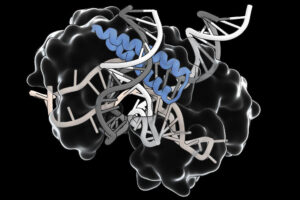
The Tas protein uses an RNA guide to home in on a specific target DNA sequence.

The Tas protein uses an RNA guide to home in on a specific target DNA sequence. [Image from Max Wilkinson/MIT]

Researchers at MIT and the Broad Institute have discovered TIGR-Tas, a novel family of RNA-guided DNA targeting systems found in bacteria and phages. Distinct from CRISPR-Cas, TIGR-Tas offers unique structural features, a much smaller size, and a different targeting mechanism that doesn’t appear to require specific DNA ‘anchors’ (PAM sites). These characteristics could directly address key bottlenecks in genome engineering. For instance, they could simplify delivery methods for cell and gene therapies (CGT) and significantly expand the range of genetic diseases potentially treatable through gene editing. An article in Science summarizes the potential benefits of the approach. The abstract of the paper notes: “TasR can be reprogrammed for precise DNA cleavage, including in human cells.”

This is a very versatile RNA-guided system with a lot of diverse functionalities.

—Feng Zhang

The identification of TIGR-Tas resulted from a computational search strategy. Researchers began by focusing on a key structural component of the well-known Cas9 protein—its guide RNA-binding domain. Using this as a starting point, they employed iterative structural and sequence homology searches across vast prokaryotic and viral protein databases. As the search yielded thousands of potential candidates, a protein large language model helped cluster these hits based on predicted structural features and likely evolutionary relationships. This AI-driven analysis pinpointed a distinct group of proteins encoded near regularly spaced, repetitive DNA sequences reminiscent of CRISPR arrays, leading to the system’s identification.

This discovery emerged from a collaborative effort led by Feng Zhang’s laboratory at the McGovern Institute for Brain Research at MIT and the Broad Institute of MIT and Harvard. Key contributors included Guilhem Faure, Makoto Saito, Max Wilkinson, Rhiannon Macrae (affiliated with the Howard Hughes Medical Institute – HHMI), and Eugene Koonin (from the National Center for Biotechnology Information – NCBI – at the NIH), highlighting the work’s interdisciplinary nature.

The computational search identified these novel TIGR-Tas systems predominantly within the genomes of bacteriophages (viruses that infect bacteria) and in parasitic or symbiotic bacteria. This search revealed a remarkable diversity, uncovering over 20,000 distinct Tas proteins within this new family. This vast number hints at potentially varied roles in their native biological contexts – roles which are now under active investigation.

The features of TIGR-Tas translate directly into several advantages for cell and gene therapy (CGT). For one, its significantly smaller size could alleviate a major delivery bottleneck. That makes it easier to package the necessary genetic components within the limited capacity (~4.7 kb) of viral vectors like AAVs, often used for in vivo therapies. Simultaneously, its independence from PAM site restrictions expands the potential targeting landscape within the human genome, potentially enabling access to disease-causing mutations or genomic locations currently inaccessible to many CRISPR editors.

Beyond therapy, the system’s inherent modularity makes it an attractive chassis for bioengineering. Researchers envision fusing various functional domains to the Tas RNA-binding scaffold to create novel tools, such as base or epigenome editors. TIGR-Tas also promises utility as a standard research tool for gene editing in the lab and offers a new window into fundamental biology.  That is, it could drive research into its natural roles within microbial ecosystems and the broader evolution of RNA-guided mechanisms.

TIGR-Tas, however, remains a nascent technology, only discovered recently (published February 2025). It thus faced hurdles compared to the highly developed CRISPR toolkit refined over more than a decade. A central immediate challenge is rigorously validating its genome-wide specificity. While the “dual-guide” mechanism hints at precision, the lack of a PAM requirement could raise concerns about potential off-target activity and tolerance for mismatches. Comprehensive, unbiased experimental data addressing this specificity paradox is essential but not yet available.

Beyond specificity, the system’s efficiency could require substantial optimization for reliable therapeutic applications. Additionally, standard gene editing challenges, such as achieving efficient in vivo delivery to target tissues and managing potential immune responses (immunogenicity) to the bacterial/phage-derived Tas proteins, must also be addressed. The path forward requires independent validation by the broader research community, alongside ongoing work by the discovery team focused on structural biology, protein engineering for improved performance, and understanding the system’s natural biological function.

 

Related Articles Read More >

Musk says the cheapest place to put AI is space. SpaceX’s IPO filing isn’t so sure.
JetX automates LC sample preparation with integrated extraction, filtration and dilution
NASA’s Hubble detects first-ever spin reversal of comet
Long-read sequencing unlocks “invisible” genome regions for rare disease diagnosis
rd newsletter
EXPAND YOUR KNOWLEDGE AND STAY CONNECTED
Get the latest info on technologies, trends, and strategies in Research & Development.

R&D World Digital Issues

Fall 2025 issue

Browse the most current issue of R&D World and back issues in an easy to use high quality format. Clip, share and download with the leading R&D magazine today.

R&D 100 Awards
Research & Development World
  • Subscribe to R&D World Magazine
  • Sign up for R&D World’s newsletter
  • Contact Us
  • About Us
  • Drug Discovery & Development
  • Pharmaceutical Processing
  • Global Funding Forecast

Copyright © 2026 WTWH Media LLC. All Rights Reserved. The material on this site may not be reproduced, distributed, transmitted, cached or otherwise used, except with the prior written permission of WTWH Media
Privacy Policy | Advertising | About Us

Search R&D World

  • R&D World Home
  • Topics
    • Aerospace
    • Automotive
    • Biotech
    • Careers
    • Chemistry
    • Environment
    • Energy
    • Life Science
    • Material Science
    • R&D Management
    • Physics
  • Technology
    • 3D Printing
    • A.I./Robotics
    • Software
    • Battery Technology
    • Controlled Environments
      • Cleanrooms
      • Graphene
      • Lasers
      • Regulations/Standards
      • Sensors
    • Imaging
    • Nanotechnology
    • Scientific Computing
      • Big Data
      • HPC/Supercomputing
      • Informatics
      • Security
    • Semiconductors
  • R&D Market Pulse
  • R&D 100
    • 2025 R&D 100 Award Winners
    • 2025 Professional Award Winners
    • 2025 Special Recognition Winners
    • R&D 100 Awards Event
    • R&D 100 Submissions
    • Winner Archive
  • Resources
    • Research Reports
    • Digital Issues
    • Educational Assets
    • Subscribe
    • Video
    • Webinars
    • Content submission guidelines for R&D World
  • Global Funding Forecast
  • Top Labs
  • Advertise
  • SUBSCRIBE