The 3 mm Multi-Nuclear Inverse (MNI) CryoProbe is a Nuclear Magnetic Resonance (NMR) detector “combining the highest sensitivity and versatility,” according to the R&D 100 2025 team at Bruker who developed it.
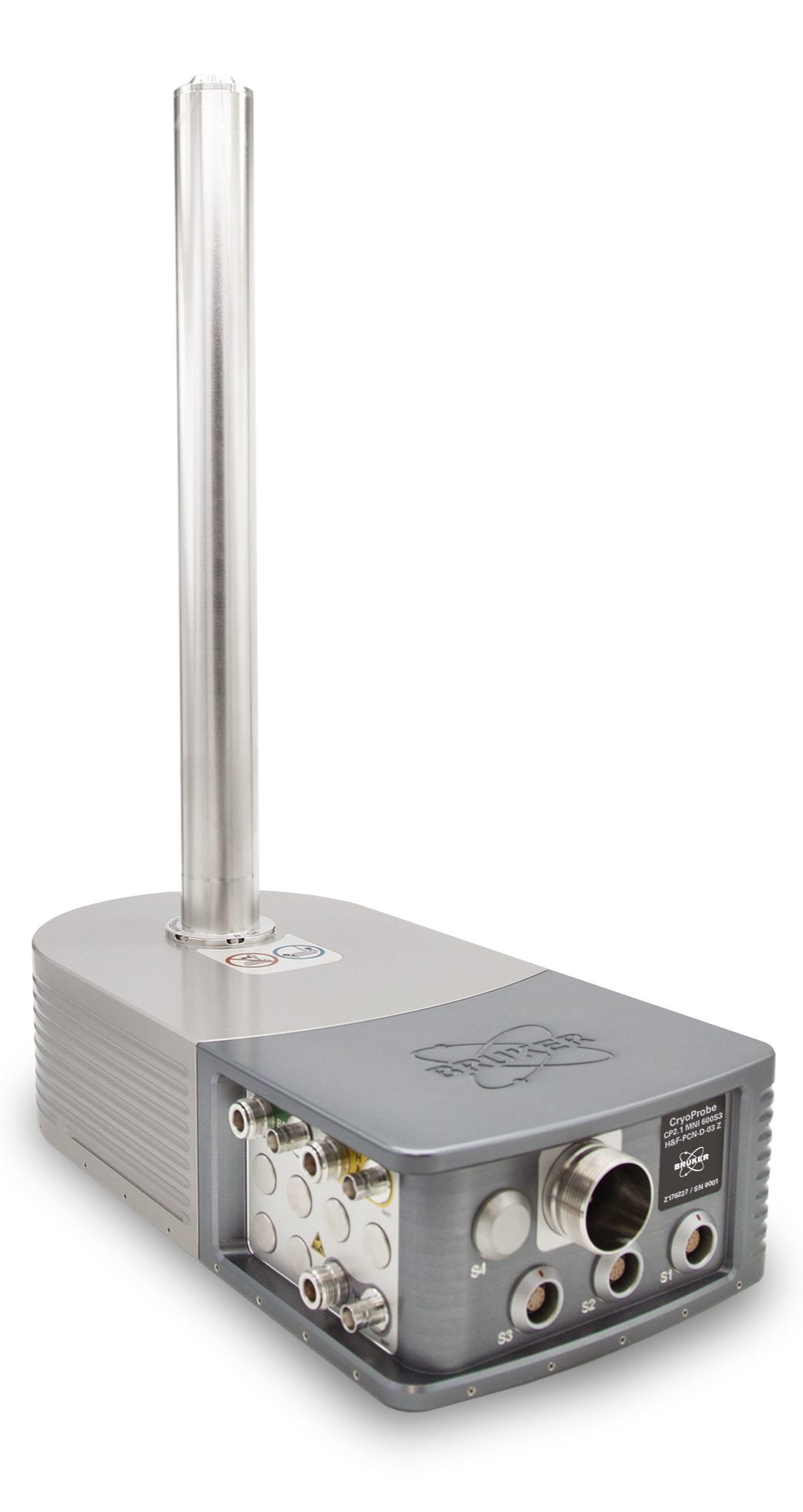
The 3mm Probe. Credit: Bruker
The Ultra-Sensitive 3 mm MNI CryoProbe
Scientists working in discovery and development were having difficulties characterizing lead compounds and their related substances considering limited amounts of materials available, said Dr. Vijaykumar Ramaswamy, lead development engineer in the Probes R&D department at Bruker Switzerland. This probe was designed to help address that problem.
The solution was to improve the detection efficiency of the probe through innovative coil technology combined with a reduction of active volume, said Vijaykumar. While previous development efforts prioritized improving the sensitivity on one channel at the cost of sacrificing another, the MNI team worked with a mission of “sensitivity with versatility”. A core team of five R&D engineers worked for five years to develop the MNI probe, he added, ably supported by colleagues from product management, application, production engineering, quality management, and procurement.
Vijaykumar adds, “The result is a probe tailored to the needs of the pharmaceutical research & development customers — unprecedented sensitivity and versatility for the characterization of organic molecules with natural abundance isotopes. For the first time, we can offer our customers a 2x gain in sensitivity of the 1H or 19F channel compared to the state-of-the-art, simultaneously with a multi-nuclear channel tunable offering performance rivalling that of state-of-the-art broadband-observe cryoprobes. This translates to a 4x-reduction in measurement time, which holds the potential of reducing the timeframe for therapeutics development and time-to-market.”
“We have a growing installed base of MNI probes at Pharma client sites. The MNI probe is a breakthrough technology tool supporting researchers working on the structural characterization and development of active pharmaceutical ingredients. It offers faster access to the characterization of size limited samples and delivers high sensitivity for complex biologically active molecules like peptides, such as those used in weight-loss GLP1 pharmaceutical analogues, and oligonucleotides, such as siRNA used in gene silencing therapies” said Dr. Frederic Girard, Senior Director of Pharma-Biotech business unit at Bruker.
The MNI CryoProbe is easy to integrate into the lab as it is installed and operated like a regular cryoprobe with no special requirements. The coils are cooled with the standard Bruker CryoPlatform to approximately 20 K, like a regular cryoprobe, with no special system requirements. The multi-nuclear channel of the MNI probe can be tuned to the most relevant nuclei, 13C, 15N or 31P, allowing for spin manipulations as well as decoupling pulses on one of these nuclei during 1H or 19F detection. At the same time, it is also possible to observe one of these three nuclei while decoupling on 1H or 19F channels.
How it works
Nuclear magnetic resonance spectroscopy (NMR) is an analytical technique that allows for non-invasive and non-destructive quantitative analytical investigations into molecular structure, dynamic processes and chemical reactions. The probe houses the radiofrequency coils that transmit pulses to excite the nuclei and detect the resulting signals used to generate the NMR spectrum. To a trained chemist, the NMR spectrum is the signature of the molecule to analyze the molecular structure and dynamics.
In a CryoProbe, the detector coils and pre-amplifiers are cooled to extremely low temperatures to reduce thermal noise and increase the sensitivity of detection. The Ultra-Sensitive 3 mm MNI CryoProbe employs an inner coil optimized for detection 1H or 19F nuclei, with an outer coil tuneable to 13C, 15N or 31P.