Research & Development World

  • R&D World Home
  • Topics
    • Aerospace
    • Automotive
    • Biotech
    • Careers
    • Chemistry
    • Environment
    • Energy
    • Life Science
    • Material Science
    • R&D Management
    • Physics
  • Technology
    • 3D Printing
    • A.I./Robotics
    • Software
    • Battery Technology
    • Controlled Environments
      • Cleanrooms
      • Graphene
      • Lasers
      • Regulations/Standards
      • Sensors
    • Imaging
    • Nanotechnology
    • Scientific Computing
      • Big Data
      • HPC/Supercomputing
      • Informatics
      • Security
    • Semiconductors
  • R&D Market Pulse
  • R&D 100
    • 2026 R&D 100 Award Winners
    • 2026 Professional Award Winners
    • 2026 Special Recognition Winners
    • R&D 100 Awards Event
    • R&D 100 Submissions
    • Winner Archive
  • Resources
    • Research Reports
    • Digital Issues
    • Educational Assets
    • Subscribe
    • Video
    • Webinars
    • PharmSci360
    • Content submission guidelines for R&D World
  • Global Funding Forecast
  • Top Labs
  • Advertisers
    • Advertise
    • PR Submissions
    • Eblast Submissions
  • SUBSCRIBE

Molecular Devices and Automata partner to connect lab instruments end-to-end

By R&D Editors | February 10, 2026

As life science laboratories face escalating pressure to accelerate drug discovery while maintaining rigorous data integrity, the “manual bottleneck”—the human intervention required between high-tech instruments—remains a primary hurdle. To address this, Molecular Devices, a Danaher Corporation company, has announced a strategic collaboration with London-based Automata to create a truly interconnected research ecosystem.
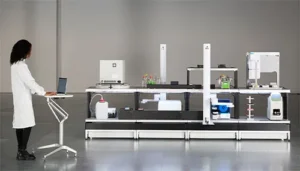
Credit: Molecular Devices

Molecular Devices’ imaging systems and microplate readers will be integrated with Automata’s LINQ platform to connect the machines via software and robotics. The LINQ platform allows instruments from different brands to communicate and move samples around without human intervention, transforming disparate pieces of lab hardware into a singular, flowing “nervous system” for research.

Today’s automation often exists in silos. A high-content screener might be automated internally, but moving plates between that screener, an incubator, and a liquid handler often requires a human scientist. This manual “bridge” introduces variability and potential error.

“Many of today’s scientific teams are working to increase productivity and data quality without adding operational complexity,” said Lars Hartvig Kristiansen, vice president of Product Innovation and Strategy at Molecular Devices. “Combining Molecular Devices’ microplate readers and high-content screening systems with Automata’s LINQ platform gives customers a clear path to connected, scalable workflows.” 

The collaboration reflects broader strategic alignment: Danaher Ventures, the venture capital arm of Molecular Devices’ parent company, participated in Automata’s Series C funding round and secured a board seat, while Beckman Coulter Life Sciences, another Danaher company, is also integrating its instruments with LINQ, creating a unified ecosystem across multiple Danaher life sciences brands.
Related Articles Read More >

A two-armed white robot with dexterous hands above a lab bench holding a glass funnel on a ring stand, a beaker and a wash bottle
NVIDIA’s GR00T 2 reaches 95% on selected robot tasks after five demonstrations
HEMCO UniFlow SE AireStream fume hood with a sash and support cabinet
HEMCO offers UniFlow fume hoods with application-specific liners
Anthropic acquires a one-person biotech that used Claude to coordinate 11 labs
Schematic of the M2PC lab interior showing rows of Ginkgo Bioworks automated instrument carts for media prep, strain engineering, cell culturing, functional testing, sample prep and phenotyping analysis, linked by automated connectivity
PNNL breaks ground on a 100-instrument autonomous microbe lab that will open to outside researchers in 2029
rd newsletter
EXPAND YOUR KNOWLEDGE AND STAY CONNECTED
Get the latest info on technologies, trends, and strategies in Research & Development.

R&D World Digital Issues

Fall 2026 issue

Browse the most current issue of R&D World and back issues in an easy to use high quality format. Clip, share and download with the leading R&D magazine today.

R&D 100 Awards
Research & Development World
  • Subscribe to R&D World Magazine
  • Sign up for R&D World’s newsletter
  • Contact Us
  • About Us
  • Drug Discovery & Development
  • Pharmaceutical Processing
  • Global Funding Forecast

Copyright © 2026 Arrowfly LLC. All Rights Reserved. The material on this site may not be reproduced, distributed, transmitted, cached or otherwise used, except with the prior written permission of Arrowfly
Privacy Policy | Advertising | About Us

Search R&D World

  • R&D World Home
  • Topics
    • Aerospace
    • Automotive
    • Biotech
    • Careers
    • Chemistry
    • Environment
    • Energy
    • Life Science
    • Material Science
    • R&D Management
    • Physics
  • Technology
    • 3D Printing
    • A.I./Robotics
    • Software
    • Battery Technology
    • Controlled Environments
      • Cleanrooms
      • Graphene
      • Lasers
      • Regulations/Standards
      • Sensors
    • Imaging
    • Nanotechnology
    • Scientific Computing
      • Big Data
      • HPC/Supercomputing
      • Informatics
      • Security
    • Semiconductors
  • R&D Market Pulse
  • R&D 100
    • 2026 R&D 100 Award Winners
    • 2026 Professional Award Winners
    • 2026 Special Recognition Winners
    • R&D 100 Awards Event
    • R&D 100 Submissions
    • Winner Archive
  • Resources
    • Research Reports
    • Digital Issues
    • Educational Assets
    • Subscribe
    • Video
    • Webinars
    • PharmSci360
    • Content submission guidelines for R&D World
  • Global Funding Forecast
  • Top Labs
  • Advertisers
    • Advertise
    • PR Submissions
    • Eblast Submissions
  • SUBSCRIBE