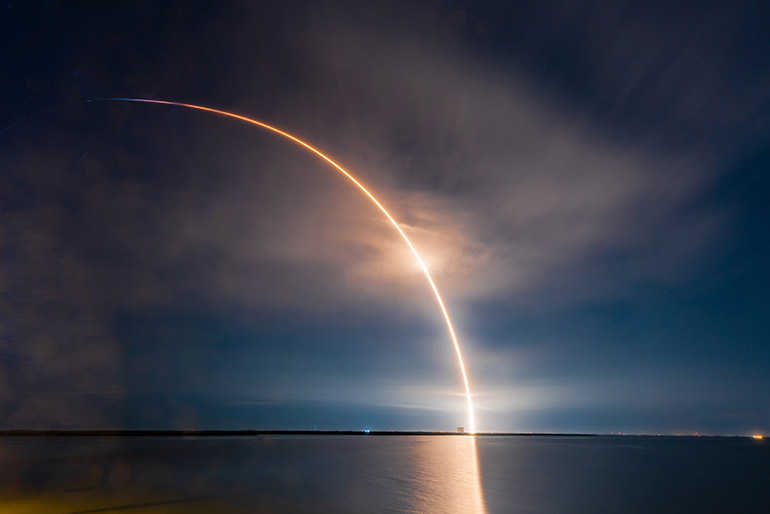
SpaceX Falcon 9 Starlink L22 in 2021 [Adobe Stock]
SpaceX laid out its vision weeks ago in its S-1, the registration document filed with the Securities and Exchange Commission (SEC). In the S-1, SpaceX presents itself as a vertically integrated company focused on reusable rockets, Starlink broadband and mobile satellites, its Grok AI family, X (formerly Twitter) and gigawatt-scale AI compute. Its next leap is orbital AI: satellites that function as data centers, which would draw solar power in sun-synchronous orbit and use Starlink as the network back to Earth. In the Dwarkesh Patel podcast in February, Musk claimed that putting AI in space would eventually be far cheaper than continuing to build out data center infrastructure on Earth.
The S-1 filing also spelled out the $28.5 trillion addressable-market claim, with $26.5 trillion tied to AI alone. It also framed the vision of space travel as a potential way to escape human extinction. “We do not want humans to have the same fate as dinosaurs.”
Days before the debut, Morningstar initiated coverage with a fair value of $63 a share, about $780 billion, and called the offering significantly overvalued. The IPO priced at $135 and closed its first session near $161, roughly two and a half times Morningstar’s initial stated value for the stock.


Tell Us What You Think!
You must be logged in to post a comment.