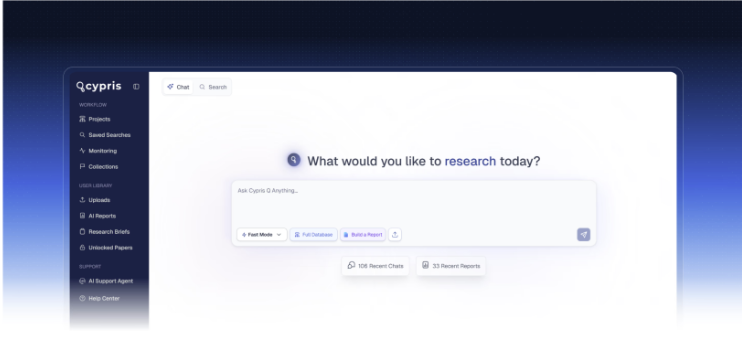
Cypris offers a familiar user-interface for tasks R&D tasks including idea screening. [Cypris]
Cypris, a roughly 30-person R&D intelligence startup, has long sought to harness the genAI trend rather than try to outrun it. “Why would you want to train your own model and compete with OpenAI, Anthropic, and Google?” said CEO Steve Hafif. “It’s better to lean into RAG,” or retrieval-augmented generation, the practice of feeding a general-purpose model your own curated data at query time rather than baking knowledge into the model itself.

Steve Hafif
On June 1, New York City–based Cypris launched Agentic Monitoring, which the company bills as the first R&D intelligence product designed to operate continuously while customers are off the platform. It runs “continuously across patent offices, scientific literature, chemical compound databases, regulatory bodies, M&A activity, product launches, grant awards, and corporate news,” as the release notes. It then pushes what it finds to their inboxes.
The strategy behind Cypris’ Agentic Monitoring is an outgrowth of the company’s long-standing strategy to build on genAI rather than try to compete against it. The company began as a patent marketplace Hafif was building in late 2019, before he pivoted it into an R&D intelligence platform. The semantic-search system Cypris built in 2021 used vector embeddings to surface conceptually related patents and papers rather than exact keyword hits. That retrieval layer later gave Cypris a way to ground large language model outputs in company-curated data. “The market shifted from dismissing products as GPT wrappers to describing RAG as the future,” Hafif recalled.
That conviction eventually drew capital from investors who shared it. In July 2024, Cypris announced a $5.3 million Series A led by Vocap, which described Cypris as an “AI-driven research platform tailored for R&D teams.”
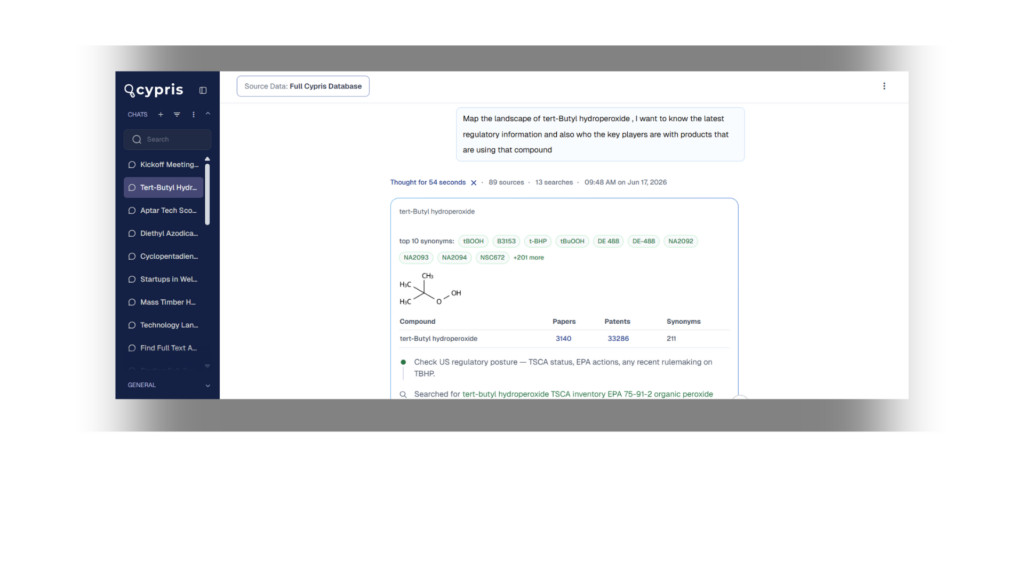
A compound-landscape query resolves synonyms and CAS numbers before mapping associated papers and patents. [Cypris]
Why patents aren’t enough
By 2024, Cypris was already building the platform around a broader view of the innovation ecosystem, with patent data serving as one source among many. For instance, Cypris differentiates itself from the legally-focused competition by its focus on R&D stakeholders, engineers and technical groups. “Patents account for about 20% of our database,” Hafif said. The rest include data streams related to papers, market data, startups and chemistry. “We’ve built chemical-intelligence databases and ontologies,” he said. Hafif said Cypris indexes more than 120 million chemical compounds. “The scope is much broader than patent data alone,” Hafif said.
The case for that breadth rests on a critique of how R&D organizations use patent data. “R&D teams follow what’s called the stage-gate process,” Hafif said. “At the earliest stage, they conduct prior-art searches and white-space analyses with IP teams.” An IP team might report that a domain contains white space for a product based solely on a patent review. That approach is “a narrow view,” Hafif said. “White space in the patent ecosystem can exist without commercial opportunity.”
Because the R&D team proceeds without that commercial context, Hafif said, much of the resulting IP never gets commercialized and the IP team ends up acting as a “business-strategy team” without recognizing the role. The narrow perspective, he said, can lead to poor decisions.
Patents are also less than ideal barometers for innovation for other reasons. Some companies may lean more on trade secret protections or deprioritize patent filings in the short- or long-term. “Patents are lagging indicators, sometimes by years as applications move through the process,” Hafif said. Patent-centric platforms inherit that limit, Hafif said: they’re built for drafting and portfolio management, which leaves them too narrow for market intelligence, competitive intelligence and predictive analytics. He points instead to a faster signal. “One of the strongest signals of what a company is doing comes from the job descriptions for the engineers it’s hiring,” Hafif said. The specs often spell out exactly what a company needs, he added, which a platform can stitch together for predictive analysis.
On ontology and chemistry
In addition, Cypris also develops extensive ontologies and its databases continue to grow with a variety of data types. “Over time, the intelligence layer becomes more synthesized. That makes the insight difficult to replicate,” Hafif said.
That ontology work is most developed in chemistry, where naming itself is the obstacle. Cypris has focused on synonym resolution there. “When you’re researching a chemical compound and mapping its landscape, you need to understand every trade name and synonym,” Hafif said. R&D teams and patent applicants sometimes coin new names for compounds to obscure them, he added, so before the model runs an analysis, Cypris’ ontology resolves those synonyms across its patent and scientific-literature corpus.
Chemicals are now the company’s biggest investment in vertical datasets, and Cypris recently added structure search to the product. Hafif said users can begin a query with a chemical-structure drawing, index the database with it and run prompts from there. In a company demonstration he described, a user asked the system to map the landscape for a compound, including the latest regulatory information and key players; it resolved 201 synonyms and multiple CAS numbers before identifying about 3,000 papers and 33,000 patents associated with it.
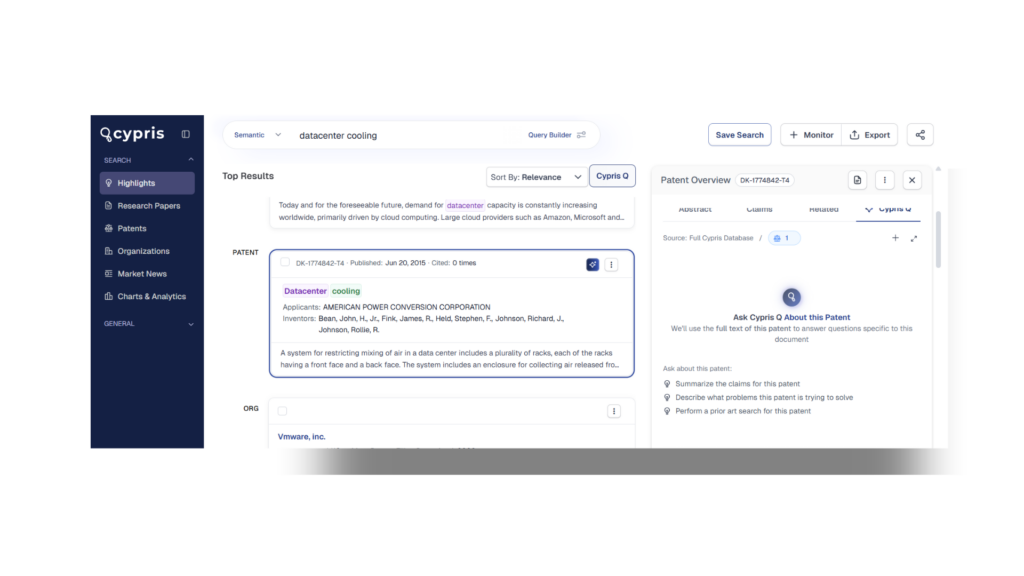
A semantic search for “datacenter cooling” returns a 2015 American Power Conversion patent, with a Cypris Q panel that answers questions against the patent’s full text. [Cypris]
Cypris’ strategy to keep competitors at bay
The popularity of genAI also lowers the bar for competitors to scoop up public patent data. The patent intelligence market was already crowded, and now is getting more so. “It seems like a new [patent intelligence startup] appears every week because [patent] data is easy to access,” Hafif said. Anyone can subscribe to IFI and apply RAG to those data points.
As for competition, Hafif worries less about incumbents than fast movers, though he expects the incumbents to lag. “The large incumbents move too slowly,” he said. The harder thing to copy, in his telling, isn’t the product but the enterprise sales and implementation work around it, which is where many vibe-coded startups stall. Cypris’ answer is a team of forward-deployed analysts. The model is closely associated with Palantir’s forward-deployed engineers. The forward-deployed analysts help customers configure agents and integrate them into existing workflows.
In a world where new feature announcements from frontier labs can disrupt SaaS stocks, maintaining a singular focus on customers offers some protection. “A moat is difficult to sustain these days,” Hafif said. “The strongest moat we see comes from customer lock-in after adoption, based on the amount of data the customer contributes through actual use,” Hafif said.

Tell Us What You Think!
You must be logged in to post a comment.